Saturday, April 20, 2013

The Highest Human Science: III. The Pre-Socratics

This is a post from the series, "The Highest Human Science". Click here for a complete list of all posts in the series.

 Finally! The Greeks figure it out that rational thought is the proper exercise for Man's reason. It's no surprise, actually, that the nation that would sire one of the worlds most delicious entrees would also produce such intellectual superiority (I am, of course, speaking of the gyro which is pictured below on a soft pita with tzatziki sauce and garnishment). The Greeks shed the burden of the ritualistic imposition created by religion, just as the shed all their clothes before competing in the Olympic games (which they also created). Truly, this was a nation of intellectual giants.

NOT Ancient Grease
Ok, well, maybe the guys we're going to talk about today weren't the most accurate in their theories, but credit must be given where it's due: these guys used their heads as best as they could and they paved the way for their countrymen to become some of the biggest intellectual giants of all time. It all began around the 6th or 7th century B.C. The Greeks were mostly concerned with public affairs and political matters, but around this period, Man's reason would soon be used for scientific purposes and asking the big questions about life, purpose, and meaning.

Beginnings were small, however, and the first question that came to mind was the one every child asks: what is this made of? And just as a child's answers are rather amusing, so were the answers proposed by the 'Pre-Socratic' philosophers. Thales, for example, believed that since moisture was the nourishment of all living bodies, water must be the substance of which everything consists. On the other hand, Anaximenes believed this substance was air. Further, Heraclitus believed it was fire, and still, Anaximander believed it was the "boundless" or indeterminate. Essentially, these brave intellectuals were trying to answer the question of material cause according to theories of materialistic monism, or the theory that everything is materially made up of one substance.

The Gyro
 Despite the apparent silliness of the pre-Socratics, three philosophers of the era distinguished themselves as great and innovative thinkers in the open ocean of rational thought. Heraclitus, also mentioned above, put forth the distinctly unique thought that reality is change or becoming. This is best explained by the notion that nothing is what it was a split-second before. The very fact that you have an interaction with an object, changes something about that object. However, the contradiction to this thought is in admitting that to some degree, things must stay the same in certain respects. A large rock doesn't change much under one gust of wind, though under by many years, it may change the entire appearance of the rock. So to some degree, a rational man must maintain that an object stays the same (I don't become a completely different person when I eat a gyro, which coincidentally, I would love to be doing right about now). Therefore, in the same instant, something is both changing constantly (the thing itself) and not changing at all (because through change, it isn't a "something"). Of course, this is blatantly contradictory and though an interesting thought, is now not worth any more discussion here.

The Material Monist Lineup, from left: Thales, Anaximenes, Heraclitus, and Anaximander
The next thinker of note is Democritus. His philosophy can be characterized as looking for the one constant thing in the world of flux and change theorized by Heraclitus. The void was the solution to this riddle, and since it was indeed "nothing", it both existed and did not exist. The substance that did exist in the void, the plenum, was made of indivisible particles called "atoms" (though this is the origin of the name, these are very different from the the modern notion of atoms). Using this framework, he proceeded to explain that the organization of the universe was arrived at though a series of coincidental and lucky circumstances. This was built upon the notion that events are purely mechanical and determinant; therefore, the fact that a particle collides a certain way with another is due to laws of physics, whereas the reason why both particles were moving in those particular directions to begin with is purely random and dictated only by chance. This makes the fallacious assumption that just because we cannot see the first cause of a particle moving in a particular direction (just like we can see and predict the result of a collision, due to the laws of physics),

Anaxagoras however had probably one of the most uniquely insightful, though incorrect attempts at explaining the ever-changing world. His belief that something could not become something it did not possess within it already. For example, the physical qualities of a tree, such as hardness of back, greenness of leave, etc., must all be properties contained within the seed. Furthermore, the material causes of that tree (e.g. bark, leaves, wood, etc.) must all be contained within that see as well. How else was it possible that the seed should become a tree? Or, better yet, bread contains every element of bone, blood, and flesh that it will eventually dissolve into when it nourishes the human body (that'll make you think twice about eating out again). Granted, this idea is pretty silly; however, it was a step in the right direction of understanding and taking into account the natures of actuality and potentiality which are integral to understanding Aristotelian and Thomistic philosophy.

Monday, April 15, 2013

The Highest Human Science: II. Pre-Philosophical Thought

This is a post from the series, "The Highest Human Science". Click here for a complete list of all posts in the series.
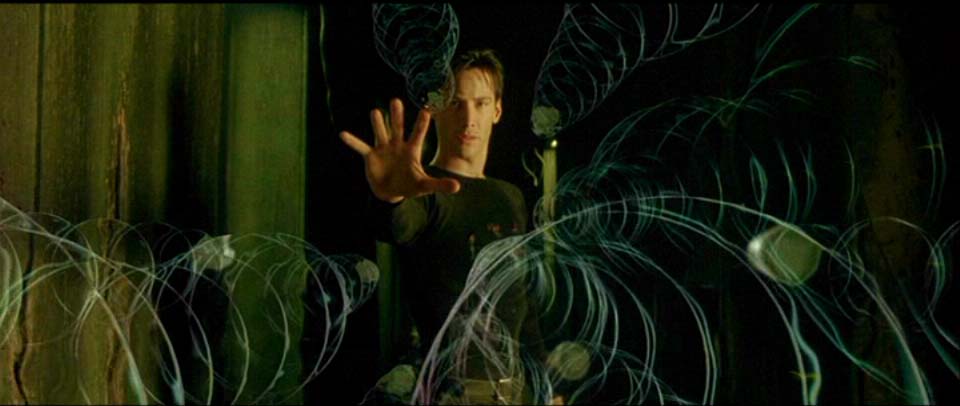
This flippin' bonkers scene from "The Matrix" is brought to you by: IDEALISM!
 One of the most popular action films of all time, "The Matrix" (1999) has been critically acclaimed for its original and captivating story. For those who haven't seen the film, it is about a world in which the "real world" you experience is not actually real. Instead, the entire human populations is plugged into one massive super computer via a prehistoric USB connection in the base of the neck, whilst being suspended in a vat of jelly. This is the general premise of the film and, yes, it makes for some exciting science fiction. If you haven't seen it, I can't recommend it enough because it truly revolutionized the way films are made (the sequels, I could do without).

Though I said this was an original story, it's true that many  philosophers, most notable Renee Descartes, suggested that our senses may not be entirely trustworthy. His philosophy's foundation was to doubt everything and rebuild our rational structure from the certain truths while leaving out the falsehoods, almost like overturning an apple cart of ripe and rotten apples, so as to pick up the good apples and leave the rotten ones on the ground and out of the cart. It was in this process that he wrote the now-famous (or infamous) phrase, Cogito ego sum ("I think, therefore I am") in which he claims to have proven his own existence after doubting it momentarily. (Descartes was pretty hardcore about this doubting thing) But what was truly revolutionary about the Matrix was that with the dawn of the digital age, it put forth a world in which there might be a very good reason to doubt what we see, taste, smell, touch, and hear.

Descartes upset the apple cart and this donkey
Too bad it's all a bunch of nonsense. Though entertaining for a science fiction film to speculate upon, it is purely fictional in its expression of ideas. This may sound harsh, but although philosophy specializes in the exercise of human reason, man is not always fully rational, so he is not always correct in the conclusions he draws. Unfortunately, rational thought has a spotty history, and along the way, many mistakes have been made, leading to the ruin of entire civilizations. Even today, despite our civilization's hyper-intensive focus on the supreme authority of the natural sciences, rational errors are rampant everywhere you look: in religions, in politics, and most certainly in ethics.

Early "pre-philosophical" thought was frequently confused as being rooted in religious beliefs and practices. The human wisdom studied in philosophy was mingled with sacred traditions and practices such that it was no longer rooted in human reason. Rather, it took its foundations in religious traditions of ancient cultures, and not in the exercise of human reason, independent of religion. Essentially, human reason had little or no part in informing the civilization's philosophy.

One such mistake is the concept of dualism, the idea that two eternal and uncreated principles of Good and Evil fight in a never-ending cosmic struggle. It is typically commonly used as an answer to the problem of evil, and was the core belief of the Persian culture, specifically in the beliefs of Zoroastrianism and Manichaeism. The hope was to explain why good and evil are able to coexist in the world; however, the erroneous implication of dualism is that evil is natural to the world, (as opposed to the Christian understanding in which evil is a privation of good). This leads to the conclusion that there are created beings that are evil by their very nature.

 
A musical summary of pantheism as taught/sung in Disney's Pocahontas

The concept of pantheism is another such confusion. Pantheism is the idea that God is comprised of everything in the universe: every being, every substance shares equally in the fullness of the divine being. Problem with this is that there leaves no distinction between creator and creation, and this completely contradicts the obvious multiplicity of distinct and seemingly independent beings. Brahmanism (or Hinduism) is one of the primary culprits of this error, though they go further and explain away the apparent multiplicity by saying that the world is actually an evil illusion (an idea known as idealism) and one must detach from it, striving always to lose one's role in the deceitful multiplicity. Buddhism, an off-shoot of Brahman philosophy in some respects, goes so far as to claim that not only the possession of individuality is an evil, but the very existence of the soul is an evil.

This short account of pre-philosophical errors is by no means exhaustive. We will examine many other errors in thought in future posts, but this will serve for now as a high-level overview of a few of the oldest intellectual errors. The main purpose of our dive into the weirdness of what the human mind can conceive was to prove that though these ideas may be worthy of science fiction, they're not worthy of much else...

Except for this...


 *Adapted from Jacques Maritain's book, "An Introduction to Philosophy" (trans. by E.I. Watkin)

Sunday, April 14, 2013

The Highest Human Science: I. Introduction

Jacques Maritain
This is a post from the series, "The Highest Human Science". Click here for a complete list of all posts in the series.

In 1917, the French Catholic philosopher, Jacques Maritain, wrote in his Elements de Philosophie (Introduction to Philosophy) that "philosophy... is the sovereign science. Therefore, it is competent to judge every other human science, rejecting as false every scientific hypothesis which contradicts its own results." By this, Maritain is claiming that every other human study which is governed by reason is ultimately subject to the study of reason itself, which is none other than philosophy.

In today's culture, philosophy is seen as boring, a joke, or as excellent screenplay material for the latest science fiction films, such as "The Matrix" and "Minority Report". In liberal arts universities, it's a core requirement, though the reason why it's a requirement is often forgotten. It appears, more often than not, that philosophy is included in these curriculums to simply make students aware of many different way to view the world, but without any guidance as to which ones should be taken seriously and which ones should be discarded into the dump heap of nonsense.

But this is to completely miss the point of philosophy, and Maritain demonstrates the correct understanding with the statement I just quoted above. In the modern desire for self-autonomy, each human study (he uses the term "science", but to distinguish from the strictly natural sciences, I will use "human study") has claimed sole authority over every aspect of its domain. In the case of fine arts, artists have defined their work as self-expressive and reflective of subjective passions or ideas. They no longer seek to inform themselves of what "good" art consists and instead determine that it must be anything and everything that comes from the artist, a classically self-absorbed notion that is typical of the vain. 

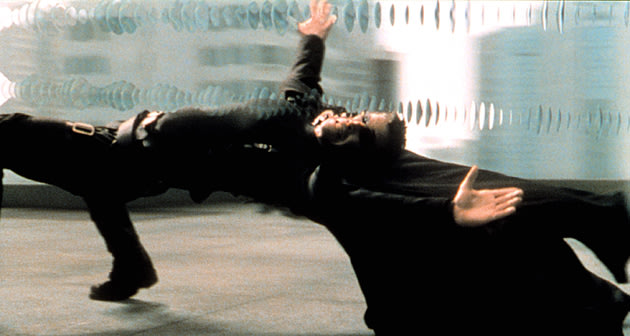
The Matrix: because the "bullet stop" trick just isn't possible without philosophy
In other cases, some studies not only claim complete dominion over their subject matter, but plot to overthrow the authority of other fields of study. The natural sciences (biology, chemistry, physics, etc.) assert that their studies directly nullify the authority that theology possesses over its subject matter, such as using scientific evidence to disprove the existence of God. Psychology and many other social sciences, have also been hijacked by this mentality, using wildly inappropriate extrapolative methods to reduce the immaterial, yet real human soul to nothing but determinate chemical interactions in the material organ of the brain.

Human studies need authority to guide them in the right direction. If they can be held accountable to no authority, then the study will contradict itself and break down into nonsense. Philosophy is primarily concerned with the study of human reason, therefore it establishes the infrastructure that makes every other study possible. For example, the scientific method is based on a form of logic (philosophy's domain) called "inductive reasoning". It's a very powerful short hand method of reasoning, but it remains fatally flawed in the sense that no matter how many times you verify your hypothesis, you cannot guarantee with 100% certainty that it is correct.

So why do we study philosophy? We study philosophy because it is solely devoted to the study of human reason, and since every human study is based on human reason, philosophy has it's "fingers in every pie", so to speak. Though it allows physics to judge its own study by principles of physics, it is responsible for wielding authority over the principles of philosophy on which physics and every other human study depends. It keeps the other studies "honest" in their intellectual endeavors and acts like referee in in interdisciplinary disputes.

Though knowing philosophy won't make a student an expert in any one field of human study (except maybe philosophy), it empowers the student to judge the validity of a study's conclusions. In conversation, the student of philosophy can participate in any study, and armed with the understanding of the very infrastructure of human reasoning, he can independently judge and remain intellectually critical of every other study. By "intellectual criticism" I'm not talking about snobbish remarks or obnoxious policing, but there are many fields of human study that are largely without a formal education in philosophical principles, so they make all kinds of logical errors in their study. The student needs to be able to actively discern the truth of a conclusion reached in a study and judge whether or not this agrees with reason.

That is why I have begun this series, entitled "The Highest Human Science". I will be drawing most of the source material from Maritain's "Introduction to Philosophy", which is an excellent guide to understanding the basics of philosophical study, but there will occasionally be other sources sprinkled here and there as we go. Stay tuned into the blog for upcoming posts in this series! I end this introduction post with one of the most crucially informative philosophy videos ever.


*Adapted from Jacques Maritain's book, "An Introduction to Philosophy" (trans. by E.I. Watkin)

Saturday, April 13, 2013

You Are What You Hear...

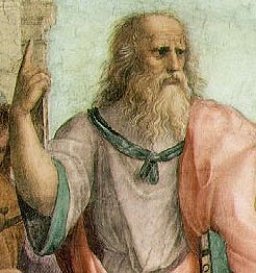
Plato from "The School of Athens"
In Book III of Plato's Republic, Socrates and Glaucon discuss the role and content of musical compositions to be included in their fictional, utopian polis. The beginning of this topic involves them throwing out all bad or unhelpful forms of music in an effort to preserve those that will be good for the polis as a whole.

He correlates/compares particular modes of music with particular activities. For example, lamentations have a particular mode that imitates a sorrowful person. Other modes can be associated with drunkenness, idleness, and softness. Still others are associated with battle and courage. When confronting the question of why music selection is so important in the polis, Plato claims that "rhythm and harmony permeate the inner part of the soul more than anything else," and that the music will inform the souls of the city's people as much as an academic education can.

Plato also believes that music is instrumental in aiding people to determine "goodness". People very familiar with good forms of music (and poetry) will be able to "sense it acutely when something has been omitted from a thing and when it hasn't been finely crafted or finely made by nature." Essentially, that person will be better equipped to discern right from wrong, simply by having an education in good music. A harmony of soul will allow the person to reject those things that jeopardize that harmony.

Ok, wait, seriously? Does this mean we have to listen to Christian rock all the time or classical music? While I, personally, am a strong advocate for tuning in to classical music regularly, I do not think that's what we should be taking away from this point.

It's practically scientific fact that certain types of music affect our moods, and this makes perfect reasonable sense because we all have our happy playlists and our angry playlists, right? So this shouldn't be too crazy.

James Hetfield of Metallica; Exhibit A of Musical PTSD
However, prolonged exposure to a particular kind of music can have lasting effects. Similar to post-traumatic stress disorder (PTSD), listening to a single genre can influence your nervous system and hormones in such a way that they create semi-permanent conditions, just like constant shelling and gunfire. For example, listening to only grunge and other forms of hard rock can acclimate your body's hormones to stressful levels, regardless of if you are listening to music at that moment or not. The music conditions your body to release hormones that induce stress and adrenaline into your system. If the exposure to this music is regular, then the stress hormone release is also regular until it becomes the norm, whether you are listening to the music or not.

So, now the question I always want to know the answer to: what would the virtuous man do? What music would the virtuous man listen to? Well, the answer is not as easy as pointing to one particular artist/band or even one particular genre. And it certainly is not found in listening to the 10 hour version of Trololo (I think that if you can make it through 10 hours of this, you'll be a master in the virtue of fortitude, but I'm sure your prudence would be sharply called into question). So where is it?

To be a good person, one must do good things, eat good food, have good friends, etc. No good man will desire to surround himself with evil because he only delights in good things and everything less than that is abhorrent to him in varying degrees. So if goodness is to permeate the virtuous man's life, this must also apply to listening to good music. Therefore, our next inquiry is to discover of what things good music consists.

I am not necessarily referring to the gospel group, Virtue,
(above) when I refer to "virtuous music"
Just as food contributes to the goodness of our bodily health, music contributes to the health of our mind. The saying, "you are what you eat," applies just as much to music as it does to food. If certain kinds of food create unhealthiness in your body, then you will become unhealthy. If certain kinds
of music create unhealthiness of the mind, as described above, then the mind will become unhealthy. We care about the health of mind and body because it is integral to the soundness of one's soul. Our minds and bodies enable us to live virtuous or vicious lifestyles, and those lifestyles inform our character and, ultimately, our souls. Just as a hammer without a sufficient grip on the handle is unwieldy and inept at performing its task, we too will be inept at living a properly good life if our bodies are disordered.

So if music is so important to the health of the soul, we probably should pay a lot of attention to what good music is, so as to properly nourish our souls. Good music consists of that which brings us to realize our human good, namely virtue. After agreeing in the above paragraph that music does have an effect on the soul, it stands to reason that it must have either a positive or negative effect. And since "the good" is the aim for all of our actions, why would we ever desire to listen to "bad" music? (Note: by "bad", I am not referring to poorly performed or untalented music; I am referring to music that deteriorates the mind and corrupts the soul)

Music informs our minds and souls, just as the rhythm of a drum cadence informs a marching army to march in step. In the case of the human soul, good music is going to be that which inspires virtue in the individual. It lifts man's heart and mind to higher things and inspires him to perform heroic feats in everyday life. In times of struggle, it must comfort and console him, but always encouraging him to keep his goals of character firmly fixed. Music moves the human heart, and for the man who aspires to virtue, it must always move him towards his goal of being the virtuous man.

Therefore, good music inspires and directs man's desires, will, and actions to the achievement of virtue, and therefore, this is the best kind of music.

And now, here's a small sample of music that inspires me personally to virtue!

The Cave by Mumford & Sons on Grooveshark
Born to Run by Bruce Springsteen on Grooveshark
Overture To The Royal Fireworks Music by Handel on Grooveshark
The Breaking of the Fellowship / In Dreams by Howard Shore on Grooveshark


Sunday, February 10, 2013

The Dangers of God's Grace

Since middle-school, I had been very fond of swimming, particularly racing. I prided myself on being the fastest free-style and backstroke swimmer on the team, and winning first place in races was a common occurrence. One meet, however, the coaches had signed me up for my usual free-style and backstroke events, but also on my list of race events was the butterfly stroke race. This was a problem: I had never swam butterfly.

Sure, we had done some practice with it, but I never possessed the proper coordination to make it more than a few meters before I was doggie-paddling. I approached the starting blocks, shaken with fear of not only losing the race, but possibly not even finishing. Silently, I prayed to God that I should at least finish the race, let alone not drown in my attempt.

I not only finished, but I earned first place. It's difficult to convince anyone that the occurrence of this result was a miracle, but to me, it's profoundly clear that it was. Whatever grace I received was accompanied by the unsettling fear of failure before and a consequently very sore and worn-out body afterwards. In this instance, God's grace had been a painful experience.

"The Calling of the Apostles Peter and Andrew"
by Duccio di Buoninsegna
Today's gospel provides Luke's account of the first meeting between Christ and Peter. A few weeks ago, I published a post on the struggle with habitual sin and proper contrition for them, and I cited the example of Peter's initial encounter with Christ in the gospel of Luke. They meet on the shores of the Sea of Galilee and Christ instructs Peter to cast out to open water and lower his nets. Peter, having caught nothing at night, remained doubtful with the success of this course of action, but he acquiesced anyway. Once the nets had been lowered, the catch of fish was so great that their nets began to tear and even with the help of a second boat, they were both in danger of sinking.

First, receiving God's grace only takes a simple "yes". Peter's dubious "yes" led to an incredible catch of fish. Mary's simple, yet perfect "yes" opened her to the conception of the very Son of God. On the mountain, the young boy's "yes" to providing the few loaves and the fishes he possessed led to the feeding of five thousand people with some to spare. Our gifts may be small, but in cooperation with God, miracles become possible. Most people have heard of this aspect of God's grace (or have experienced it for themselves). It is definitely a wonderful blessing to realize this and acknowledge it in our lives.

However, what you don't hear is that sometimes, God's grace may nearly kill us with its intensity. In the today's second reading, Paul refers to his conversion story of being cast off his horse simply at the sound of Christ's voice, and in the Gospel, Peter and his fellow fishermen nearly drowned as a result of an incredible catch of fish. In both circumstances, God's grace manifested itself in violent, threatening ways. These accounts challenge a common notion that God's grace is always quiet or subtle because sometimes, the furious power of God's grace comes to us in these "life(style)-threatening" situations.

Focusing on the Gospel account, the fishermen's nets were tearing, the boat was capsizing, and the human help of the second boat could not even alleviate the sheer enormity of God's grace. Similarly when we encounter His grace, the nets of our vices will be torn through and our lives, it seems, will be in danger of sinking and drowning. The manner in which we have allowed ourselves to just "float" through life will be shaken to such a degree that in order to be set right, we will be confronted with the reality of that very real danger of death to our lifestyles, If we're open to it, God's dangerous graces will "kill us", but our death will be a "death to self" and our rebirth will be in His divine love. Our sins and depravities will be put to death and all that will remain is our charity. 
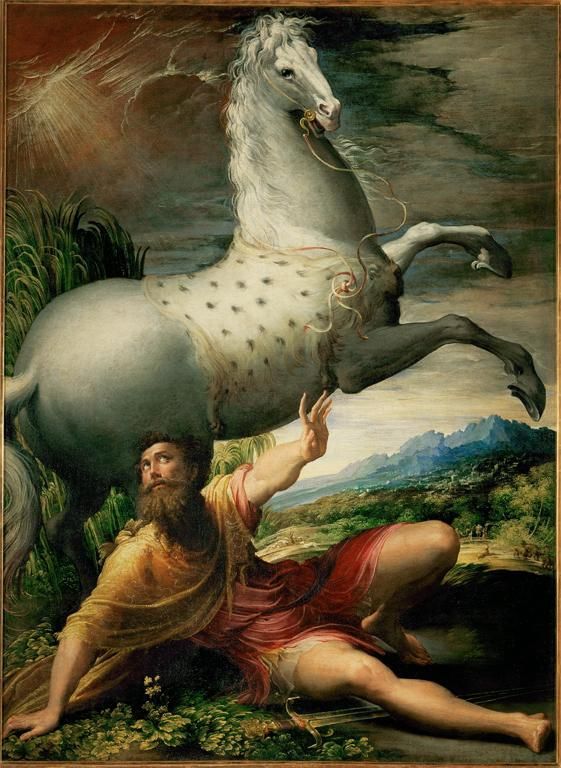
"The Conversion of St. Paul" by Francesco Mazzola
So why is God's grace sometimes so violent in this fashion? Grace must necessarily purify us. In today's first reading, Isaiah had a hot coal placed on his mouth. In the second reading, St. Paul was cast from his horse and blinded. In the Gospel, Peter's physical strength fails him and even with the help of his companions, he is filled with fear of a drowning death. Each of these men were flawed and each received the cleansing gift of God's grace. However, just as Purgatory prepares us to see God face to face by a painful purification, God's grace to these sinful men is so great that in their fallen nature, they perceive it to be painful. To eyes that have never seen the sunlight, even the slightest ray of sunshine is blindingly painful, but once the eyes become accustomed to the goodness of the illumination around them, they rejoice at that purifying grace which was once excruciating.

How often do we allow ourselves to experience this fearful level of grace in our lives? Do we shirk away from it for fear of braving the danger to our lifestyles? There is a significant amount of dying-to-oneself that we all need to do in our lives, and if we avoid this death, we will always be devoid of God's greatest graces and blessings. But if we are open to that painfully purifying grace in our daily lives, we are given a blessed opportunity to suffer with the Suffering Servant, the Crucified Christ.

Wednesday, February 6, 2013

The Lost World of Children

"BOYS! Look away!" my mother said, sternly.

Immediately, I obediently scrunched my eyes shut and turned my face to my skinny, boyish legs. I wasn't missing anything important, my mom would always tell me. Sometimes, I would become curious and try to catch a glimpse, but Mom would have none of it. She made sure that each of the boys had their eyes shut and faces turned away.

A brief moment later, the passionate kiss between the film's main characters had ended, and I was allowed to resume watching.

A kiss? Seriously? Were you home-schooled or something? That's nothing compared to the other stuff out there!

Yes, it was just a mildly zealous kiss between a man and a woman, but I thank God every day for the first woman who taught me to value affection and guard my heart. It's true, I have not always been good at it. I have never stopped trying though, hoping one day to return to that childlike innocence.

Can one reclaim that innocence that we sacrifice over age and experience? In Genesis, Adam and Eve ate of the Tree of Knowledge of Good and Evil. They did so willingly because their pride directed them to challenge the only restriction that God placed upon them.* So after their sin, could Adam and Eve re-enter the Garden of Eden? Could they return to the paradise of blissful innocence? No, they could not, and because of original sin, neither can we. There is no going back, and what is gone is gone now for good.

Last weekend at Mass was Scout's week, and before the Final Blessing, the pastor distributed a good Christian award to 15 young Cub Scouts for completing the merit requirements. The boys, no older than 10 years old, processed from their pew towards the front to the side of the sanctuary, but as they did, I noticed that the last boy was wearing jeans that had the pant hem ending awkwardly right above is skinny ankles. No doubt, the poor kid was beginning to hit his growth spurt. And at that instant, my heart wept for him.

In his innocence, he was oblivious to what lay ahead of him. He has no idea that in a short time, his boyish heart will be violated and assaulted by a cruel society, intent on stealing that precious gift. It will be gone forever, and if he values virtue, he will weep for this loss as I do. In that moment, I made a quiet, but urgent prayer for the safety of their hearts, now and in the future. I prayed that they might desire to become virtuous and upstanding men and that this award might be the first step in that direction.

And it's not just for boys that I worry about: I worry for the girls. They will be abused, objectified and disrespected to a degree lower than animals. Any semblance of integrity will be challenged and lost in the hormone-driven high school and college years by the "skin race", an escalation of how much they can bare for a boy's hungry eyes. A frightening thing is that most girls never realize this, but the most disturbing thing is that even if they realize it, they may never have the courage to reclaim their dignity and restore their innocence.

However, I do not believe all is lost with the departure of childlike innocence. St. John in the Book of Revelations writes:
"And I heard a loud voice from the throne saying, "Behold, the dwelling of God is with men. He will dwell with them, and they shall be his people, and God himself will be with them; he will wipe away every tear from their eyes, and death shall be no more, neither shall there be mourning nor crying nor pain any more, for the former things have passed away." And he who sat upon the throne said, "Behold, I make all things new." (Revelation 21:3-5).
Christ has taken what was, and he has fulfilled it and glorified it. He took a human body, made filthy and a vehicle for immorality by Man, and glorified it in the Resurrection. He took on a human heart, made bitter and selfish by Man’s sin, and glorified it, making it an eternal model of perfect charity. Christ makes these things, and all things new and better. Therefore, it is Christ who has made our innocence new.

With that statement, two things are important to realize. First, this is not something we can do alone, for Christ works on this through us. This innocence is a unmerited gift that God gives to those who are open to receiving it. Therefore, its attainment is not directly related to any effort that I make to achieve it; rather, my effort to remain in God’s holy grace and foster a real relationship with Christ is what will open me to this gift.

Second, because our childlike innocence is made new and glorified by our struggle, it is better than the innocence of the child. Just as the resurrected body is more perfect than our sinful body, the glorified innocence renewed by Christ is more perfect than that given to Adam and Eve in Eden. This is because we have chosen it for ourselves and the longevity of this resolution, through struggle and toil, confirms this choice with greater glory and rewards, both temporal and eternal.

It will always be a challenge to every man, young or old, to seek and find that holy innocence renewed by Christ, but once discovered, it will chase away our fears, replaced by a lasting peace that we will carry with us  until our deaths and into Eternal Glory.

Monday, February 4, 2013

Schedule Killed the Action/Adventure Star

I use Google Calendar every day. It's incredibly handy and helpful, and all my appointments and events are on there. With alerts, I can be reminded of events that I might otherwise forget. I have separate calendars for my different kinds of events (birthdays, fitness training, etc.) The plethora of different views allows me to see my schedule in any way I might (or might never) want.

I hate Google Calendar. And any kind of calendar/schedule-maker that is easy to use. If it's easy to use, people will use it, and with calendars and schedule-makers, that just won't do.

The Face of Boredom
When you have a schedule, you subtly believe you know what is going to happen during your day. You set the events of your day and you move from one appointment to the next, one task to the next, and one pre-planned moment to the next. It's true that society could hardly function without schedules, but it's just a cultural symptom of our obsession with productivity and efficiency.

This is bad for two reasons: First, because your day is "planned", nothing new or exciting can happen. You know the sequence of events (in fact, you have determined most of them). You become the ultimate master of your own destiny and therefore, there are no surprises.

Second reason: how mind-numbingly boring is that? The chief problem afflicting our culture today is not poverty, hunger, or filthy interstate rest stops... it's boredom. When we use a schedule to line up every minute detail of their days, weeks, years, and lives, we perpetuate this heinous evil and rob ourselves of engaging stimulation.

Maybe each day feels the same because they ARE the same.
"Well, what if there is no tomorrow? There wasn't one today."
For most people with schedules, each day feels exactly the same. It's like you know what's going to happen tomorrow. In corporate America, a select few people have truly exciting jobs, but for the rest of us, it can be a drudge. If you're expecting  the same unexciting day as yesterday, what are you looking forward to? Tomorrow will come and go, and you might ask yourself why do you really care?

Maybe we like schedules to feel in control of our lives. In an effort to be certain of as many things as possible, we plan our lives as a sequence of calender events and appointment invites. It's like giving someone a wrapped gift that you picked out. They may have no idea what's inside, but you do. For that reason, there is no surprise for you. Imagine always giving people wrapped gifts and never receiving one yourself.

What is this ultimately taking a toll on? Reliance on schedules negatively affects our ability to be spontaneous and adventurous that romantically invaluable skill. Imagination is the heart and soul of spontaneity. A common error is to believe that one must be erratic or impulsive to be spontaneous. However, it is imagination that gives the human soul the agility to be spontaneous. But there are few things that kill imagination, and consequently spontaneity, more than pre-planning your life and relying on rigid structures. Consequently, we become slaves to our schedules, both self-imposed and imposed from the outside.

Spontaneity also has a profound influence on one's courage. When an unexpected opportunity or challenge arrives, our ability to rise to it will be diminished, just because it does not fit into whatever we expected. Life is meant for action, and courage is what enables us to take appropriate action in any circumstance. Without courage, we miss out on life's rewards. Life is not always pre-canned or predetermined, and the most critical moments in life are usually those ones that are not planned or expected. Most of us don't need to chase after tanks on horseback or stop an alien invasion or escape from an island of genetically-engineer dinosaurs to satisfy our spirit of adventure and test our courage (if you do, you might be a fictional character), but that courage and adventurousness needs to be reclaimed.

Seize the moment. Push yourself to heroics. Do not settle for blindly following the established order, and do not be afraid to throw the schedule out and blaze your own trail!

I'll bet Indiana Jones didn't schedule this... and he turned out just fine.