Showing posts with label Catholic Church. Show all posts

Wednesday, February 6, 2013

The Lost World of Children

"BOYS! Look away!" my mother said, sternly.

Immediately, I obediently scrunched my eyes shut and turned my face to my skinny, boyish legs. I wasn't missing anything important, my mom would always tell me. Sometimes, I would become curious and try to catch a glimpse, but Mom would have none of it. She made sure that each of the boys had their eyes shut and faces turned away.

A brief moment later, the passionate kiss between the film's main characters had ended, and I was allowed to resume watching.

A kiss? Seriously? Were you home-schooled or something? That's nothing compared to the other stuff out there!

Yes, it was just a mildly zealous kiss between a man and a woman, but I thank God every day for the first woman who taught me to value affection and guard my heart. It's true, I have not always been good at it. I have never stopped trying though, hoping one day to return to that childlike innocence.

Can one reclaim that innocence that we sacrifice over age and experience? In Genesis, Adam and Eve ate of the Tree of Knowledge of Good and Evil. They did so willingly because their pride directed them to challenge the only restriction that God placed upon them.* So after their sin, could Adam and Eve re-enter the Garden of Eden? Could they return to the paradise of blissful innocence? No, they could not, and because of original sin, neither can we. There is no going back, and what is gone is gone now for good.

Last weekend at Mass was Scout's week, and before the Final Blessing, the pastor distributed a good Christian award to 15 young Cub Scouts for completing the merit requirements. The boys, no older than 10 years old, processed from their pew towards the front to the side of the sanctuary, but as they did, I noticed that the last boy was wearing jeans that had the pant hem ending awkwardly right above is skinny ankles. No doubt, the poor kid was beginning to hit his growth spurt. And at that instant, my heart wept for him.

In his innocence, he was oblivious to what lay ahead of him. He has no idea that in a short time, his boyish heart will be violated and assaulted by a cruel society, intent on stealing that precious gift. It will be gone forever, and if he values virtue, he will weep for this loss as I do. In that moment, I made a quiet, but urgent prayer for the safety of their hearts, now and in the future. I prayed that they might desire to become virtuous and upstanding men and that this award might be the first step in that direction.

And it's not just for boys that I worry about: I worry for the girls. They will be abused, objectified and disrespected to a degree lower than animals. Any semblance of integrity will be challenged and lost in the hormone-driven high school and college years by the "skin race", an escalation of how much they can bare for a boy's hungry eyes. A frightening thing is that most girls never realize this, but the most disturbing thing is that even if they realize it, they may never have the courage to reclaim their dignity and restore their innocence.

However, I do not believe all is lost with the departure of childlike innocence. St. John in the Book of Revelations writes:
"And I heard a loud voice from the throne saying, "Behold, the dwelling of God is with men. He will dwell with them, and they shall be his people, and God himself will be with them; he will wipe away every tear from their eyes, and death shall be no more, neither shall there be mourning nor crying nor pain any more, for the former things have passed away." And he who sat upon the throne said, "Behold, I make all things new." (Revelation 21:3-5).
Christ has taken what was, and he has fulfilled it and glorified it. He took a human body, made filthy and a vehicle for immorality by Man, and glorified it in the Resurrection. He took on a human heart, made bitter and selfish by Man’s sin, and glorified it, making it an eternal model of perfect charity. Christ makes these things, and all things new and better. Therefore, it is Christ who has made our innocence new.

With that statement, two things are important to realize. First, this is not something we can do alone, for Christ works on this through us. This innocence is a unmerited gift that God gives to those who are open to receiving it. Therefore, its attainment is not directly related to any effort that I make to achieve it; rather, my effort to remain in God’s holy grace and foster a real relationship with Christ is what will open me to this gift.

Second, because our childlike innocence is made new and glorified by our struggle, it is better than the innocence of the child. Just as the resurrected body is more perfect than our sinful body, the glorified innocence renewed by Christ is more perfect than that given to Adam and Eve in Eden. This is because we have chosen it for ourselves and the longevity of this resolution, through struggle and toil, confirms this choice with greater glory and rewards, both temporal and eternal.

It will always be a challenge to every man, young or old, to seek and find that holy innocence renewed by Christ, but once discovered, it will chase away our fears, replaced by a lasting peace that we will carry with us  until our deaths and into Eternal Glory.

Sunday, January 20, 2013

“Smells ‘n Bells” VS “Drums ‘n Chums”


As a Roman Catholic, I have been to many Masses in my lifetime. The majority have been your typical, run-of-the-mill parish Sunday Masses or your quick daily Masses, but I’ve also been to youth Masses, Novus Ordo Latin Masses, Tridentine (Pre-Vatican II) Latin Masses, and even Masses involving people collapsing into tears and wailing after receiving Communion.

That being said, I would like to discuss what I perceive to be two different “styles” of the Holy Mass. The first is one I’ve referred to here as “smells ‘n bells” (which alludes to the frequent use of incense and the bells that are rung at the moment of the Consecration), which one might consider to be orthodox. A Latin Mass is a perfect example of a “smells ‘n bells” Mass, but many vernacular Masses will also neatly fall into this category. Each piece of music is referred to as a “hymn” and the primary instrument is the organ. With these details, I am assured that the reader has been to a Mass of this sort before, so I will not spend any more time on describing it. For brevity’s sake, I will hereafter refer to this as the solemn Mass.

Blessed Pope John Paul II at World Youth Day
Second, there is the style of Mass that I refer to as the “drums ‘n chums” Mass (which refers to the frequent use of rock drums sets and the emphasis on the community of those in attendance). The style is largely attributed to the influence of Blessed Pope John Paul II and his institution of World Youth Day. From what I know of its history, the youth Mass was a method to attract young people who had no firm foundation of faith to the sacrament of the Eucharist. Thus, its execution is less conservative and of a higher energy. Guitars and drums belt out songs that focus primarily on the greatness of God and worshiping him. I will define this and refer to this as the youth Mass.

Most of the time, the style in which Mass is celebrated is a blend of these two and most people have a preference for one style over another, but it is my perception that a large number of faithful Catholics have strongly critical opinions about one or the other. Of the solemn Mass style, people say that it is too boring which makes it difficult to pay attention. Another frequent complaint is that the priest’s homilies are too difficult to follow or contain content irrelevant to them. Of the youth Mass, common criticisms are that the Mass becomes more like a social hangout spot where kids go to see their friends instead of going to receive Christ. Also, the sign of peace lasts fifteen minutes and everyone is so "touchy-feely".

So which is better? The goal of faith is to increase in it. Ultimately, the more faith we place in Jesus Christ as our Lord and Savior, the better our lives will be and the better life after death will be. Anything that keeps us from increasing our faith must be discarded and a solution to this blockage should be discovered.

It is no mystery to any observant Catholic that generations of Catholics since the 1960’s have been without firm foundations for faith. John Paul II saw this crisis around the entire world, so he began World Youth Day to draw the youth of the world to Christ, and the concept of the youth Mass spun off of that. Had the Church said, “Well, we really can’t do anything for these people because that would involve adapting the Mass and our approach towards apostolate to a degree we’re not comfortable with,” that would have been an obstacle to the Church’s increase in faith, and an evil.

A youth Mass
The youth Mass has to attract young people, while staying true to its purpose. Why is the youth Mass emotionally appealing? For many people with emotional baggage, there are significant obstacles from their past lives that have to be overcome before a deep faith can be achieved. It is OK to be on fire with Christ’s love, after all. Why does the youth Mass seem to place an emphasis on relationship with one another in community? Many people are unaware of the unity of the Body of Christ, made up of the members of the Church. Society encourages individuality and rejects community, so it's very important that people realize that they are part of something bigger and more amazing than just them. Also, emphasizing healthy, virtuous relationships with one another is a step towards fostering a close, loving relationship with Christ.

However, many youth Mass attendees that I have known stop there. They get into a routine of going to youth Mass every Sunday and hearing the music and seeing their friends, but they do not look inward to discover if there is anything more that they’re missing. Truth is, they’re missing 2000 years of Church history and tradition. They could be missing doctrine and teaching on Mary, the lives and writings of the saints, and the other sacraments that are vital to a flourishing life of faith (just to name a few). They stay where they’re at because they are comfortable there and no one tells them otherwise. This is also an obstacle to the Church’s increase in faith, so it is also an evil.

Tridentine Mass
A return to the solemn Mass is the answer. The solemn Mass moves beyond the secularly appealing aspects of the youth Mass and focuses intently on deep theological truths of our faith. These truths are by no means those you would only find in a PhD theology program; rather, they are those deep aspects of Christ, His Mother Mary, and His Church that we are called to contemplate. The solemn Mass removes the guitars, drums, buddies, and girlfriends, and places the individual in a chapel with a monstrance containing the Blessed Sacrament, alone in mental prayer and Adoration. Ultimately, the Mass is meant to draw us to Christ and, in doing this, to one another; not the other way around. The Church allows for the secular noise to which we are accustomed with the hopes that in a desire to grow more deeply in faith, we will cast off the training wheels by doing things like spending Holy Hours with the Blessed Sacrament, reciting the Rosary, and going to silent retreats for contemplation.

The solemn Mass fulfills the purpose of the youth Mass. It is a channel through which we may pass in our relationship with Christ that speaks to us in terms that we are initially comfortable with. As our desire to more fully know Christ matures, we must also work to mature our faith and contemplate those deep mysteries of the Divine Love.

Graphic Credits:
catholicseeking.blogspot.com
becketyouth.org
traditioninaction.org
sttimothy.pipertechnology.com

Tuesday, January 8, 2013

The Philosophical Basics of the Resurrection

Courtesy of WikiPaintings.org

Probably of all my classes at Our Lady’s University, none had me more attentive than my course on St. Thomas Aquinas’ account of human nature, taught by Dr. John O’Callaghan. Unfortunately, this was my first formal exposure to the philosophy of St. Thomas, and as a 4000 level course, I do not think I got the most out of it. I had taken a course on Aristotle’s ethical theory the semester before, but though these two great minds were similar in worldview, Aristotle’s pagan terminology and approach was nowhere near a proper introduction to Thomas’ intellectually mammoth rational constructions.

Despite this, I did benefit from this study, and as I have only and always been interested in acquiring the truth and never in spouting off any philosopher’s theories word-for-word, this was not an insignificant benefit. One thing that really fascinated me during my study of Aquinas’ philosophy of human nature was in terms of the resurrection.

As is the relationship between theology and philosophy, divine revelation can invariably be confirmed by human reason. The saying, “philosophy is the handmaiden of theology” springs to mind. Basically, if our understanding were to be laid out on a line spectrum with things we know from human reason and things we know from divine revelation, each would generally lie on either side of the spectrum and there would be a gap in between. This gap represents our lack of full understanding of the higher bits of knowledge, specifically those things divinely revealed to us, creating what we call “mysteries”. Divine revelation gives us those truths that would otherwise be impossible to reach solely with our own reason, though these truths are coherent with our own human reason. Everything divinely revealed can be confirmed with the same human reason that we use to work a math problem or organize a closet or make a gourmet meal.


The resurrection of the body promised by Christ at his Second Coming is just one of those things that, with a little Thomistic ontology, is completely reasonable to believe, though the particulars certainly remain a mystery. First, it is important to remember that we are human beings (don’t forget that definition), and “human being” is defined as a living body animated by a rational, immortal soul. Therefore, it is accurate to say that when John dies, John (the unified human being) ceases to exist because his soul is separated from his body. However, John’s essence, his soul, is immortal and survives the body.

So our soul lives on, separated from our body which decays and fades away with time. At this point, do our souls just remain in Heaven? It is eternal beatitude, after all, so what more could we want or need? Why does Christ promise that our souls will be reunited with our bodies in the Resurrection? Is that really necessary after achieving eternal beatitude?

I certainly cannot say what is divinely necessary, but I can definitely say that it’s perfectly reasonable that I should be reunited with my body after I die. In the state after death, our human nature is divided: our soul is in Heaven and our decomposing body remains on earth. But since we were created as human beings (body and soul) and not as angels who are purely spiritual and incorporeal beings, it would seem a little odd that we should spend eternity in such a divided state, especially when our bodies are an intrinsic part of our own creation and being. (if they were not, why should we bother caring for them in this life?)

As an analogy to illustrate this, a free-floating balloon is caught by a child and tied down. The balloon’s natural destiny is to float away into the sky, but here, it is separated from that destination and tied to the ground. If the balloon was meant to remain close to earth, why was it filled with a lighter-than-air gas to begin with? Similarly, it is our natural destiny to be unified, soul and body. When we die, our soul is separated from our body and allowed to take root in Heaven. If this were the end of the story, then why did God create us with bodies in the first place? It seems perfectly natural to believe, then, that the destiny of our human nature is to be unified, body and soul, in eternal beatitude with God after the Resurrection.

So our use of human reason confirms the revelation of the Resurrection. I am not suggesting that while in Heaven after death, we will in some way miss our physical bodies or feel uncomfortable without them. This would suggest that eternal beatitude is deficient in some way. But as it has been revealed to the human race, Divine Justice promises to return us to our bodies at the end of time, and this is at the very least is something we can partially understand.

Saturday, January 5, 2013

Habitual Sins and Contrition

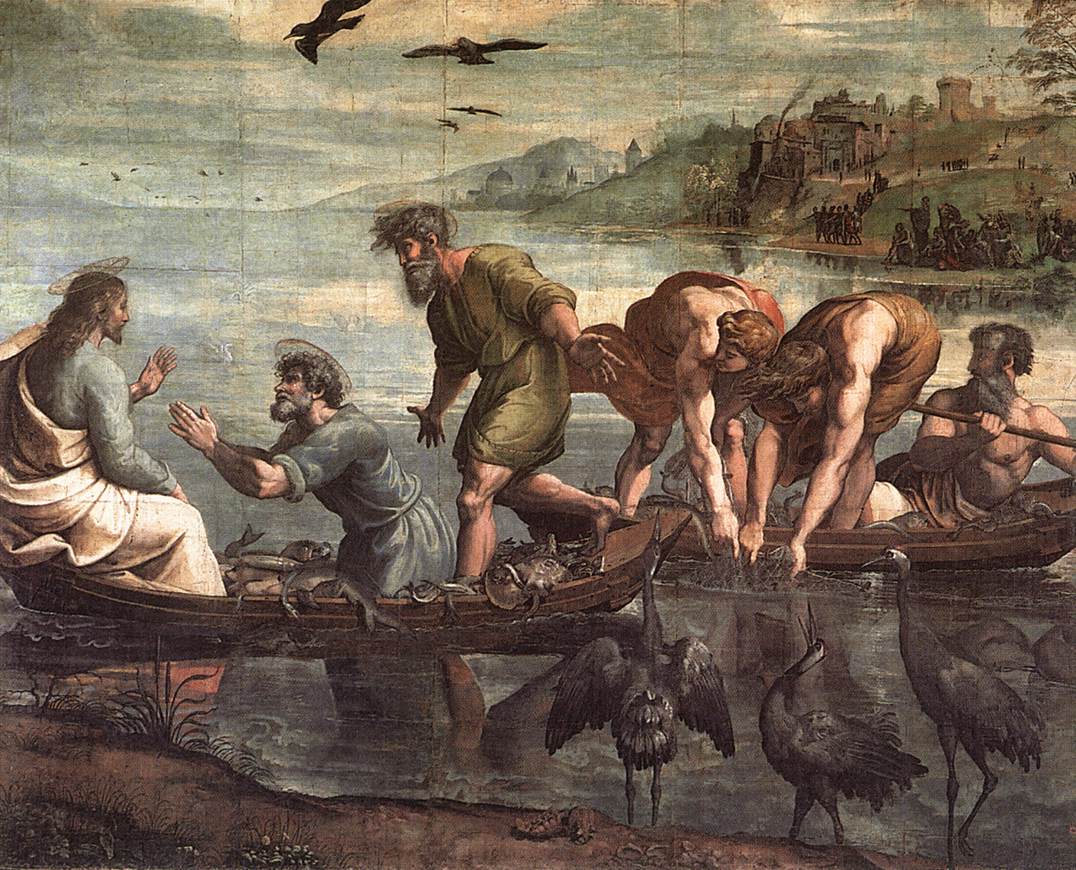
"The Miraculous Draught of Fishes" by Raphael
When one deals with a habitual sin, it can be difficult to arrive at proper contrition. True contrition necessitates that you reject the sin and resolve to never commit it again; however, because of our fallen nature, it is not unlikely that despite our best intentions, we will succumb to temptation and descend into that sin again. We acknowledge this in an attempt to be realistic about ourselves and the situation, but often it gives the effect of despair. The past is gloomy from those sins already committed, the present is dark because we are still committing the sin, and the future looms ominously because this is a habitual sin and the temptation, at least, will most certainly occur again.

What should our outlook be under these circumstances? It is possible the habitual sinner will equate the occurrence of the temptation with the occurrence of the sin itself, assuming the success of the devil’s efforts and an inevitable fall from a state of grace. In this sense, the sinner has already ‘given up’ trying to break the chain of sin formed by habit.

However, the past is only an indication of the trials we will face and not a determination of our future actions. We can certainly look to the past to ascertain the obstacles of the future and even learn from our past failures in terms of what aided us or hindered us from clearing those hurdles.  Though, it is not true that because we have stumbled over the same obstacle again and again, we are incapable of achieving breaks in the chain. It is definitely a slow process and success will be elusive at the beginning, but we must be careful to not assume the devil’s triumph, just because he tempts us.

Therefore, we return to the question of contrition: what should be the elements of our contrition, especially for the difficult case of habitual sins? Peter told Christ, “Depart from me, O Lord, for I am a sinful man.” (Luke 5:8) This certainly seems like despair at first glance, but Peter’s desire to be with Christ is so strong that at his invitation, he leaves everything to follow him. He was so eager to be with Jesus that despite his unworthiness, he was willing to give up all he owned to be with him.

So on the one hand, we must acknowledge our unworthiness; for the slightest sin, much less a habitual sin committed several times, without God’s mercy is enough to damn us to Hell forever. This acknowledgement must not, however, prohibit us from recognizing the profound, all-consuming desire we have for Christ. We may need to apologize seventy times seven times, but we must never cease to proclaim our love for him who loved us so much as to give his life for us. In our sorrow, we must beat our breasts lamenting, “mea culpa” then shout joyously, “Gloria in excelsis Deo!” for His Divine Mercy.

Wednesday, December 12, 2012

Was, Is, and Ever Shall Be, Chapter 1


Finished with Morning Prayer, Cale shut the breviary and put it back in his pack. He had spent the night at the edge of a small pond and a light fog surrounded him in the early autumn morning. The sun had just risen over the edge of the plain, but it had not yet penetrated the thick copse of rusty trees that concealed the pond. Cale had chosen this spot to remain concealed.

Arising from the half-rotten stump that served as a stool, the young deacon grabbed his empty plastic water bottle and knelt by the edge of the pond. He scanned the area around the pond, from the edge of the water to the line of trees, and then submerged the bottle in the murky water to fill it. Clean water was difficult to find in the Wilderness. Ingesting bad water this far from any sort of medical aid would be fatal, making proper drinking water crucial. After filling the bottle nearly to the neck, Cale returned to his sack and extracted another small plastic bottle of commercial household bleach and a roll of duct tape. Just a drop of the bleach would purify water to proper drinking standards. Who would have thought bleach would have become so essential?

Screwing on the cap, Cale laced his worn boots and wrapped a sizeable length of the duct tape around the boot’s toe and sole, wrapping the two together. The left boot had long ago come apart at this spot and the right boot was not far behind. This finished, Cale donned his dirty-white cowboy hat, picked up his pack, and headed for the edge of the copse.

The copse was only a few trees thick, but it had fulfilled its purpose of hiding the light of his small evening campfire from others. Although this area was largely deserted, some farms were still inhabited, and the residents might not have taken kindly to squatters on their land. Cale, however, was only passing through, and in a few steps, he emerged from the tree line and beyond.

The sun was now well above the perfectly flat, barren landscape about him. Corn had once grown on these rich plains, but the land now lies fallow and untilled. It had been some years since man had nurtured this area. The rains fell and the still sun shone on this beautiful land, now overgrown with high grass and some smaller trees. The earth here had mostly forgotten man’s past husbandry, now a fading memory of its youth that becomes more difficult to recall with each passing year.

Still, the paved highway remained cutting across the untended lands. A scar down the length of the open landscape, this was the most difficult memory for the land to suppress. Great fissures had formed in the asphalt, from which courageous shoots of the high grass had arisen. The bright painted lines were now all by sun bleached and gone. The surface eroded, little by little with the passing rains and occasional flood waters, but a highway, it continued to be. It was empty of any vehicles though. Neither car nor truck had driven on this road for some time, and with the circumstances of the state government, repairs were out of the question.

It was this highway that was Cale’s practical guide. He only possessed a road map and a compass, as this area had not yet been mapped for travel by foot. The map was simple enough to read; simply follow the roads and you will reach your destination. This had always concerned Cale, however. He had grown fond of following natural dirt roads and paths, and the idea of leaving himself exposed on such an open, though deserted, landscape while following a government-made road was unsettling. Therefore, Cale located the road and walked alongside it, close enough to the high grass should the need for a hiding place arise. But no one would see him here.

Cale used the sun to get his bearings and ascertain his direction. Then, adjusting the pack on his shoulder and tipping his hat forward, he headed north, in the direction of the destitute city of Chicago.

Within an arms length of the high grass, the going was fairly easy for Cale.   The earthy sloped up to the level of the pavement of the highway, creating a shallow trough for the traveler to carry on in. He not only had the high grass close enough to use for cover, but anyone traveling on the highway would have difficult spotting him. The only thing visible was his lean torso, his broad, but skinny shoulders and his pack, the rest of him hidden behind the trench wall.

Cale stood taller than most men. However, men were not as tall now as they had been, so he had heard. It appears that the lack of organized nutrition made proper growth a difficult thing, and though he was counted among the tallest of the remaining population, he amply moved through doorways and buildings constructed by mankind in previous times.

His shoulders, though wide in build, were lean and a bit scrawny.  Cale’s body had suffered greatly  from the effects of starvation only two years previous, and he was still on the road to recovery. Thus, his naturally large frame was left covered with only sparse muscle tissue and even less body fat. However, despite his lean appearance, Cale possessed a dangerous, frantic strength that derived from his unbreakable will of iron.

His curly, dark brown hair crowned his face, accented by his forceful green eyes beneath thick eyebrows. His nose lacked both prominence and distinction, but his chin and jaw compensated imposingly with an impressively square characteristic. He was mostly clean shaven, the typical appearance for members of the clergy, and only a short stubble dotted that angular jaw line. This, he scratched at thoughtfully, as he peered over his shoulder to check the road behind him.

He had only one pair of boots which he tried to keep in the best condition possible. Once those wore out, his ability to travel would be greatly diminished, unless he opted to proceed barefoot. Certainly, this was a mortification he would gladly undertake for the salvation of souls.  However, it would slow his progress and, if carried on for too long, could result in some hapless injury, rendering him unable to walk at all.

On his back, he wore a short, black leather jacket, provided to him by the diocese. Scuffed and beaten in outward appearance, it kept the warmth in and the damp out well enough. Beneath it, he had on a brown, moth-eaten sweater that smelled musty, but was enough to supplement the jacket. His jeans were faded and well-worn, ragged at the hemming and devoid of much of their original color. The white hat he wore completed the picture of something akin to a modern day cowboy, full of swagger and adventurously dusty, but beneath this visage trudged a scrawny young man, struggling just to put one foot in front of the other.

Yet each step he took brought him closer to his assignment. The Diocese of Southern Illinois had sent him on a missionary trip to the long starving city of Chicago, in which the Church had no formal presence. Since the earliest affronts against her, the Church had found it increasingly difficult to maintain established dioceses in the cities. The state government, now only an extension of the national government, used legislation and taxes to bend the Church to its will by compromising her beliefs or else destroy her. Unwilling to bend to tyranny and unable to die, the Church was outlawed, resulting in the diocesan authority’s exodus into the countryside to avoid arrest and criminal punishment for defiance of state law. From there, they continued to lead the remaining faithful while still sending missionaries in an attempt to reclaim souls within the cities. The Archdiocese of Chicago was now the Diocese of Southern Illinois, and due to a very sparse Catholic population in Illinois, the wilderness diocese had its hands full with all the land between Missouri and Indiana.

Cale had travelled from Centrum, the headquarters of the wilderness diocese, and there resided the bishop, The Most Reverend Patrick Grayson. The community was the largest in the state and was still growing. To maintain the secrecy of diocesan capital’s location, Bishop Grayson appointed some of the more experienced priests to establish parish communities elsewhere in the nearby wilderness to keep Centrum’s population at a manageable level. The bishop also held a strong desire to return lost souls in the large towns and cities, especially Chicago, and to this end, he assigned able missionaries to the task. Travelling in pairs, they usually consisted of priests or deacons accompanied by a willing layman. Women were not allowed to aid in these assignments, due to the dangerous and morally depraved conditions of souls in the cities and the harm they could inflict.

After a quick drink from his water bottle, Cale checked the road map again. The flat terrain had begun to dip, and before him the highway descended into a thick wood of brown and yellow autumnal color. Somewhere within the wood was the settlement of Occulta. To maintain secrecy, there were no markings on the road map to indicate its location, but a large amount of preparation for the priesthood and deaconate was spent memorizing the locations of the various wilderness parishes. Therefore, Cale knew well enough where to find it, though he had never been there himself.

Replacing the map back into his pack, he hoisted the pack over his shoulder once more and descended into the wood.