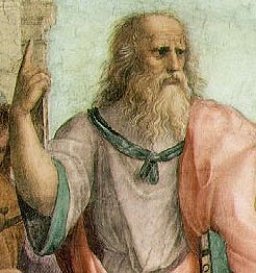
In Book III of Plato's Republic, Socrates and Glaucon discuss the role and content of musical compositions to be included in their fictional, utopian polis. The beginning of this topic involves them throwing out all bad or unhelpful forms of music in an effort to preserve those that will be good for the polis as a whole.
He correlates/compares particular modes of music with particular activities. For example, lamentations have a particular mode that imitates a sorrowful person. Other modes can be associated with drunkenness, idleness, and softness. Still others are associated with battle and courage. When confronting the question of why music selection is so important in the polis, Plato claims that "rhythm and harmony permeate the inner part of the soul more than anything else," and that the music will inform the souls of the city's people as much as an academic education can.
Plato also believes that music is instrumental in aiding people to determine "goodness". People very familiar with good forms of music (and poetry) will be able to "sense it acutely when something has been omitted from a thing and when it hasn't been finely crafted or finely made by nature." Essentially, that person will be better equipped to discern right from wrong, simply by having an education in good music. A harmony of soul will allow the person to reject those things that jeopardize that harmony.
Ok, wait, seriously? Does this mean we have to listen to Christian rock all the time or classical music? While I, personally, am a strong advocate for tuning in to classical music regularly, I do not think that's what we should be taking away from this point.
It's practically scientific fact that certain types of music affect our moods, and this makes perfect reasonable sense because we all have our happy playlists and our angry playlists, right? So this shouldn't be too crazy.
James Hetfield of Metallica; Exhibit A of Musical PTSD
However, prolonged exposure to a particular kind of music can have lasting effects. Similar to post-traumatic stress disorder (PTSD), listening to a single genre can influence your nervous system and hormones in such a way that they create semi-permanent conditions, just like constant shelling and gunfire. For example, listening to only grunge and other forms of hard rock can acclimate your body's hormones to stressful levels, regardless of if you are listening to music at that moment or not. The music conditions your body to release hormones that induce stress and adrenaline into your system. If the exposure to this music is regular, then the stress hormone release is also regular until it becomes the norm, whether you are listening to the music or not.
So, now the question I always want to know the answer to: what would the virtuous man do? What music would the virtuous man listen to? Well, the answer is not as easy as pointing to one particular artist/band or even one particular genre. And it certainly is not found in listening to the 10 hour version of Trololo (I think that if you can make it through 10 hours of this, you'll be a master in the virtue of fortitude, but I'm sure your prudence would be sharply called into question). So where is it?
To be a good person, one must do good things, eat good food, have good friends, etc. No good man will desire to surround himself with evil because he only delights in good things and everything less than that is abhorrent to him in varying degrees. So if goodness is to permeate the virtuous man's life, this must also apply to listening to good music. Therefore, our next inquiry is to discover of what things good music consists.
I am not necessarily referring to the gospel group, Virtue,
(above) when I refer to "virtuous music"
Just as food contributes to the goodness of our bodily health, music contributes to the health of our mind. The saying, "you are what you eat," applies just as much to music as it does to food. If certain kinds of food create unhealthiness in your body, then you will become unhealthy. If certain kinds
of music create unhealthiness of the mind, as described above, then the mind will become unhealthy. We care about the health of mind and body because it is integral to the soundness of one's soul. Our minds and bodies enable us to live virtuous or vicious lifestyles, and those lifestyles inform our character and, ultimately, our souls. Just as a hammer without a sufficient grip on the handle is unwieldy and inept at performing its task, we too will be inept at living a properly good life if our bodies are disordered.
So if music is so important to the health of the soul, we probably should pay a lot of attention to what good music is, so as to properly nourish our souls. Good music consists of that which brings us to realize our human good, namely virtue. After agreeing in the above paragraph that music does have an effect on the soul, it stands to reason that it must have either a positive or negative effect. And since "the good" is the aim for all of our actions, why would we ever desire to listen to "bad" music? (Note: by "bad", I am not referring to poorly performed or untalented music; I am referring to music that deteriorates the mind and corrupts the soul)
Music informs our minds and souls, just as the rhythm of a drum cadence informs a marching army to march in step. In the case of the human soul, good music is going to be that which inspires virtue in the individual. It lifts man's heart and mind to higher things and inspires him to perform heroic feats in everyday life. In times of struggle, it must comfort and console him, but always encouraging him to keep his goals of character firmly fixed. Music moves the human heart, and for the man who aspires to virtue, it must always move him towards his goal of being the virtuous man.
Therefore, good music inspires and directs man's desires, will, and actions to the achievement of virtue, and therefore, this is the best kind of music.
And now, here's a small sample of music that inspires me personally to virtue!
Maxwell had killed his sister. It was a pretty efficient murder at that; and Sir Maxwell Stewart prided himself on efficiency, whether it was with closing a business deal or doing away with nosy siblings. Although, the business deals were a significantly more common occurrence than the occasions that required the snuffing of relatives.
It had been efficient because she had consumed enough wine at his going away party that she did not feel the slight pin-prick of a syringe as it injected its lethal payload of insulin. Maxwell was a diabetic and his sister was not. The overdose had quietly put her to sleep on the sofa of the mansion's parlor. It did not take much.
The silent killing was also an excellent method of murder because it left no crime scene clues, should the body ever be found. There were no lacerations, no stab wounds, no bullet holes, no broken bones, or anything else of the gory and ghastly sort typically associated with the dark deed. She was indeed very old and by all appearances, it would seem that her poor, ailing heart had simply given out and her soul had flown to the heights of that holy Paradise.
Maxwell knew that it was her blood sugar, not her heart, that gave out, and that her soul was actually rotting in the circle of Hell reserved exclusively for prying, gossipy nannies. She had invented this grand conspiracy theory that his business empire was somehow built on lies and cheating, all claims were woefully unsubstantiated, of course. Doubtless she had concocted this inconceivable foolishness to tarnish his sterling reputation and ruin his going-away party. Maxwell had tolerated his sister's ignorance on a variety of other subjects, but it seemed to him hardly fair that he should suffer her vague fantasies of corruption and sleight-of-hand dealings when his good name was at stake.
However, his reputation was the furthest thing from his mind when this cake knife in his chest was the closest thing to his heart. James Ironsides, his American business rival, had put it there. Just like his business manners, Ironsides had no tact: no silent poisons or macabre premeditation. He just walks right up to you and plunges the cake knife unpretentiously into your chest. He did not even have the decency to wipe the icing from the blade.
Anyhow, things were beginning to feel very cold for Sir Maxwell. He could not tell if it was the two feet of snow in which he was lying or the icy caress of death stealing over him. Whichever the case, he was alone. Ironsides had not even had the decorum to gloat over his dying form. He could have at least thanked him for inviting him to the party, yes, thank you it truly is marvelous, is this wine a special vintage? of course, most excellent, are you finished with that cake knife? here Maxwell, let me pin this thank you note to your blazer with this cake knife, comfortable? well, I must be going, lovely party, let's do this again sometime.
But it was not so, and Maxwell felt the chill of his fate long before he arrived at that frozen circle of Hell reserved exclusively for dishonest, sibling-murdering businessmen.
My door in St. Edward's as decorated by Kyle
and Patrick after my 2nd LSAT
William Shakespeare, a writer that I greatly admire, once said, “Be not afraid of greatness; some are born great, some achieve greatness, and others have greatness thrust upon them."
My ‘greatness’ was thrust upon me.
It is not with pride that I publish this account because it does not seem entirely appropriate that I have been given this title. Rather, I write on this topic to “let everyone in” on the inside joke that is my undeserved nickname and the namesake for half of the title of my blog.
Kyle, Herald of the King and Servant of the Kingdom, and Dan, Knight of the Kingdom, (if I have a title, it's only fair that they have ones too) in the year 2011 gave me the title of “King Quinlan” on the event of our yearly pilgrimage to Washington DC, to bear witness to the life of unborn children and the atrocities committed against these innocents (aka, the March for Life). The night before the march, men and women mingled in the men’s sleeping quarters until well after time permitted in our school’s student rulebook. Some men were attempting to retire to be ready for the early morning ahead; however their attempts were in vain as the incessant giggles and cries from the nearby women made sleep impossibly elusive.
At this injustice, I rose to action. Finding the nearest chair, I mounted it with arms outstretched, to be seen by all the transgressors.
“Everyone, it is now 12:15 AM, fifteen minutes past our school’s parietal policy for weekdays. Since this is a school sponsored field trip, the rules of Du Lac still apply. We have guys trying to sleep here, so the women in the area will need to either go back to their own sleeping quarters or find somewhere else to socialize.”
A young woman with an exasperated expression replied, “But we have nowhere else to go.”
I paused, attempting to determine what bearing this had on what I had just said. Giving up trying to reconcile nonsense with reason, I replied.
“Well, you will just have to find somewhere else to go.”
And with that, the crowd dispersed and the men were allowed peace. It was deemed by Kyle and Dan that I had handled the conflict with such a firm conviction and regal presence that thenceforth, I was given the title of King Quinlan.
However, like Prince “Harry” of Shakespeare’s plays before he became King Henry V, I was not always as kindly and virtuous.
I was a brash, hot-tempered youth. Following a traumatizing sophomore year, I had learned to despise a group of individuals known collectively as the “bros”. They were deplorable individuals who gave themselves to drinking and lewd activities every weekend, and it was such a weekend as these when they incurred my wrath.
I had retired for the evening, as had my roommate Patrick, the King’s Court Fool. It was about 4 AM when there was a loud commotion in the hallway outside our door. The bros had returned from their night of debauchery and were looking to make more trouble.
They sought to disturb a senior who lived across the hall from me and Patrick by finding a nearby vacuum cleaner and turning it on outside his door. They pounded thunderously upon his door and jeered at him. This went on for nearly 10 minutes without any sign of the arrival of hall authorities to put an end to this madness. Fully awake and angry now, I leapt from my 8 foot high loft, flung open the door, and entered the guilty hallway in naught but a pair of shorts.
Consumed by unfathomable rage, I cannot recall exactly what I said upon my appearance. I do remember that whatever it was, I had used such profuse profanity that the transgressors immediately ceased their depravities and met my fury with surprise and uncertainty. I could feel every muscle in my body strained, resisting the urge to enter the throng of at least a dozen miscreants and commit violence to each of them. With vulgar bellowing, I advanced upon them and forced most of them to retreat.
Scott, alone, defied me.
Of all those previously present, Scott despised me the most. I had never injured him, so it always puzzled me as to why he hated me. It actually was he that had stolen my Xbox the previous semester and used it for his own purposes in his room. Of course, the established social understanding among this group was that whatever belonged to one, by default, was accessible to all. I never agreed with this policy and Scott had frequently taken advantage of my belongings. Thus, I deprived his sense of entitlement to whatever he desired and invited his derision.
Now, three yards separated Scott and me in the deserted hallway.
“Go on! Get out of here!” I shouted at him.
With eyes glassed over, he slurred a reply, “It’s a free hallway.”
With deft agility, I closed the distance between us in a moment and was now close enough to smell the repulsive combination of Kamchatka vodka and Keystone beer on his brutish breath.
“No, it’s not,” I trembled with rage, “It’s MY [expletive] hallway! Now get the [expletive] out!”
With each word, he cringed as I involuntarily spewed him with venomous spittle. Thankfully, this had the desired effect because he drunkenly turned and stumbled in the same general direction as his friends. Had he not moved, I dread to think of what might have happened next.
Upon my return to the room, Patrick had remained silent. We had only known one another for a few weeks, and I imagine this event had cast some doubt on my general mental health. Kyle, who lived in a room next door to the commotion, also later bore witness to these events, but it was only well into our friendship that the topic of that night arose. He had not realized that it was I who had walked out into the hallway, surging with wrathful madness. We shared a good laugh over the incident and it became only greater cause for the royal title. Though I am certainly not proud of my intemperate behavior, I have endeavored since then to become more level-headed, and I am largely succeeding in this task.
All such incidents aside, though, I regret to admit that the title of King is primarily due to my manner of speech. As is the habit of the Quinlan family, I have a tone that exudes confidence and the force of truth. I rarely begin my thoughts with the words, “I think that” or “I feel like”. To me, this seems repetitive and unnecessary because anything that I say is, of course, my own statement.
This linguistic style and confidence, I have been told, creates an air of authority to my statements. My self-assuredness and lack of soft language projects each word as one of ironclad truth, unassailable by any argument. Even on topics which I have no practical experience on, I make an estimation as to a reasonable position and defend it.
However, this strength of tone often appears as arrogance to many. I will be the first to admit that truthfully, at times, my words carry at least a tinge of haughtiness. However, I do not apologize for my self-confidence, the root of this character of speech. It is sad to see many unwilling to engage in open debate with others for fear of conflict. I carry myself in a way that I hope others will follow.
Every man must be ruler and king of himself. If a man is apprehensive of the slight breezes that barely change the course of his ship, how will he weather the torrential gales and roaring maelstroms of life? A king can have no subjects under his governance until he learns to govern himself properly in the sight of God. As I have not yet learned to rule myself completely with justice, I claim no subjects as my own, but with all eagerness, I welcome into my court those willing to receive my love and affection.
This post is not necessarily meant as a sequel to my first post on developing friendships, but while writing it, I suppose that's what it became. In my long history of friendships, I've learned some incredibly valuable things. One thing is that when I talk about physics, I scare people away. Another thing is that you shouldn't be too eager to evangelize because people are turned off to that kind of thing. And also, that you can't pay people to be your friends (well, if you want them to be real friends that is).
However, I believe that all of my "lessons learned" don't hold a candle to the priceless understanding that I have acquired regarding rejection (specifically, with friendships, but romantic relationships can fit in here as well). No matter who you are, we've all experienced it.
So, you meet someone you really think is alot of fun (guy or girl, it doesn't matter). They seem to enjoy themselves and you think, "Gee, I'm really attracted to this person's fun-loving nature. I think I want to get to know him/her more." You talk for a little bit and if you're smart, you don't take this as a sure-fire sign that they like you already. They might be conversing with you out of politeness, but that's ok, you're not best buds yet.
Fast-forward a week. You want to get a group of people together or maybe you just want to hang out with this person for some one-on-one time. You call this person to see what they're up to and they say they're busy or maybe that they'll keep your invitation in mind as they figure out their evening/weekend plans. Ultimately, they decide to not hang out with you. And that's the same story for the following weekends until you just decide to give up on them.
Why do people do that?? They never get back to you, they never decide to hang out with you, and they may ignore you at all future gatherings. In other words, they're just really flaky and not committed to forming a friendship with you, despite there seeming to be some initial potential. Unfortunately, I still search for the answer to this question, but my gut tells me that it varies by circumstance. But, it doesn't change the way you feel. Repeat the above-described process a couple more times and it'll kill any motivation you ever had to make friends, especially in a new environment. You feel like you've extended your hand to someone and it's been slapped away or, worse, chopped off. Or maybe you feel like you stuck your neck out for someone with a little generosity, only to have the ax swing and rend your head from your shoulders. It's painful, it hurts, and nobody likes to feel that way.
People can be disappointing. Certainly a depressing thought, but despite all the optimistic thoughts about human beings, I've found this one to be fairly consistent. Therefore, I propose the following thought: let not the measure or worth of your friendship efforts be the responsiveness (or lack of responsiveness) on the part of those whose friendship you pursue. Or in other words, change your operational mindset when making friends.
The approach I propose requires concentration on what each of us is doing to facilitate a welcoming atmosphere to those we wish to befriend. We must polish our approach to people to make them feel welcome. We shouldn't go to social events as if we're going out into the wilderness to "headhunt" for friends. This approach is too aggressive and our intentions will quickly become apparent to those we encounter. They will feel "stalked" or "preyed upon" if we aggressively attempt to make their acquaintance. And obviously, this quality is wholly unattractive in another human being.
When we go out to socialize, we must bring the hospitality of our homes with us. Instead of hoping to slay someone with our charm, wit, and laughter, we should have the mindset of inviting people to us, telling them to pull up a chair, and enjoy one another's company. That's the difference. A "headhunting" friendship approach is based on results; a "home entertainer" friendship approach is based on improving our own merits. Instead of going out to win or conquer friends, we develop our personal generosity and then invite others to join us in our exquisite beneficence. If performed genuinely, this can be deeply gratifying for you, the host. And it will encourage others to open their generosity to you as well.
There are a few key pitfalls to this approach that must be avoided. One may interpret this approach as allowing others to "take, take, take" from your well-meaning. You must keep your dignity here because a successful friendship is never a one-sided engagement. Anyone who is interested in who you are for who you are will naturally be willing to return your kindness with their own form of graciousness. Another is that when realizing that someone is not interested in being your friend, we become bitter and self-righteous, claiming that "they were never deserving of my generosity", so "screw them". This must be avoided at all costs because it robs us of our peace and completely disarms this mindset. It is also indicative of a regression into the "headhunter" mentality, which gets frustrated and resentful when results are not achieved. If you do not have peace with this approach, then you're not doing it right.
There are many other benefits to this mindset as well. One benefit is that as long as you have purged your intentions of any "headhunting" tendencies, you will be better equipped to deal with rejection better. If someone isn't open to you good will, you can move on because you weren't concerned with "conquering" them to begin with. Instead, you can turn your efforts to other prospects. Secondly, since this approach is focused on our own service and merit offerings, we can seek to make friends and deal with rejection dispassionately. If someone refuses your generosity, look elsewhere for those who can appreciate your hospitality. We can be resistant to bitterness and emboldened against rejection. Also, this emboldenment will necessarily boost our self-esteem and self-image. We can become confident in what we have to offer other people and sure of our own merits.
If you are in a new environment or just looking to make friends, I highly recommend that you give this approach an honest try.
Most people might read this statement and think, "what is a 'hobbit'?" I'm sorry if you're one of those few, but feel free to educate yourself here.
I have several reactions to this statement, and hopefully by the end of this blog post, I will have gotten my bewilderment sorted out and (maybe) have a coherent opinion on this news.
First: why? Why are they making three films out of one book? This strikes me as a stupid money-making marketing ploy. I hate it when Hollywood complicates stuff like this and really ruins good films. Because the creative team here is mostly intact and all the original actors have returned to play their respective characters as needed, this "trilogy" will forever be associated with The Lord of the Rings, which is critically acclaimed as excellent. Whether for good or ill, this will be considered as essentially the same story. So if this goes south, LotR is going to go the way of Star Wars and its 3 prequel films and Jackson will be regarded as just another George Lucas who creates your childhood cinematic loves, (LotR is very much this for me) then once you've reached adulthood, he ruins them by using it to get more cash from you. So this thought makes me angry.
Second, how? The Hobbit is about 310 pages long. This is just a little over half the size of the Fellowship of the Ring... the first book in the series of the Lord of the Rings trilogy! And it's about one fifth the size of the whole LotR trilogy. Somehow, they got it so that the original plan was to make two movies out of the Hobbit. Where are they getting this new material from? Apparently, much of it arises from the appendices listed at the end of the Return of the King (the third book in the LotR series) and in Tolkien's other notes. But unfortunately, alot of this was not published by Tolkien as its own work because it was not complete/finished.It might be mentioned in passing in an appendix, but will Jackson and the crew be able to fully realize Tolkien's vision and tell his story? Or is it just material scraped and scrounged to make a Hollywood blockbuster? I'd say this idea makes me doubtful.
Now, my reaction to this news has also been positive. Peter Jackson has done a pretty good job of adapting Tolkien's work to the screen. And while it may not be faithful to every single little detail written in the books, I think it does a good job of illustrating for the viewer in the span of 10ish hours what Tolkien is trying to say. (if you want any more than that, then I'm sorry, but you're just going to have to suck it up and read the books) So with this in mind, I'm a little curious to see how Jackson pulls it off.
Also, Howard Shore will be composing the music. All three of his scores for the LotR trilogy were stellar (with the scores for the 1st and 3rd films garnering Academy Award wins). So, if anything, the extra film will just produce more beautiful music that I will inevitably be buying. An example of this are the additional Pirates of the Caribbean films. I have only seen the first two sequels, but the music that Hans Zimmer wrote for them complement and expand on Klaus Badelt's decent score for the first film (which I believe that Hans Zimmer also had a strong hand in creating). Regardless, I'd say more music from Howard Shore's interpretation of Middle Earth makes me giddy.
In conclusion, I'd say I'm dubiously furious at Peter Jackson's audacity to make what was a simple bedtime story into 3-film cinematic epic, while still remaining inquisitively enchanted at the prospect of there being more of Middle Earth to see on the Silver Screen.