Showing posts with label music. Show all posts

Saturday, May 11, 2013

"I'll Know My Name as It's Called Again"

If I began a sentence with "I was listening to some Christian rock and...," most people have one of two reactions. If you're one of those people that would get really excited and eager to talk about your favorite Reliant K song, I'm sorry to say I'm going to disappoint you with this post. On the other hand, if you're one of those people who says that Christian rock is for uncool, churchy kids, then I'm going to surprise you by revealing that some of the most Christian music I have ever heard is actually from a popular band.

"Jacob Wrestling with the Angel" by Rembrandt
My primary criticism of much of the popular Christian music that I've heard is that it lacks the human element. Personally, I find much of it nauseatingly upbeat and predictably appealing to my feelings (if I had any). As a result, much of it fails to wrestle with faith, as Jacob wrestled with the angel. For this generation, faith doesn't come easy, and I think it doesn't come easy for anyone. There are far too many challenges to it for it to be simply a walk in the park. Personally for me, it's a regular struggle to push past my own rational outlook on the world and seek to understand the Divine Being who is the source of all good. Therefore, simply praising and worshiping is not something I completely "get".

Whether you have this same conflict as I do or not, everyone has their own reasons to struggle with faith. It might not be perpetual, though. Often times, it's a thing that works in a cycle: you find an inspiration to your faith, you cultivate and treasure it. Then, when you're feeling strong on your feet, you forget what go you there, which is why you fall flat on your face soon after. But ultimately, the true Christian will arise once more and fight his way back to faith and this time, in an effort to keep it.

Therefore, the Christian rock that is going to popularly engage this generation of people is going to appeal to this seemingly contradictory notion of zealously high aspirations for our faith, frustration and anxiety at our repeated failures, and a committed conversion back to our faith in God. The band I have in mind, then, is none other than Mumford & Sons, and more specifically, their album, "Sigh No More".

Mumford & Sons
The album contains more Christian themes than I myself understand, and yet it maintains a firm grounding in the human person, with all of our struggles and trials. Anyone who is truly a Christian knows that it takes hard work to be one. If you don't feel like your sweating blood sometimes, just to keep your faith, then I would say you're not a Christian: your faith is not being tested, you are not truly following the path of Christ in suffering and sorrow. It is a constant struggle, one in which we occasionally, or even frequently fail to meet. But the hallmark of such an epic fight for our souls is to dust off and try again.

It all begins with the statement: "Serve God, love me, and mend". (Sigh No More) Service to God, love others, and then take care of yourself. This, of course, is none other than the Golden Rule, learned from Jesus Christ. Our lives belong to God and it is through our interaction with others that we can show our affection for God, by keeping his commandment first with the people around us and then with ourselves. The song continues with a statement so hopeful, I must reproduce it here in its entirety:
Love; it will not betray you
Dismay or enslave you, it will set you free
Be more like the man you were made to be
First, Love is what sets us free, and as God is caritas, the highest, ultimate form of love, that voluntary servitude towards God and others will paradoxically give us freedom, not take it away. It is in this choice of service that we demonstrate that we are free to do so. The third line suggests that to love like this is Man's true purpose, which is confirmed in the second song of the album, The Cave. The desire for freedom is once more urgently desired, "Cause I need freedom now, and I need to know how, to live my life as it's meant to be." (The Cave) The imagery of the song makes unmistakeable references to Homer's The Odyssey, in which the homeward hero, Odysseus, instructs his crew to tie him to the mast of the ship as they passed by the island of the deadly Sirens, temptresses of the sea who draw sailors to their deaths on the rocky island shores. The song draws on this desire to resist their temptuous call, even taunting the sirens with the lines, "The harvest left no food for you to eat. You cannibal, you meat-eater, you see, but I have seen the same, I know the shame in your defeat," (The Cave) for it was believed that the Sirens were cannibalistic. The third song of "Sigh No More", Winter Winds, speaks further of this same hope, reminding us that "remember spring swaps snow for leaves, you'll be happy and wholesome again, when the city clears and sun ascends." (Winter Winds) Hope that is a sure mark of the Christian, for while the rest of the world despairs in its damnation, this soul understands that he was made to be united with God and He will deliver him.

Ulysses and the Sirens by John William Waterhouse
However, pride, doubt, and rebellion begins to creep in. Despite the obviously Christian references of Roll Away the Stone, it is not a positive song towards faith. In fact, it is contemptuous and bitter towards God: "It seems that all my bridges have been burnt, but you say that's exactly how this grace thing works." (Roll Away the Stone) To be honest, I sympathize with the verses of this song because faith often results in the free choice of the Creation against the Creator. It is certainly not Man's purpose to do this, as we have seen, but we do it anyway because our created natures "know better" than the omnipotent nature: "But you, you've gone too far this time, you have neither reason nor rhyme, with which to take this soul that is so rightfully mine." (Roll Away the Stone)

My interpretation of White Blank Page, the fifth song on the album, presumes to put words in the mouth of God, as I believe he reacts to this rebellion. The opening verses of the song question Man's desires and probes his very soul for fittingness:
Can you lie next to her
And give her your heart, your heart
As well as your body
And can you lie next to her
And confess your love, your love
As well as your folly
And can you kneel before the King
And say I'm clean, I'm clean
To me, this echoes a soul's Examination of Conscience, in which the Christian surveys their words, thoughts, and actions for any sins committed for which reparations need to be made. It is true, a man in rebellion against God cannot answer these and still claim to be His servant. However, it is with great sadness that the words mournfully carry on, "But tell me now, where was my fault, in loving you with my whole heart." (White Blank Page) Who can claim no fault or harm towards us and also have loved us with His whole heart? My guess is Jesus Christ.
The human soul is now steeped in bitterness towards his Creator. He has forsaken Him and has turned towards his own passions, "Stars hide your fires, these here are my desires, and I won't give them up to you this time around." (Roll Away the Stone) But it is in I Gave You All that Man must express his unmistakeably anguish at having been separated from God.The lost and wayward soul has given his God everything he has, and yet "... you rip it from my hands, and you swear it's all gone. And you rip out all I have, just to say that you've won," like a small child who takes what is not his and hides it behind his back, claiming complete ignorance of the wrong.

Devils from a fresco in the Rila Monestary in Bulgaria
Little Lion Man by Mumford & Sons on Grooveshark
Now, the devil has his prize. Man has forsaken God for his own passions, and now Satan claims what is his. He taunts Man, "Weep for yourself, my man, you'll never be what is in your heart. Weep, little lion man, you're not as brave as you were at the start." (Little Lion Man) This hits very close to home for me and for anyone who recognizes, despite their best intentions, there is always that evil voice, whispering in your ear and telling you about all the things you could never do because you lack the strength and courage to do them. This song is by far the most angsty and frustrated of the entire album. Even the chord progression sounds like a demon's jig over his winnings. The devil gloats to us that despite all our strength, all our virtue, we are still subject to his power and "your grace is wasted in your face, your boldness stands alone among the wreck." (Little Lion Man) In fear is the way the devil likes to keep Man, and it is in our fears that Satan reigns supreme.

Timshel by Mumford & Sons on Grooveshark


If Little Lion Man is Satan's triumphant jeering, then Timshel, the proceeding song, is God's invitation to return to His grace. Upon seeing the peculiar title of the song, I was immediately curious about what it meant. As it turns out, timshel is commonly understood to be Hebrew for "thou shalt", as it is found in the Ten Commandments. However, in John Steinbeck's book East of Eden, two characters have a discussion of its meaning, and one of them reveals that it's original meaning has been confused and that it actually means "thou mayest". He claims that the "mayest" distinguishes itself from "shalt" because it puts emphasis on Man's freedom to choose, and not on the deterministic and inevitable implications of "shalt". Mumford & Sons makes this a critical, tender moment after the previous harsh, and at times vulgar tune of Little Lion Man. The soul now realizes that despite his despair, "you have your choices, and these are what make man great, his ladder to the stars." (Timeshel) Man's freedom is what makes him like God, in his image and likeness. God does not leave Man to these choices, alone and unaided: "you are not alone in this, as brothers we will stand and we'll hold your hand." (Timshel) However as the song ends, the final haunting words, "But I can't move the mountains for you" (Timshel) put the ultimate responsibility on Man to make the right choices. God's grace is sufficient to do anything, and He gives it to us all time, but if we are not willing to to do the will of God, His grace will fall on fallow ground or  choked by thorns. (Luke 8:4-15)


Thorns, or Thistles and Weeds, which coincidentally enough, is the title of the next song, rise up and choke our faith in Christ's Parable of the Sower. The lyrics tell us to "plant your hope with good seeds, don't cover yourself with thistle and weeds, rain down, rain down on me." (Thistles and Weeds) In keeping with the Parable of the Sower, the teachings of Christ are the good seeds we should seek to plant within us, and those of the world only yield destructive fruits. The song creates an air of impending doom, as if the vices of this world threaten to strangle any faith that we have.
Landscape with the Parable of the Sower
by Pieter Bruegel the Elder
Threatened by this evil, Man cries out to be free of these vicious habits and temptations. Our souls were made for higher things, but when our back have been turned to God's graces, these higher things are impossible to realize. Very soon, a soul must admit that he's been wrong, that "now my heart stumbles on things I don't know, my weakness I feel I must finally show." (Awake My Soul) That 'weakness' of dependence on God is a lie from the devil. Of course, we are weak, but the notion that we are autonomous, that we have no dependence on anything is a clever deception of the devil to take advantage of our pride: "How fickle my heart and how woozy my eyes, I struggle to find any truth in your lies." (Awake My Soul) But Man knows in the depths of his heart that he is dependent and that he cannot live without a higher Helper. The Helper, which is a term used by Christ in reference to Holy Spirit, offers to us, "Lend me your hand and we'll conquer them all, but lend me your heart and I'll just let you fall. Lend me your eyes I can change what you see, but your soul you must keep, totally free." (Awake My Soul) God permits us to keep our souls and our freedom. He does not take that timshel away, but gives us that responsibility to make those choices. He allows us to fall sometimes because that is how we realize our dependence on our Creator, "For you were made to meet your maker." (Awake My Soul)

The eleventh song on the album, Dust Bowl Dance, deviates strangely from the rather abstract, introspective tone of the rest of the album. It tells the story of a young man whose farm is being foreclosed upon after a recent famine. The young man's anger and bitter frustration with those who would take his land is frighteningly apparent with, "I'll go out back and I'll get my gun, I'll say, 'You haven't met me, I am the only son.'" (Dust Bowl Dance) However, this song is retrospective because the crime has already been committed, "Well, yes sir, yes sir, yes, it was me, I know what I've done, 'cause I know what I've seen." (Dust Bowl Dance) After the evil Man does in a moment of passionate rage, the soul feels the crushing weight of its sins and the feeling is one of intense contrition, "So collect your courage and collect your horse, and pray you never feel this same kind of remorse." (Dust Bowl Dance) And this is how we reapproach our God who we have denied: with sorrow and true contrition for our sins. The soul, having made this painful journey illustrated in each chapter of this album, now looks to return to God and seek his forgiveness.

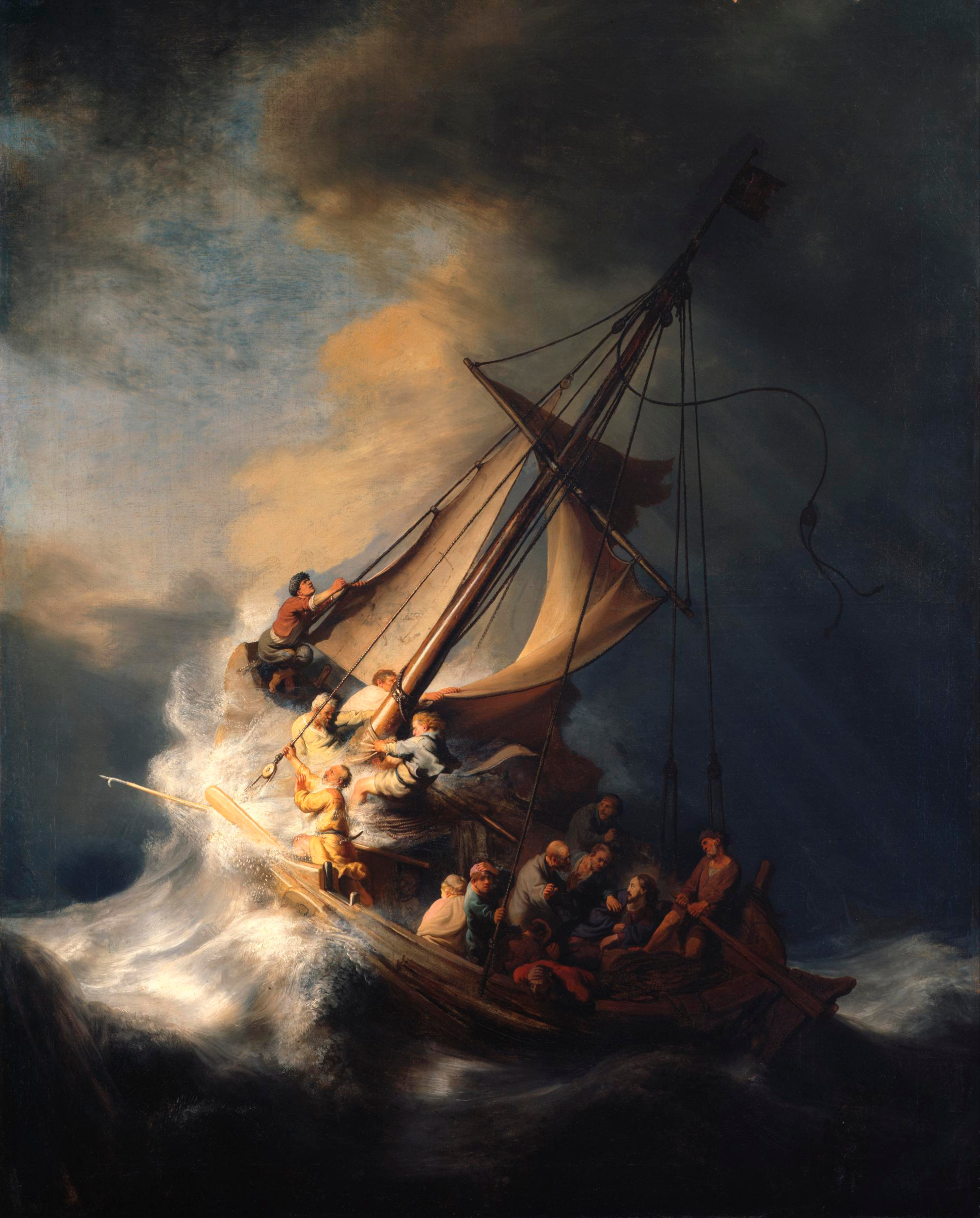
The Storm on the Sea of Galilee by Rembrandt
It is fitting then, that final song of the "Sigh No More", After the Storm, draws on some imagery from the Parable of the Prodigal Son. After his defiance to God, after his bitter rebellion against his Creator, Man's pride fails him and he cannot run anymore, "And after the storm, I run and run as the rains come and I look up, I look up, on my knees and out of luck, I look up." (After the Storm) His soul is weary of his insurgency against the Lord, for he has found the bottom of the pit which he himself has dug. He sees the meaninglessness of his own acts, but still desires to not waste away, "But I won't rot, I won't rot, not this mind and not this heart, I won't rot." (After the Storm) Now, the soul must return to his God. His loneliness in his appalling state has shown him that God is the only one who can welcome him back: "And I won't die alone and be left there. Well I guess I'll just go home, Oh God knows where." (After the Storm) Though his sorrow for his own sins makes him realize the grave injustice that he has done to his Maker, it does not stifle all his hope. With God, there is a better life, and these verses make that abundantly clear:
And there will come a time, you'll see, with no more tears.
And love will not break your heart, but dismiss your fears.
Get over your hill and see what you find there,
With grace in your heart and flowers in your hair.

And with that, Sigh No More reaches it's conclusion, and the Christian begins once more in his quest for unity with God. So am I totally full of it? Am I just making this up and really this album is another rant meant to fulfill any lingering teenage angst? Maybe, but as far as I'm concerned, this is the most Christian rock album I've ever heard.


Monday, May 6, 2013

Great Deeds and Noble Hearts: A Musical Revolution

Remember those stories that had you fill in key words or phrases to create a totally random and hilarious story? It'd typically go something like, "This morning, I woke up to the sound of a     (noun)     while I was dreaming about     (an activity you hate doing)    ..." You would ask a friend to give the your necessary words or phrases without telling him or her the context of the words. When you were finished, you'd read the short story from beginning to end and have a good laugh over it.

I bring this up because I was thinking about what kinds of answers would fill in the blanks if modern popular music provided the answers. Probably something like this:

I was awoken this morning by    tik tok, on the clock, but the party don't stop no   , after a long night of    livin' a Teenage Dream   . I put on my    ripped jeans, skin was showin'    before going downstairs to have some breakfast. Next thing I know, I'm    gonna pop some tags, only got twenty dollars in my pocket   , but before I do, my mom says to me, "   HEYYYY, SEXY LADY!!!!   ".

Ok, maybe this is a silly exercise, so are these lyrics. Although the truth is that you could do this to Shakespeare and he'd look pretty comical, the point is that these are the things were hear from popular music and have been for a very long time.

PSY performing "Gangnam Style"

However, I am sensing a shift in the preferences of a growing portion of today's music lovers, and it's exactly because the younger generations are realizing that life isn't about the instant gratification anymore. They've been there, they've done that for long enough and they're finally over its glamor. So how is this reflected in musical tastes?

Whatever is "popular" appeals to a baser part of our souls. People choose what is "popular" not because it enriches them; rather one chooses what is popular because it is in keeping with the status quo. Since "everyone is doing it", no one is going to criticize or attack your for doing it yourself.

Sometimes, though, this conception of "popular" wavers and falters under the underestimated strength of the human heart. Sometimes, a truthful light shines through and those who are open to it gather around it. I believe that some interesting trends in contemporary can be seen in this way: as encouraging and cultivating inspirations of what we all truly long for in the deepest desires of our hearts.

Someone Like You by Adele on Grooveshark
The first expression of such a longing is in hurt. Artists such as Grace Potter and the Nocturnals and ADELE come to mind here. The primary subject matter of their songs center around themes of sadness, hurt, and loneliness. Broken and shattered amidst the heartbreak in the world, this music expresses confusion and laments, "I often think about where I went wrong, the more I do, the less I know." ("Don't You Remember" - ADELE, click here for full lyrics) Living the disillusioned life has indeed brought about this pain because the indulgence in what is "popular" has promised the maximum pleasure, but only delivers the deepest, cutting pain. This hurt is always present in the shame at who we have become and what we have sacrificed, "'Cause every town's got a mirror and every mirror still shows me, that I am my own ragged company." ("Ragged Company" - Grace Potter and the Nocturnals, click here for full lyrics)


Ragged Company by Grace Potter and the Nocturnals on GroovesharkThese artists and others have become "popular" because they speak for the hurt and shame that we all have. Their appeal is in their lamenting that we can all identify with. Though it would be a mistake to believe that one day, this is all the world will listen to, this is what a large number of people are gravitating towards because 'misery loves company', and these artists make explicit what lives implicitly in all of our broken souls.


Sigh No More by Mumford & Sons on Grooveshark
Acknowledgement of one's misery is the first necessary step, but even more imperative is the discover of our innate desire for the good and the willful resolution to obtain it. Florence + the Machine and Mumford & Sons rank among the most popular influences on this genre which encourages people to be "more like the man you were made to be." ("Sigh No More" - Mumford & Sons, click here for full lyrics) It's true, these songs are about pain and hurt, but their defining characteristic is not in complaining to the world about endless woes. Courage is necessary to carry on after being let-down, the ability to pick up the pieces and find peace in carrying on. This kind of music has gained significant popularity because the listener it attracts is "done with [her] graceless heart, so tonight [she's] gonna cut it out and then restart." ("Shake It Out" - Florence + the Machine, click here for full lyrics)

Though we must not fool ourselves into thinking that because a few artists are gaining some traction in popular culture, the whole world will suddenly embrace this truth and desire for the full meaning of our lives, but what I think it does mean is that there is a growing number of people out there who are realizing that their lives have purpose and they are called to acts of heroism and virtue.

A calling to deny those passions that come so easily to us and ascend to lives of greatness and meaning is the heart's true desire. "Party rocking" and living "gangnam style" feed the body, but they leave the soul starving for sustenance. Pop culture is popular and will remain so, as long as it feeds our vices and encourages our lukewarmness. But life's true adventure is proving to ourselves, even when no one is watching, that we were made for great deeds and noble hearts.

Saturday, April 13, 2013

You Are What You Hear...

Plato from "The School of Athens"
In Book III of Plato's Republic, Socrates and Glaucon discuss the role and content of musical compositions to be included in their fictional, utopian polis. The beginning of this topic involves them throwing out all bad or unhelpful forms of music in an effort to preserve those that will be good for the polis as a whole.

He correlates/compares particular modes of music with particular activities. For example, lamentations have a particular mode that imitates a sorrowful person. Other modes can be associated with drunkenness, idleness, and softness. Still others are associated with battle and courage. When confronting the question of why music selection is so important in the polis, Plato claims that "rhythm and harmony permeate the inner part of the soul more than anything else," and that the music will inform the souls of the city's people as much as an academic education can.

Plato also believes that music is instrumental in aiding people to determine "goodness". People very familiar with good forms of music (and poetry) will be able to "sense it acutely when something has been omitted from a thing and when it hasn't been finely crafted or finely made by nature." Essentially, that person will be better equipped to discern right from wrong, simply by having an education in good music. A harmony of soul will allow the person to reject those things that jeopardize that harmony.

Ok, wait, seriously? Does this mean we have to listen to Christian rock all the time or classical music? While I, personally, am a strong advocate for tuning in to classical music regularly, I do not think that's what we should be taking away from this point.

It's practically scientific fact that certain types of music affect our moods, and this makes perfect reasonable sense because we all have our happy playlists and our angry playlists, right? So this shouldn't be too crazy.

James Hetfield of Metallica; Exhibit A of Musical PTSD
However, prolonged exposure to a particular kind of music can have lasting effects. Similar to post-traumatic stress disorder (PTSD), listening to a single genre can influence your nervous system and hormones in such a way that they create semi-permanent conditions, just like constant shelling and gunfire. For example, listening to only grunge and other forms of hard rock can acclimate your body's hormones to stressful levels, regardless of if you are listening to music at that moment or not. The music conditions your body to release hormones that induce stress and adrenaline into your system. If the exposure to this music is regular, then the stress hormone release is also regular until it becomes the norm, whether you are listening to the music or not.

So, now the question I always want to know the answer to: what would the virtuous man do? What music would the virtuous man listen to? Well, the answer is not as easy as pointing to one particular artist/band or even one particular genre. And it certainly is not found in listening to the 10 hour version of Trololo (I think that if you can make it through 10 hours of this, you'll be a master in the virtue of fortitude, but I'm sure your prudence would be sharply called into question). So where is it?

To be a good person, one must do good things, eat good food, have good friends, etc. No good man will desire to surround himself with evil because he only delights in good things and everything less than that is abhorrent to him in varying degrees. So if goodness is to permeate the virtuous man's life, this must also apply to listening to good music. Therefore, our next inquiry is to discover of what things good music consists.

I am not necessarily referring to the gospel group, Virtue,
(above) when I refer to "virtuous music"
Just as food contributes to the goodness of our bodily health, music contributes to the health of our mind. The saying, "you are what you eat," applies just as much to music as it does to food. If certain kinds of food create unhealthiness in your body, then you will become unhealthy. If certain kinds
of music create unhealthiness of the mind, as described above, then the mind will become unhealthy. We care about the health of mind and body because it is integral to the soundness of one's soul. Our minds and bodies enable us to live virtuous or vicious lifestyles, and those lifestyles inform our character and, ultimately, our souls. Just as a hammer without a sufficient grip on the handle is unwieldy and inept at performing its task, we too will be inept at living a properly good life if our bodies are disordered.

So if music is so important to the health of the soul, we probably should pay a lot of attention to what good music is, so as to properly nourish our souls. Good music consists of that which brings us to realize our human good, namely virtue. After agreeing in the above paragraph that music does have an effect on the soul, it stands to reason that it must have either a positive or negative effect. And since "the good" is the aim for all of our actions, why would we ever desire to listen to "bad" music? (Note: by "bad", I am not referring to poorly performed or untalented music; I am referring to music that deteriorates the mind and corrupts the soul)

Music informs our minds and souls, just as the rhythm of a drum cadence informs a marching army to march in step. In the case of the human soul, good music is going to be that which inspires virtue in the individual. It lifts man's heart and mind to higher things and inspires him to perform heroic feats in everyday life. In times of struggle, it must comfort and console him, but always encouraging him to keep his goals of character firmly fixed. Music moves the human heart, and for the man who aspires to virtue, it must always move him towards his goal of being the virtuous man.

Therefore, good music inspires and directs man's desires, will, and actions to the achievement of virtue, and therefore, this is the best kind of music.

And now, here's a small sample of music that inspires me personally to virtue!

The Cave by Mumford & Sons on Grooveshark
Born to Run by Bruce Springsteen on Grooveshark
Overture To The Royal Fireworks Music by Handel on Grooveshark
The Breaking of the Fellowship / In Dreams by Howard Shore on Grooveshark


Tuesday, December 18, 2012

Throwing a Legitimate Dance Party: A How-To Guide

Ever since I was in high school, going to homecomings and proms, I always wanted to throw my own "dance" party. Why? Well, I just didn't like the way high school did stuff the stuff they did. I did not like every one's "dancing" style around me. I did not like the indiscriminate choice of music. I did not like that fact that there were no serious refreshments of which to speak. I just thought I could do it better...

So that is what I did. Over the past year, I've orchestrated the throwing of three very successful and legit dance parties. With each party, I learned some valuable lessons and the next time, I made the relevant changes to keep the party 'raging'. Below, I have created a 'how-to' guide for this delicate, but highly rewarding process:

1. Budget
Like every good endeavor, you need to sit down and determine what you're willing to spend on this thing. If you're looking to do it right and this is your first time doing it, it's going to be expensive. (for perspective, I believe my first budget was $100) The good news, though, is that the money you spend on infrastructure here will not have to be re-spent for future parties. It might be worth it to see if you can get an interested core group of people to help fund some of the various aspects.

2. Who To Invite
This is certainly more up to the personal preference of the hosts, but one hard-and-fast rule that I've found out is that you need to keep the guy-to-girl ratio pretty even. An overwhelming number of one over the other is not conducive to a properly socializing group because guys certainly want to be with their buddies, but they also want to have the opportunity to meet and socialize with plenty of girls. The same goes for girls; girl friends are nice to have, but a party with too many girls will make them feel like they're being used. This dynamic also becomes more clear when dancing begins; what guy wants to dance with another guy? And what girl wants to only be dancing with her girl friends all the time? I cannot stress this rule enough.

3. Music
The party doesn't have a chance without music, of course. It's probably a good idea to make two playlists: one of just general party tunes and another for dance music (the reason for this will become clear later). If you do not already have all the music yourself, see if you might be able to get it from that core group of friends. In selecting music, it is good to have a genre variety. Sure, Flo Rida and Lady Gaga are modernly relevant, but what about the timeless classics like Elvis Presley, Little Richard, Spice Girls, or *NSYNC? Every one likes to get taken back to the old days once in a while, so give them that diversity. Also, I recommend splicing in some other genre types such as salsa and swing dancing numbers.

4. Infrastructural Items, Pt. 1: "Sound"
Ah, here's the point that might be a bit hard to swallow: you'll have to invest some money into this party. Not just "some" money, but depending on what your goals are, potentially "alot" of money. For a first party, this does not always need to be a giant expenditure, but that also depends on what you already have to start with. You'll need a stereo of some sort, and you'll need an MP3 player that you can plug into said stereo. This is not a bad investment, party planning aside, but it can definitely be one that sets you back a few bucks. If you do not have an MP3 player and no one else you know has one, then you're probably Amish and I'm curious as to why you're throwing a dance party in the first place. Though seriously, if this is the case, MP3 CDs work well enough. They have a higher storage capacity than regular audio CD formats and iTunes can burn in this format.

All-in-one Disco Ball; $25
5. Infrastructural Items, Pt. 2: "Lights and Special Effects"
Colored light bulb; $5
This step will also require some monetary investment. Party lighting will give your dance party teeth, beyond simply having loud music. The cheapest route to take would be to purchase variously colored light bulbs. This will create a pretty static atmosphere for what should be a dynamic party, so I would only recommend these as a supplement. There are a couple of mid-range alternatives, however, such as small disco balls. And if you really have money burning a hole in your pocket, there is some professional DJ equipment out there that will really give the dance floor some kick. And smoke machines are reasonably inexpensive, depending on what you get. The low power ones (such as the 400 watt model) only create 'smoke', which is great to project LED through because it creates an awesome laser effect. The higher powered models (such as the 1100 watt) are able to create a low-lying fog effect that you see in the movies. It requires a special fog juice to create, so make sure you do your research on fog machines to ensure that you get what you want.

6. Food and Drink
Fog Machine 400 Watt; $30
Though not nearly as fun to shop for as the items listed above, proper nutrition and hydration (or de-hydration, depending on the beverage in question) is important. It would be appropriate to call on guests to bring either a snack food or a beverage when they accept the invitation, but you will undoubtedly need to supplement that. Chips and salsa is a decent, inexpensive starter. Also, it is vital that the host(s) provide the first round of beverages. This is important because your assigned beverage bringers might not arrive on time and while people are waiting, they should have a drink in their hand, if they desire it.

7. Decorations
This should probably be the weakest link in your budget. If you're short on cash or time, this becomes nonessential, but if you just don't have cash, then creatively-used, ordinary party streamers can change the look of your place drastically and get people in the party spirit.

8. Other Last Minute Preparations
Moonflower LED Light; $60
Of course, clean your place and make it look nice. Also, rearranging the furniture will give you more dance room space. If you live in an apartment complex, you should warn your neighbors of the noise the party will generate. Give them your cell phone number(s) and ask them to call you if it ever gets too loud. This is always better than the alternative of having the cops called. Reiterate that their comfort is your first concern and that you will be more than happy to bring the volume (or at least the bass) on the stereo down.

9. Timing and Bringing It All Together
Invariably, most of the guests will arrive anywhere between a half hour late to one hour and a half late. This is not terrible news because odds are you won't be fully ready by party time anyway. If you can get that core group of friends to show up early, they can play host or hostess while you are putting the finishing touches on the evening or getting ready yourself.

When people do arrive, they will want to have a drink or two and socialize with the other guests. This is a great time to put the 'party tunes' playlist or CD on the stereo at a conservative volume. Allow people plenty of time to snack and talk with their friends. Resist the urge to be over eager in moving to the dancing portion because regardless of the scene, people will not dance until they're ready too.


When it comes time to dance, the host should pause the music and call everyone around. A toast is usually appropriate here, as well as a few thank yous for everyone that came and for the food/drink they brought. While you're doing this, a trusted friend is setting up the dance playlist/CD. After the toast and thank yous, the host announces in some fashion that the dancing portion will begin shortly. Then, the party lights, which had been off up to this point, are switched on and the music starts.


People probably won't dance immediately, especially if this is the first time you're doing this. It will take some time for people to adjust to the idea of dancing in front of other people, especially if they weren't seriously expecting to do any dancing. So just be patient. Once they start dancing, your job is practically finished. Enjoy yourself and keep your cell phone by you to receive any calls from sleepy neighbors.

Hope this helps! Good luck!


Tuesday, July 31, 2012

Opinion: A "Hobbit" Trilogy?

"The Hobbit" is going to be three movies."
Most people might read this statement and think, "what is a 'hobbit'?" I'm sorry if you're one of those few, but feel free to educate yourself here.

I have several reactions to this statement, and hopefully by the end of this blog post, I will have gotten my bewilderment sorted out and (maybe) have a coherent opinion on this news.

First: why? Why are they making three films out of one book? This strikes me as a stupid money-making marketing ploy. I hate it when Hollywood complicates stuff like this and really ruins good films. Because the creative team here is mostly intact and all the original actors have returned to play their respective characters as needed, this "trilogy" will forever be associated with The Lord of the Rings, which is critically acclaimed as excellent. Whether for good or ill, this will be considered as essentially the same story. So if this goes south, LotR is going to go the way of Star Wars and its 3 prequel films and Jackson will be regarded as just another George Lucas who creates your childhood cinematic loves, (LotR is very much this for me) then once you've reached adulthood, he ruins them by using it to get more cash from you. So this thought makes me angry.

Second, how? The Hobbit is about 310 pages long. This is just a little over half the size of the Fellowship of the Ring... the first book in the series of the Lord of the Rings trilogy! And it's about one fifth the size of the whole LotR trilogy. Somehow, they got it so that the original plan was to make two movies out of the Hobbit. Where are they getting this new material from? Apparently, much of it arises from the appendices listed at the end of the Return of the King (the third book in the LotR series) and in Tolkien's other notes. But unfortunately, alot of this was not published by Tolkien as its own work because it was not complete/finished. It might be mentioned in passing in an appendix, but will Jackson and the crew be able to fully realize Tolkien's vision and tell his story? Or is it just material scraped and scrounged to make a Hollywood blockbuster? I'd say this idea makes me doubtful.

Now, my reaction to this news has also been positive. Peter Jackson has done a pretty good job of adapting Tolkien's work to the screen. And while it may not be faithful to every single little detail written in the books, I think it does a good job of illustrating for the viewer in the span of 10ish hours what Tolkien is trying to say. (if you want any more than that, then I'm sorry, but you're just going to have to suck it up and read the books) So with this in mind, I'm a little curious to see how Jackson pulls it off.

Also, Howard Shore will be composing the music. All three of his scores for the LotR trilogy were stellar (with the scores for the 1st and 3rd films garnering Academy Award wins). So, if anything, the extra film will just produce more beautiful music that I will inevitably be buying. An example of this are the additional Pirates of the Caribbean films. I have only seen the first two sequels, but the music that Hans Zimmer wrote for them complement and expand on Klaus Badelt's decent score for the first film (which I believe that Hans Zimmer also had a strong hand in creating). Regardless, I'd say more music from Howard Shore's interpretation of Middle Earth makes me giddy.

In conclusion, I'd say I'm dubiously furious at Peter Jackson's audacity to make what was a simple bedtime story into 3-film cinematic epic, while still remaining inquisitively enchanted at the prospect of there being more of Middle Earth to see on the Silver Screen.

Sunday, July 15, 2012

The Perfect Cup of Coffee

This blog title would be wholly misleading unless I wrote something on coffee.

Sundays are typically my favorite day of the week for several reasons. It is the Lord's day, so it's good to begin with the Holy Mass and then catch up on some much needed prayer and spiritual reading. Also, because it is the Lord's day, I get to take a break from work (and who says that God is not good?). There's always some kind of good intellectual reading I can do, which has been good ever since I've graduated because I enjoy intellectual stimulation. I'm also able to indulge in my love for classical music while I read. 

But although each of these things are important to a peaceful Sunday, I might venture to say that aside from Mass and prayer/rest, the most important part of the day is the first cup of coffee. Coffee can mean alot of things to different people, but for me, it's very special and probably something I will address in another blog post. For now, I would like to share my experience and thoughts on how to make a perfect cup of coffee.

First thing I should say about coffee is that I am describing homemade coffee. Those who know me (and those who don't find out anyway) know that I am not a big coffeehouse guy. And the more commercial the coffeehouse is (i.e. Starbucks; I'm just going to make no bones about it here), the more I dislike it. I don't believe that all coffeehouse coffee is rubbish, but in my opinion, nothing beats a good homemade pot of coffee. So I'm not referring to your cafe dolce latte with double shots of espresso, low fat cream, and a little cherry on top; I'm talking about coffee as the every-man's beverage.

What's Bad for Coffee
Among the things that are bad for coffee include exposure to extreme temperatures (hot or cold), moisture, air (particularly the oxygen in the air), and light. As a result, the key to brewing the perfect cup of coffee is to avoid these things. Don't store your coffee in the freezer or in a sauna. Also, don't remove it from its original darkened, opaque container only to put it in a clear glass jar, simply because it brings culture to your kitchen (I guess you could do that, just don't think you're ever going to serve it to guests). 

Beans vs. Grounds
There are pros and cons to both. My preference has practically always been beans, whenever I can get them. The primary reason is because coffee stays fresher, longer as a bean as opposed to a being in ground form. This is because as a bean, the coffee has less exposed surface area than grounds do. If a coffee bean has approximately 1 cm squared surface area and a ground coffee bean, depending on the fineness of the grind, has a surface area of 157 cm squared, that's an increased surface area of nearly 15,000%(!) So why do we care about surface area? An increased surface area means that the points of contact for the elements listed in the previous section also increases (more surface area means more contact with oxygen, for example). Also, depending on how long you grind your beans for, you get to control how fine the ground is, per your preferences. 

However, the cons to using beans include waking roommates up when you grind your coffee (because it is noisy). In addition, you have to get a grinder, which can be relatively cheap, but it's just another "thing" you need to have for this, so it might not be convenient. As far as price difference goes, I'm not 100% sure what the comparison is. I get the feeling (step back) that you get more grounds for your money than you get beans. But that might just be me.

Brand
The best kind of coffee is foreign coffee. I've had Brazilian coffee, Venezuelan coffee, and Hawaiian coffee. My favorite was definitely Brazilian because of the fine ground and the sweet taste (yes, fresh coffee actually tastes a little sweet; it's stale/burnt coffee that tastes bitter). With that being said, truly foreign coffee is incredibly difficult to get/is very expensive. If you do get it, I recommend getting it as whole beans and save it for special occasions such as Christmas or Easter morning or whenever you have company over. As previously stated, the beans will stay fresh longer and that's what you need for good coffee that you'll only have on occasion.

Aside from the rare treat of foreign coffee, my favorite coffee brand is Stewarts. Based in Chicago, they take beans from around the world and create blends of grounds/beans for a smooth and wholesome cup of coffee. This coffee is not bitter in the slightest, which is one of my favorite qualities about it. I've only ever seen grounds in stores, but I know they sell whole beans from their website, so unless you want to order online, you're kinda stuck with grounds. My second favorite thing about Stewarts is that it is one of the only cups of coffee I've had that taste great when it's cold. To me, that's the ultimate test of a good coffee. With most coffees, alot of the flavor is passed over when you're trying to keep a hot cup from scalding the inside of your mouth. But when the cup cools, it tastes awful. Stewarts, however, actually tastes pleasant and still very smooth when cold, allowing you to finish that cup instead of throwing it out and refilling your cup with more hot coffee. 

For St. Louise-ans, I recommend Thomas. It shares all the major good qualities of Stewarts (namely the smoothness and the retainment of taste when room-temp) and it's a local business in St. Louis. Also, it does come locally in bean form. The only draw-back to these two brands is that they are fairly expensive. If you're short on cash, the standard Maxwell House or Folgers will do the trick for reasons explained in the next paragraph.

Water
If I'm honest, your pot of coffee is really only as good as your water you make it with. All talk about brands aside (that comes down to personal preference, anyway), it's objectively true that you're not going to have a good pot of coffee if you're using bad water. Luckily for me, St. Louis has the best-tasting tap water of any major city in the country. However, I know for alot of places (especially South Bend, IN), the local water is terrible. Icky water is bad for two reasons. First, it makes your coffee taste bad. Second, depending on what's in your water, it can destroy your coffee maker by causing buildups in the piping. As the coffee maker pumps the water from the reservoir into the filtering basket, it heats it up and some of the water evaporates, becoming steam. The minerals dissolved in the water, however, do not all evaporate and instead build up in the plumbing of the coffee maker. Unfortunately, the only way to get rid of this build up is to either run vinegar through your coffee maker (a smelly and time-consuming process) or throw the coffee maker out entirely and purchase a new one.

If you have poor water quality, you can either purchase bottled water in gallon jugs or use a water purifier. Having used both, I believe that a water purifier is more convenient and possibly cheaper in the long run. Instead of storing gallon-sized jugs around your house or dorm room, you just store small filters for the water-purifier. Or if you'd like to get a water purifier for your sink tap (a bit more expensive), that works also.

Brewing
From my experience, it doesn't really matter what quality of maker you use. I've only ever gotten the $20, simple-function coffee makers, so I may be wrong. But those have always suited my needs just fine. Other than that, there's really not much to say about brewing. Just make sure you don't leave the maker on for too long, otherwise it'll burn the coffee, especially when there's not much left in the pot. If you're concerned about burnage, after the coffee is finished brewing, you can position the coffee pot slightly askew to limit the amount of contact between the pot and the heating element (see pictured). This'll keep the coffee warm, but eliminate burning.

Conclusion
Anyone can have a good homemade cup of coffee and for an economical price too. Don't pay an arm and a leg and your first-born child for a caffe latte dulco macchiato over-priceo sugarwater-o americano at Starbucks (and please don't pay a dime for their "freshly-brewed coffee"). Make it yourself!