Showing posts with label political philosophy. Show all posts

Monday, February 24, 2014

Humble Servitude and the Good Master

In writing my previous post on Aristotle in the "Highest Human Science Series", I had the opportunity to review one of his more controversial philosophical views. I say "controversial", but only because our too-often arrogant modern perspective shuts us off from learning anything about the world unless it comes from a contemporary and up-to-date 'world-view'. Our tendency to ignore great thinkers and men of virtue from history just because they didn't have the Internet is a handicap that makes any attempt at intellectual honesty evaporate instantly. I think that's a topic for another time.

The Aristotelian doctrine that I am referring to is his commentary on the composition of the household. In Chapter 3 of Politics I, the Philosopher starts from the basic communities, these being man and woman or a master and a slave, and works his way up to the city-state. However, in Chapter 5, he makes the very startling claim, and I quote directly from C.D.C. Reeve's translation:
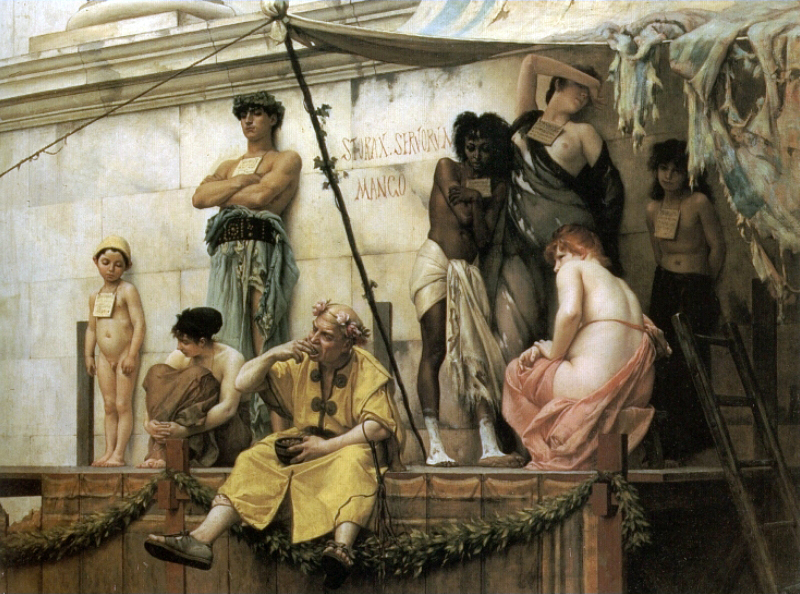
"... There are some people, some of whom are naturally free, others naturally slaves, for whom slavery is both just and beneficial." (Pol I.5 1225a 2-4)"
To the careless reader, this might be enough to stop reading and move on to a task which requires significantly less intellectual digestion. However, can this really be true? I do not hold individuals' opinions in high honor unless I have heard all of it and find all of it honorable. This pricks that nagging, hopelessly modern part of my conscience that is the mark of everyone born in this age of history. But it's so aggressively bold that given how high I have admired Aristotle's intellect up to this point, I am willing to give him a fair shot.

Aristotle's understanding of "slave" is not at all the same as that which we typically hold when reflecting on our nation's history. True, he is most likely referring to slaves taken in the conquest of one nation over another, but the imagery of Uncle Tom's Cabin is a modern intellectual prejudice exclusive to human thought in the last few centuries.

Aristotle uses the term "natural slaves" to denote that these men (or women) are made slaves by nature. So in this sense, he is not strictly referring to those slaves won as spoils of military conquest. Instead, these human beings had it in their nature to be slaves from birth. As a biologist by study, Aristotle gravitates towards assigning the distinction of "by nature" to his observances. However, he does have proof to back this up. He asserts that, "Nature tends... to make the bodies of slaves and free people different," specifically, a slaves body is physically superior to that of a free person's. (Pol I.6 1254b 26) Harkening back to his argument about function, it is plain to see that a strong body is best suited for tasks that are physically strenuous. 

Also, though I do not fully agree with the sweeping generalization of this next statement, he also points out that the natural slave "shares in reason to the extent of understanding it, but not have it himself." (Pol I.6 1254b 22-23) This statement makes it clear (and if it doesn't, he makes it more obvious later in the work) that according to Aristotle, natural slaves do not possess reason at all. However, to avoid getting into an entirely tangential argument on what Aristotle is actually saying, I think we can sufficiently agree that the people that tend to end up at the bottom of the pile are those less capable of intellectually robust activity than those above them. So I think it is fair to say that though Aristotle's statement above might not ring entirely true; there's enough to it that I can believe it to an extent.

This startling claim gathers more credence when you think about the vast majority of the people in the world that are not seriously capable of thinking for themselves. The phrase of "following the herd", an aimless hive-mind, describes this phenomenon perfectly. Following what everyone else is doing is the norm for these individuals. On a small scale, these individuals might have their checkbook balanced and their schedules planned, but if you survey their global quality of life, especially in terms of ethics, these people lack the intellectual robustness to comprehend their life's meaning on their own. 

At this point, my conclusion is that Aristotle was definitely on to something when he defines the natural slave. Though I might not agree with every characteristic that he associates with them, I do accept that there are persons capable of understanding human reason, though incapable of vigorously applying it themselves.

But to return to the initial claim, Aristotle's view that slavery could ever be both "just and beneficial" is still very difficult to swallow, despite the natural slave only being fit for physical labor (as shown above). Though without any guidance to his labors, he would be useless and unproductive. For it to be just, it would have to be in accordance with the virtue of justice and fittingness; and for it to be beneficial, it would need to be in the individual's best interest to be ruled by another man.

If a natural slave were to be ruled by another man, then who more beneficial to his interests than the virtuous, or eudaimon, man? Given the master's virtue, he would be of a superlative intellect, as contemplative wisdom, along with action-based practical wisdom, are the crowning achievement of the virtuous man and the most visible marks of his intellectual prowess.

Furthermore, without the capacity for agile rational activity, natural slaves are incapable of full human virtue, according to Aristotle; however, in the company of a virtuous master, the natural slave could share in his master's intellectual wisdom and share in living a virtuous life. Aristotle is very scrupulous when it comes to assigning the term, "virtuous". Both excellent acts and thoughts are require for the virtuous man, and on those grounds, the natural slave is disqualified from the title unfortunately. While I agree with this on the grounds that to achieve the highest status of any human being, you must perform your function the best, I believe there is a similar value and virtue associated with knowing your intellectual betters and modeling your conduct and contemplation after theirs.

And it is here that I think we have come across the most helpful and universally practical nugget in this lonely corner of Aristotle's political theory. Modern thinkers would never have discovered it because modern thinkers wouldn't have made it past the first paragraph. But we have. To some degree, we are all natural slaves; there is something deficient in our human understanding and it's something we can always work on. We need to make our understandings subservient to virtuous men; we must sit at the feet of the intellectual masters and allow ourselves to be guided by their practical and contemplative wisdom. In modern terms, it is comparable to discovering our role models and fashioning our thoughts and behavior from theirs.

To conclude, when considering Aristotle's political and ethical theory in its entirety, I believe he presents the most mature and responsible blueprint for a society that permits servitude. His biological (natural) perspective may overstep its bounds in some respects to a comprehensive understanding of the nature of all human beings, but in the end, he holds the masters of other men to high standards of conduct and responsibility in governing those under their charge. And in applying Aristotle's theory of natural slavery broadly with a little humility, we discover that we could all allow ourselves to cease our intellectual rebellions and naturally "enslave" our minds and hearts to men and women of high and admirable virtue.
Saturday, November 2, 2013

The Highest Human Science: VI. Aristotle

This is a post from the series, "The Highest Human Science". Click here for a complete list of all posts in the series.

It has been quite some time since I last posted to this series, but I have returned to it, drawn by the most important (and my favorite) chapter of it all. Thus far, we have seen Man's attempts at making sense of the confounding world in which he lives. These studies led him to ask the questions around the material and immaterial compositions of things, the purpose of reason, and the search for truth.

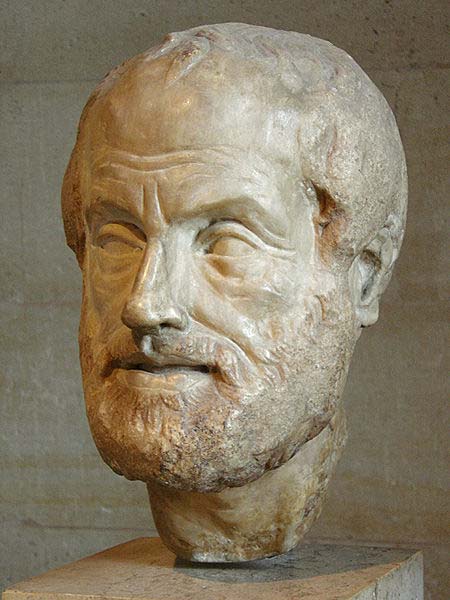
Poised and prepared to give the course of human wisdom one last mighty turn, Aristotle, a resident alien of Athens and a student of Plato, accepted the challenge of traversing the intellectual mountain that even his masters before him were unable to navigate, error-free. He took all of the good conclusions and thoughts from the teaching of Socrates, Plato, and the other noteworthy philosophers and purified them of their errors, solidifying a reality for the human intellect to comprehend. With each piece in it's proper place, he would create the true philosophy, one which if all basic principles were properly understood, would be the most excellent starting point for mankind's intellect.

A biologist by study, Aristotle's teachings and writings appeal to the practical mind and those for whom primary understand comes from their senses and experience. He did not abstract often, and applied his reason to his experiences and using fundamental philosophical principles, explained the natural world around him. In that sense, his philosophy remains perfectly balanced between the appeal to the sense and the consideration of immaterial, unchanging philosophical principles.

It is very difficult to know where to start with Aristotle, since his worldview is so tightly knit and coherent that various branches of the main shoot will often return and be interwoven with other topics of his study. 

Probably the best place to begin would be the fundamental basis on which his principles differed from Plato, his instructor. Plato's theory of substance and form had them separate: matter existed here on earth, imperfect and perceivable to the senses, while the form of a thing resided in the heavens and is the goal of our contemplation. Aristotle's view, on the contrary, places the form and matter of a thing in same entity. This dispelled the thought that the world around us was only a deception of reality and instead, established that the world around us was indeed reality.

To aid in our understanding of this, we will consider the example from the previous post of a glass of wine. It's true that in attempting to determine the essence of wine, we will arrive at an understanding of the form. But instead of each glass of wine suggesting to our intellects that there is some perfectly Wine form in heaven (according to Plato), our reason perceives a "trend" in individual physical manifestations of one idea. Therefore, a glass of wine doesn't help us to know what the perfect heavenly form is (suggested by Plato), it helps us to determine what the glass of wine itself actually is. The "matter" of wine (sugars, proteins, alcohol, etc.) all could take any other form, but the fact that the matter takes the "form" of wine is something present abstractly, though tangibly in the organization of these material ingredients to present to our senses "wine", in both form and matter (as opposed to "bread" or "wood").

In categorizing the substance and accident of a thing, Aristotle identified the two of his four "causes": the formal cause and the material cause. All together, the four causes answer the questions of "why" a thing is the way it is. The third cause is the efficient cause, which is the motivator of change within the thing. For example, the combination of nutrition in a child and the natural tendencies of his body is the efficient cause of his growth. The fourth and final cause is just that: the final cause. It is that which is the end or natural destination of the thing; it is that for the sake of which the being exists.

With this notion, Aristotle's metaphysics laid the groundwork and justification for his ethics; since the ideas we have in our heads come from our senses, it is our job to form the correct ideas from what our senses present to us. Although our understanding may err, our senses, if they be not defective, never lie. Having established that the physical world around us is a reliable source of information, Aristotle proceeds to answer the question of what man "must do" by demonstrating the "good" of man. It is towards the pursuit of this good that all of man's actions should be directed, and this good is virtue. I won't go into too much detail on this here, but you can find a more detailed study of this on one of my previous posts, "The Human Good".

In determining the good of one man, Aristotle deals with the good of all men in his Politics. His method stems from beginning with those foundations of politics that do not stem from "deliberate choice", namely that between husband and wife or master and slave. Neither can subsist without the other and so this is a necessary community. From this, Aristotle expands to a household, which includes children and servants, then to a series of households to form a village or colony.

The point of self-sufficiency is where Aristotle draws the line of what was known in ancient Greece as the polis or "city-state". The city-state comes into existence for the sake of existence and is the necessary end of the primal relationships between man and woman, master and slave. In this way, Aristotle claims that the polis is a natural organization, which makes man, by nature, a political animal.

Though I have only barely scratched the surface of the breadth of Aristotle's intellectual genius, I hope the reader has retained at least a preliminary impression of Aristotle's contribution to the study of human reason and wisdom. It seemed difficult to even hope that the human race would be so graced with the blessing of just one such intellectually masterful man; however, with the teachings of Jesus Christ (approximately 300 years after Aristotle) and the addition of this divine perspective, the study of human reason would need some finishing touches before all was said and done...

Saturday, November 3, 2012

Political Philosophy Pt. 3 "The City-State"

Part 3 in a three-part series.

In my previous poli-philo post, I specified that because each human being is capable of a measure of rational activity, they should participate in the political process of an ideal nation. However, a citizen's participation can easily be nullified by a badly established structure of governance. Sure, we claim to strive for a democracy, but is that what the political establishment facilitating?

Aristotle, in his Politics, describes his political establishment in terms of the polis, or rather, "city-state". The polis is comprised of a "downtown" area and the surrounding countryside. The size of the polis is large enough that the people that live in it are self-sufficient, but small enough that every citizen has a reasonable opportunity to know every other citizen. They are capable of feeding, housing, blacksmithing, clothing, and other necessities. They also may have some finer crafts and arts that they could use to trade with other poleis. Each polis would be governed independently from the other poleis, in accordance with that particular peoples' traditions and culture.

Currently, this is not how our political system in the United States appears to work today. The Founding Fathers granted all rights to the States, while giving the federal government only the power to regulate interstate commerce, provide for the national defense, and handle foreign policy. However, even today, that right is stretched to the limits in nationwide decrees on divorce, abortion, business, and in the most recent debate, healthcare. These are all decisions and laws handed down by the federal government and they apply to all states. As a result, most of the power in today's legal and judicial system is wielded by the federal government.

A possible advantage of having a strong central government is that it would make standardization laws among states easier. There is a universality among the states and their governance comes down to a singularity, the federal government. All decisions are made from D.C. and wherever you go, the laws will be uniform.

However, this returns us to my first blog post on the topic of political philosophy, concerning the viability of the philosopher-king. A singularity of power is not what a nation should be governed upon, especially in the vastly dissonant moral atmosphere of modernity. The moral health and character of this singularity will affect the governed body as a whole. If the leadership is sick, then the whole nation is sick.

In more recent times, our democracy has appeared more as an aristocracy (the term "career politicians" springs to mind). As the size of the federal government increases, the power of the federal legislature (the House of Representatives and the Senate) grows in terms of making federal laws. Political parties have been narrowed down to two groups, Republican and Democrat, and in order to receive any support from your party to win elected office, you must buy into the party's platform. Also, within the judicial system, the term "legislating from the bench" has become a popular phrase in light of many Supreme Court justices handing down decisions that essentially write laws for the whole nation.

But in recent years with the deadlock between entirely contrasting viewpoints, the President has gained legislative power. Nothing is accomplished in Congress's stalemate, so the President passes laws and declares wars without congressional approval. With the legislative branch rendered impotent, our political establishment appears more as a monarchy (or tyranny). Once more, the singularity narrows from the aristocracy (rule of the few) into an monarchy (rule of the one).

This is indeed troubling and worthy of much alarm, especially when 535 members of Congress legislate for over 311 million citizens and even worse when the President gets involved in the legislation process without Congress. So what is the solution?

The answer is to return power to smaller governing entities. Each area is aware of their governing needs, based upon their real-world experience in that area. Being at the "ground level" of a particular territory, whether it be the state or city level, will always be a more advantageous position to gauge the particular challenges of a population than a singular position in Washington DC.

In addition, the elected officials that wield the most power will be those that are of the same background and culture of the population. And a political system that establishes personal acquaintance and knowledge of the elected official is always to be encouraged in order that a citizen might be more informed when selecting those for governing duty.

In essence, this returns our nation from the folly of national political parties and encourages local groups with real concerns for their own community. Aristotle used the polis as a model for governance because it would prove large enough for self-sufficiency, the minimum for a decent living, but also small enough that it might not be encumbered by such extreme vanities and legislative singularities that currently plague our modern nation. Such global governing institutions cannot effectively and properly rule such a vast population. As a result, injustices occur and government is rendered incapable of completing the task it was designed to do: create and enforce laws, designed for the good of the people.

Friday, November 2, 2012

Political Philosophy Pt. 2 "The Social Order"

Part 2 in a three-part series.


Sponsored by Aristotle For Philosopher-King
In the previous post, it was established that the "philosopher-king" was an impractical scenario because in order for it to work, the ruler must be virtuous (lest the monarchy falls into tyranny) and there must be an impartial system in place for choosing his successor (elections and primogeniture have historically proven to be unreliable). And because a proper aristocracy (rule by the few) would be more difficult to establish (not only do you have to find one virtuous man, but you have to find several), it is to democracy we place our hopes.

In establishing democracy, it is necessary to determine who would be considered citizens, allowed to participate in the political process. Aristotle claimed that natural slaves/manual laborers and women were not to participate in the political process because natural slaves/manual laborers did not possess the ability for rational activity and women's rational activity held no authority over their emotional nature. Though I disagree with the end result of Aristotle's argument here, I believe he is only trying to make the best conclusions of what evidence he had.

Those who reject Aristotle's political system more than likely first point out that he believes that some individuals should, by their very nature, be enslaved. Oh horrid ideology! I, on the other hand, believe there is an alternate reading to this and it fits very well into his philosophy. Fact: there are alot of people out in the world who are well-endowed with physical strength but are not very intelligent. Asking the Aristotelian question, "what is the function of these persons?" can give us a decent idea of why Aristotle thinks these individuals should stick to manual labor and not participate in politics: because they're equipped for it and not very good at rational activity. So are there any modern day natural "slaves"? On the blue-collar side, farmers, factory workers, manufacturers, construction workers, etc. On the white-collar-side, interns, IT help desk, call center, etc. (note: these are simply generalities based on general observation; they are by no means scientific laws) These people are not performing jobs that require them to be physically strong, but they may not have the natural rational ability to rise any higher than work at this skill level. All "natural slaves" must be capable of some measure of rational activity because they take direction from their superiors and exhibit understanding of their respective roles.

So are there "natural slaves" that are better with menial tasks and not capable of high amounts of rational activity? Yes. But should these people vote and participate in the political process? If you say, "yes, of course!", ask yourself how many times you've seen people you've considered idiots or morons on the street and thought to yourself "Wow... and that guy's vote counts as much as mine." I have thought this many times myself, but in the end, I believe that "natural slaves" has a right and an obligation to participate in choosing its future because they are capable, by their nature, of rational activity.

As for women, Aristotle made a natural distinction between men and women that was a bit strong. As I've described in another post, there certainly is a distinction between how men and women express themselves: men in logical terms and women in emotional terms. Both are completely human, both can be valid, and both are prone to fault. Aristotle claims that women's reason has no authority over her emotions, but I think that a more accurate, albeit nuanced, representation of his observations is that the persuasive terminology of women is to appeal to emotional relationships. This can be a valid (though not strictly logically valid) form of argumentation because everyone has feelings. Though I don't think that appeals to emotion belong much in political governance, to say that reason has no authority in a woman is very harsh and not a true representation of the factual evidence.

Therefore, should women participate in the political process? Absolutely, because they are capable of rational activity and are free members of society that should have a say in deciding its future.

What's my point here? Hasn't modern thought solved all these problems already? Every citizen gets to vote, including women and uneducated workers. So what's the big deal?

I guess I am trying to rescue Aristotle's political philosophy from being completely disregarded in political discussion. There's a bad habit in modern thought that finds one thing wrong with ancient/medieval philosophy and then decides that it should all be tossed out. (another example is when Descartes threw out Aristotle's physics, including the notion of telos, or "final cause", only because it was not mathematical in basis; therefore, it was considered wrong and useless) That is not honest thought and a discussion misses alot of important ideas without the ancient/medieval approaches.

Wednesday, October 31, 2012

Political Philosophy Pt. 1 "The Philosopher-King"

Part 1 in a three-part series.


In Book VI of his seminal work, The Republic, Plato writes about the need for philosophers to fill the Guardian role in his utopian society. They will be fit to rule over the rest of the polis because of their wisdom and knowledge obtained in their study of philosophy. His student, Aristotle, wrote in his Politics that only those capable of rational activity should be allowed to participate in the state's politics. Despite modern philosophy's general aversion to confronting the arguments of these two ancient geniuses, there is much to be understood and gained if only we were to follow the reasoning of these honest thinkers. Sure, they made some errors, but I am confident that although I have never met these two in person, they attested to what they observed and described their thoughts without prejudice.

And so begins my first post on political philosophy. It has been a long time in coming, but with the impending election, everyone will more than likely be burned out from all the political talk after the election results come out and no one will be interested in reading this post. (so really, this is a chance that only comes once in 4 years)

First, my political views do not endorse any political party or candidate. Parties typically represent ideologies, which tend to be dangerous, and if a party offers a strict creed of political policies and not some kind of rich, dark beer (like a proper party should), than I'm ultimately not interested. That is not to say that I do not find myself aligning with one party or another; however, that only occurs because a choice must be made if anything resembling my idea of an ideal political atmosphere is to exist.

Second, the persons that have influenced my political philosophy include Plato, Aristotle, Alisdair MacIntyre, and G.K. Chesterton. Please note that none of these men are or ever were politicians. They are philosophers of one sort or another and have applied themselves to determining the goals of political activity, something that is nonexistent in today's political discourse.

In contrast, I will be the first to admit that philosophy, alone, is useless (numerous potential employers looking dubiously at my academic credentials have confirmed this). It is a guide in all areas of study and aides the thinker to understand the principles behind the other sciences. So it would not be helpful in today's political discourse to write about a "dream society" where each detail was figured out and everything was engineered for peace.

Every society in history has been faulty, some more than others. From small fishing towns to vast empires, each society has one thing in common: they are comprised of human beings. For millennia, each society has been created by human beings and comprised of human beings. I claim that the problem with creating a perfect society is man himself. There is something about human nature that consistently thwarts the establishment of a lasting, good society. Therefore, as long as a civilization is made up of human beings, it will have its faults.

However, my philosophical outlook on politics is not all that bleak. There are definitely some sound insights to be applied to a forming society.

I agree with Aristotle that the best form of government is a monarchy, and I agree with Plato that the ruler of a society should be a "philosopher-king". A monarch represents a singularity of rule and law. He discerns the good and commands his subjects towards that good. His subjects are accountable to him, just as he is accountable to God.

Most of you, I'm sure, are playing out the scenario of your college intro-philosophy professors being elected president, cringing at the thought. Fear not, I suggest no such thing. A true philosopher performs both contemplation in addition to cultivating practical wisdom. A philosopher-king is not just a philosopher (*SPOILER ALERT*: he's also a king). Devoting all one's time to either philosophy or governance makes for a poor ruler. Rather, seamless incorporation of the two is both possible and necessary for the philosopher-king because one rational activity forms the other.

Now that I've put the idea of the philosopher-king out there, I'm going to admit that it cannot be done for several reasons. First, the line between monarchy and tyranny (according to Aristotle, the best and worst forms of government respectively) is very thin, and anyone less than a virtuous man will abuse his power or be rendered impotent. Also, the means of selecting a successor would be very difficult because democratic elections would be fraught with self-interested politics and primogeniture doesn't always work properly.

The interesting thing about a monarchy would be that everything comes down to a single link, as far as decision-making is concerned. This is either very good or very bad for the society, heavily dependent on the moral stuff of the ruler. If an aristocracy (rule of the few) was installed where there were several people ruling a nation, the vices of one individual might be lessened by the virtues of the others. However, the fate of the nation still rests in the hands of a few people, and in the currently aimless moral climate of modernity, a true sense of honor and honesty in an individual is hard to come by. Therefore, we must not allow ourselves to be ruled by one or a few and aim for democracy (rule of the people), endeavoring not to fall into ochlocracy (rule of the majority).