Showing posts with label faith. Show all posts

Monday, May 6, 2013

Great Deeds and Noble Hearts: A Musical Revolution

Remember those stories that had you fill in key words or phrases to create a totally random and hilarious story? It'd typically go something like, "This morning, I woke up to the sound of a     (noun)     while I was dreaming about     (an activity you hate doing)    ..." You would ask a friend to give the your necessary words or phrases without telling him or her the context of the words. When you were finished, you'd read the short story from beginning to end and have a good laugh over it.

I bring this up because I was thinking about what kinds of answers would fill in the blanks if modern popular music provided the answers. Probably something like this:

I was awoken this morning by    tik tok, on the clock, but the party don't stop no   , after a long night of    livin' a Teenage Dream   . I put on my    ripped jeans, skin was showin'    before going downstairs to have some breakfast. Next thing I know, I'm    gonna pop some tags, only got twenty dollars in my pocket   , but before I do, my mom says to me, "   HEYYYY, SEXY LADY!!!!   ".

Ok, maybe this is a silly exercise, so are these lyrics. Although the truth is that you could do this to Shakespeare and he'd look pretty comical, the point is that these are the things were hear from popular music and have been for a very long time.

PSY performing "Gangnam Style"

However, I am sensing a shift in the preferences of a growing portion of today's music lovers, and it's exactly because the younger generations are realizing that life isn't about the instant gratification anymore. They've been there, they've done that for long enough and they're finally over its glamor. So how is this reflected in musical tastes?

Whatever is "popular" appeals to a baser part of our souls. People choose what is "popular" not because it enriches them; rather one chooses what is popular because it is in keeping with the status quo. Since "everyone is doing it", no one is going to criticize or attack your for doing it yourself.

Sometimes, though, this conception of "popular" wavers and falters under the underestimated strength of the human heart. Sometimes, a truthful light shines through and those who are open to it gather around it. I believe that some interesting trends in contemporary can be seen in this way: as encouraging and cultivating inspirations of what we all truly long for in the deepest desires of our hearts.

Someone Like You by Adele on Grooveshark
The first expression of such a longing is in hurt. Artists such as Grace Potter and the Nocturnals and ADELE come to mind here. The primary subject matter of their songs center around themes of sadness, hurt, and loneliness. Broken and shattered amidst the heartbreak in the world, this music expresses confusion and laments, "I often think about where I went wrong, the more I do, the less I know." ("Don't You Remember" - ADELE, click here for full lyrics) Living the disillusioned life has indeed brought about this pain because the indulgence in what is "popular" has promised the maximum pleasure, but only delivers the deepest, cutting pain. This hurt is always present in the shame at who we have become and what we have sacrificed, "'Cause every town's got a mirror and every mirror still shows me, that I am my own ragged company." ("Ragged Company" - Grace Potter and the Nocturnals, click here for full lyrics)


Ragged Company by Grace Potter and the Nocturnals on GroovesharkThese artists and others have become "popular" because they speak for the hurt and shame that we all have. Their appeal is in their lamenting that we can all identify with. Though it would be a mistake to believe that one day, this is all the world will listen to, this is what a large number of people are gravitating towards because 'misery loves company', and these artists make explicit what lives implicitly in all of our broken souls.


Sigh No More by Mumford & Sons on Grooveshark
Acknowledgement of one's misery is the first necessary step, but even more imperative is the discover of our innate desire for the good and the willful resolution to obtain it. Florence + the Machine and Mumford & Sons rank among the most popular influences on this genre which encourages people to be "more like the man you were made to be." ("Sigh No More" - Mumford & Sons, click here for full lyrics) It's true, these songs are about pain and hurt, but their defining characteristic is not in complaining to the world about endless woes. Courage is necessary to carry on after being let-down, the ability to pick up the pieces and find peace in carrying on. This kind of music has gained significant popularity because the listener it attracts is "done with [her] graceless heart, so tonight [she's] gonna cut it out and then restart." ("Shake It Out" - Florence + the Machine, click here for full lyrics)

Though we must not fool ourselves into thinking that because a few artists are gaining some traction in popular culture, the whole world will suddenly embrace this truth and desire for the full meaning of our lives, but what I think it does mean is that there is a growing number of people out there who are realizing that their lives have purpose and they are called to acts of heroism and virtue.

A calling to deny those passions that come so easily to us and ascend to lives of greatness and meaning is the heart's true desire. "Party rocking" and living "gangnam style" feed the body, but they leave the soul starving for sustenance. Pop culture is popular and will remain so, as long as it feeds our vices and encourages our lukewarmness. But life's true adventure is proving to ourselves, even when no one is watching, that we were made for great deeds and noble hearts.

Sunday, February 10, 2013

The Dangers of God's Grace

Since middle-school, I had been very fond of swimming, particularly racing. I prided myself on being the fastest free-style and backstroke swimmer on the team, and winning first place in races was a common occurrence. One meet, however, the coaches had signed me up for my usual free-style and backstroke events, but also on my list of race events was the butterfly stroke race. This was a problem: I had never swam butterfly.

Sure, we had done some practice with it, but I never possessed the proper coordination to make it more than a few meters before I was doggie-paddling. I approached the starting blocks, shaken with fear of not only losing the race, but possibly not even finishing. Silently, I prayed to God that I should at least finish the race, let alone not drown in my attempt.

I not only finished, but I earned first place. It's difficult to convince anyone that the occurrence of this result was a miracle, but to me, it's profoundly clear that it was. Whatever grace I received was accompanied by the unsettling fear of failure before and a consequently very sore and worn-out body afterwards. In this instance, God's grace had been a painful experience.

"The Calling of the Apostles Peter and Andrew"
by Duccio di Buoninsegna
Today's gospel provides Luke's account of the first meeting between Christ and Peter. A few weeks ago, I published a post on the struggle with habitual sin and proper contrition for them, and I cited the example of Peter's initial encounter with Christ in the gospel of Luke. They meet on the shores of the Sea of Galilee and Christ instructs Peter to cast out to open water and lower his nets. Peter, having caught nothing at night, remained doubtful with the success of this course of action, but he acquiesced anyway. Once the nets had been lowered, the catch of fish was so great that their nets began to tear and even with the help of a second boat, they were both in danger of sinking.

First, receiving God's grace only takes a simple "yes". Peter's dubious "yes" led to an incredible catch of fish. Mary's simple, yet perfect "yes" opened her to the conception of the very Son of God. On the mountain, the young boy's "yes" to providing the few loaves and the fishes he possessed led to the feeding of five thousand people with some to spare. Our gifts may be small, but in cooperation with God, miracles become possible. Most people have heard of this aspect of God's grace (or have experienced it for themselves). It is definitely a wonderful blessing to realize this and acknowledge it in our lives.

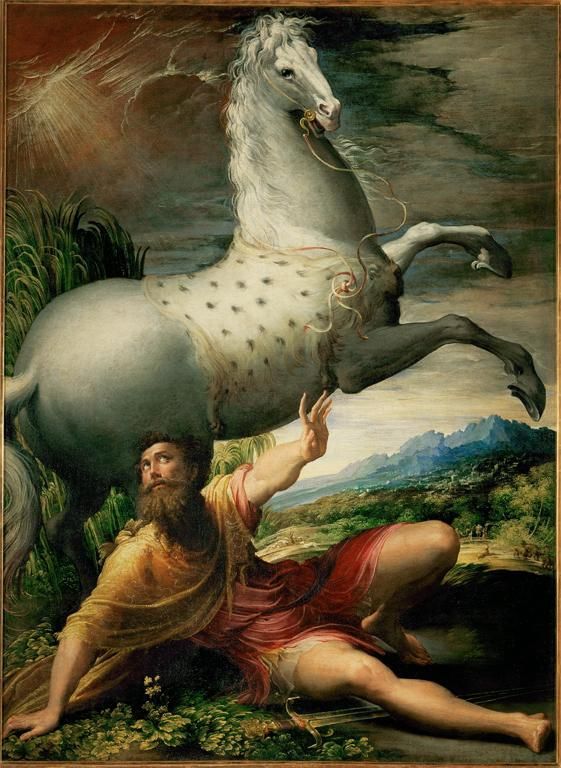
However, what you don't hear is that sometimes, God's grace may nearly kill us with its intensity. In the today's second reading, Paul refers to his conversion story of being cast off his horse simply at the sound of Christ's voice, and in the Gospel, Peter and his fellow fishermen nearly drowned as a result of an incredible catch of fish. In both circumstances, God's grace manifested itself in violent, threatening ways. These accounts challenge a common notion that God's grace is always quiet or subtle because sometimes, the furious power of God's grace comes to us in these "life(style)-threatening" situations.

Focusing on the Gospel account, the fishermen's nets were tearing, the boat was capsizing, and the human help of the second boat could not even alleviate the sheer enormity of God's grace. Similarly when we encounter His grace, the nets of our vices will be torn through and our lives, it seems, will be in danger of sinking and drowning. The manner in which we have allowed ourselves to just "float" through life will be shaken to such a degree that in order to be set right, we will be confronted with the reality of that very real danger of death to our lifestyles, If we're open to it, God's dangerous graces will "kill us", but our death will be a "death to self" and our rebirth will be in His divine love. Our sins and depravities will be put to death and all that will remain is our charity. 

"The Conversion of St. Paul" by Francesco Mazzola
So why is God's grace sometimes so violent in this fashion? Grace must necessarily purify us. In today's first reading, Isaiah had a hot coal placed on his mouth. In the second reading, St. Paul was cast from his horse and blinded. In the Gospel, Peter's physical strength fails him and even with the help of his companions, he is filled with fear of a drowning death. Each of these men were flawed and each received the cleansing gift of God's grace. However, just as Purgatory prepares us to see God face to face by a painful purification, God's grace to these sinful men is so great that in their fallen nature, they perceive it to be painful. To eyes that have never seen the sunlight, even the slightest ray of sunshine is blindingly painful, but once the eyes become accustomed to the goodness of the illumination around them, they rejoice at that purifying grace which was once excruciating.

How often do we allow ourselves to experience this fearful level of grace in our lives? Do we shirk away from it for fear of braving the danger to our lifestyles? There is a significant amount of dying-to-oneself that we all need to do in our lives, and if we avoid this death, we will always be devoid of God's greatest graces and blessings. But if we are open to that painfully purifying grace in our daily lives, we are given a blessed opportunity to suffer with the Suffering Servant, the Crucified Christ.

Monday, February 4, 2013

Schedule Killed the Action/Adventure Star

I use Google Calendar every day. It's incredibly handy and helpful, and all my appointments and events are on there. With alerts, I can be reminded of events that I might otherwise forget. I have separate calendars for my different kinds of events (birthdays, fitness training, etc.) The plethora of different views allows me to see my schedule in any way I might (or might never) want.

I hate Google Calendar. And any kind of calendar/schedule-maker that is easy to use. If it's easy to use, people will use it, and with calendars and schedule-makers, that just won't do.

The Face of Boredom
When you have a schedule, you subtly believe you know what is going to happen during your day. You set the events of your day and you move from one appointment to the next, one task to the next, and one pre-planned moment to the next. It's true that society could hardly function without schedules, but it's just a cultural symptom of our obsession with productivity and efficiency.

This is bad for two reasons: First, because your day is "planned", nothing new or exciting can happen. You know the sequence of events (in fact, you have determined most of them). You become the ultimate master of your own destiny and therefore, there are no surprises.

Second reason: how mind-numbingly boring is that? The chief problem afflicting our culture today is not poverty, hunger, or filthy interstate rest stops... it's boredom. When we use a schedule to line up every minute detail of their days, weeks, years, and lives, we perpetuate this heinous evil and rob ourselves of engaging stimulation.

Maybe each day feels the same because they ARE the same.
"Well, what if there is no tomorrow? There wasn't one today."
For most people with schedules, each day feels exactly the same. It's like you know what's going to happen tomorrow. In corporate America, a select few people have truly exciting jobs, but for the rest of us, it can be a drudge. If you're expecting  the same unexciting day as yesterday, what are you looking forward to? Tomorrow will come and go, and you might ask yourself why do you really care?

Maybe we like schedules to feel in control of our lives. In an effort to be certain of as many things as possible, we plan our lives as a sequence of calender events and appointment invites. It's like giving someone a wrapped gift that you picked out. They may have no idea what's inside, but you do. For that reason, there is no surprise for you. Imagine always giving people wrapped gifts and never receiving one yourself.

What is this ultimately taking a toll on? Reliance on schedules negatively affects our ability to be spontaneous and adventurous that romantically invaluable skill. Imagination is the heart and soul of spontaneity. A common error is to believe that one must be erratic or impulsive to be spontaneous. However, it is imagination that gives the human soul the agility to be spontaneous. But there are few things that kill imagination, and consequently spontaneity, more than pre-planning your life and relying on rigid structures. Consequently, we become slaves to our schedules, both self-imposed and imposed from the outside.

Spontaneity also has a profound influence on one's courage. When an unexpected opportunity or challenge arrives, our ability to rise to it will be diminished, just because it does not fit into whatever we expected. Life is meant for action, and courage is what enables us to take appropriate action in any circumstance. Without courage, we miss out on life's rewards. Life is not always pre-canned or predetermined, and the most critical moments in life are usually those ones that are not planned or expected. Most of us don't need to chase after tanks on horseback or stop an alien invasion or escape from an island of genetically-engineer dinosaurs to satisfy our spirit of adventure and test our courage (if you do, you might be a fictional character), but that courage and adventurousness needs to be reclaimed.

Seize the moment. Push yourself to heroics. Do not settle for blindly following the established order, and do not be afraid to throw the schedule out and blaze your own trail!

I'll bet Indiana Jones didn't schedule this... and he turned out just fine.

Sunday, January 20, 2013

“Smells ‘n Bells” VS “Drums ‘n Chums”


As a Roman Catholic, I have been to many Masses in my lifetime. The majority have been your typical, run-of-the-mill parish Sunday Masses or your quick daily Masses, but I’ve also been to youth Masses, Novus Ordo Latin Masses, Tridentine (Pre-Vatican II) Latin Masses, and even Masses involving people collapsing into tears and wailing after receiving Communion.

That being said, I would like to discuss what I perceive to be two different “styles” of the Holy Mass. The first is one I’ve referred to here as “smells ‘n bells” (which alludes to the frequent use of incense and the bells that are rung at the moment of the Consecration), which one might consider to be orthodox. A Latin Mass is a perfect example of a “smells ‘n bells” Mass, but many vernacular Masses will also neatly fall into this category. Each piece of music is referred to as a “hymn” and the primary instrument is the organ. With these details, I am assured that the reader has been to a Mass of this sort before, so I will not spend any more time on describing it. For brevity’s sake, I will hereafter refer to this as the solemn Mass.

Blessed Pope John Paul II at World Youth Day
Second, there is the style of Mass that I refer to as the “drums ‘n chums” Mass (which refers to the frequent use of rock drums sets and the emphasis on the community of those in attendance). The style is largely attributed to the influence of Blessed Pope John Paul II and his institution of World Youth Day. From what I know of its history, the youth Mass was a method to attract young people who had no firm foundation of faith to the sacrament of the Eucharist. Thus, its execution is less conservative and of a higher energy. Guitars and drums belt out songs that focus primarily on the greatness of God and worshiping him. I will define this and refer to this as the youth Mass.

Most of the time, the style in which Mass is celebrated is a blend of these two and most people have a preference for one style over another, but it is my perception that a large number of faithful Catholics have strongly critical opinions about one or the other. Of the solemn Mass style, people say that it is too boring which makes it difficult to pay attention. Another frequent complaint is that the priest’s homilies are too difficult to follow or contain content irrelevant to them. Of the youth Mass, common criticisms are that the Mass becomes more like a social hangout spot where kids go to see their friends instead of going to receive Christ. Also, the sign of peace lasts fifteen minutes and everyone is so "touchy-feely".

So which is better? The goal of faith is to increase in it. Ultimately, the more faith we place in Jesus Christ as our Lord and Savior, the better our lives will be and the better life after death will be. Anything that keeps us from increasing our faith must be discarded and a solution to this blockage should be discovered.

It is no mystery to any observant Catholic that generations of Catholics since the 1960’s have been without firm foundations for faith. John Paul II saw this crisis around the entire world, so he began World Youth Day to draw the youth of the world to Christ, and the concept of the youth Mass spun off of that. Had the Church said, “Well, we really can’t do anything for these people because that would involve adapting the Mass and our approach towards apostolate to a degree we’re not comfortable with,” that would have been an obstacle to the Church’s increase in faith, and an evil.

A youth Mass
The youth Mass has to attract young people, while staying true to its purpose. Why is the youth Mass emotionally appealing? For many people with emotional baggage, there are significant obstacles from their past lives that have to be overcome before a deep faith can be achieved. It is OK to be on fire with Christ’s love, after all. Why does the youth Mass seem to place an emphasis on relationship with one another in community? Many people are unaware of the unity of the Body of Christ, made up of the members of the Church. Society encourages individuality and rejects community, so it's very important that people realize that they are part of something bigger and more amazing than just them. Also, emphasizing healthy, virtuous relationships with one another is a step towards fostering a close, loving relationship with Christ.

However, many youth Mass attendees that I have known stop there. They get into a routine of going to youth Mass every Sunday and hearing the music and seeing their friends, but they do not look inward to discover if there is anything more that they’re missing. Truth is, they’re missing 2000 years of Church history and tradition. They could be missing doctrine and teaching on Mary, the lives and writings of the saints, and the other sacraments that are vital to a flourishing life of faith (just to name a few). They stay where they’re at because they are comfortable there and no one tells them otherwise. This is also an obstacle to the Church’s increase in faith, so it is also an evil.

Tridentine Mass
A return to the solemn Mass is the answer. The solemn Mass moves beyond the secularly appealing aspects of the youth Mass and focuses intently on deep theological truths of our faith. These truths are by no means those you would only find in a PhD theology program; rather, they are those deep aspects of Christ, His Mother Mary, and His Church that we are called to contemplate. The solemn Mass removes the guitars, drums, buddies, and girlfriends, and places the individual in a chapel with a monstrance containing the Blessed Sacrament, alone in mental prayer and Adoration. Ultimately, the Mass is meant to draw us to Christ and, in doing this, to one another; not the other way around. The Church allows for the secular noise to which we are accustomed with the hopes that in a desire to grow more deeply in faith, we will cast off the training wheels by doing things like spending Holy Hours with the Blessed Sacrament, reciting the Rosary, and going to silent retreats for contemplation.

The solemn Mass fulfills the purpose of the youth Mass. It is a channel through which we may pass in our relationship with Christ that speaks to us in terms that we are initially comfortable with. As our desire to more fully know Christ matures, we must also work to mature our faith and contemplate those deep mysteries of the Divine Love.

Graphic Credits:
catholicseeking.blogspot.com
becketyouth.org
traditioninaction.org
sttimothy.pipertechnology.com

Tuesday, January 8, 2013

The Philosophical Basics of the Resurrection

Courtesy of WikiPaintings.org

Probably of all my classes at Our Lady’s University, none had me more attentive than my course on St. Thomas Aquinas’ account of human nature, taught by Dr. John O’Callaghan. Unfortunately, this was my first formal exposure to the philosophy of St. Thomas, and as a 4000 level course, I do not think I got the most out of it. I had taken a course on Aristotle’s ethical theory the semester before, but though these two great minds were similar in worldview, Aristotle’s pagan terminology and approach was nowhere near a proper introduction to Thomas’ intellectually mammoth rational constructions.

Despite this, I did benefit from this study, and as I have only and always been interested in acquiring the truth and never in spouting off any philosopher’s theories word-for-word, this was not an insignificant benefit. One thing that really fascinated me during my study of Aquinas’ philosophy of human nature was in terms of the resurrection.

As is the relationship between theology and philosophy, divine revelation can invariably be confirmed by human reason. The saying, “philosophy is the handmaiden of theology” springs to mind. Basically, if our understanding were to be laid out on a line spectrum with things we know from human reason and things we know from divine revelation, each would generally lie on either side of the spectrum and there would be a gap in between. This gap represents our lack of full understanding of the higher bits of knowledge, specifically those things divinely revealed to us, creating what we call “mysteries”. Divine revelation gives us those truths that would otherwise be impossible to reach solely with our own reason, though these truths are coherent with our own human reason. Everything divinely revealed can be confirmed with the same human reason that we use to work a math problem or organize a closet or make a gourmet meal.


The resurrection of the body promised by Christ at his Second Coming is just one of those things that, with a little Thomistic ontology, is completely reasonable to believe, though the particulars certainly remain a mystery. First, it is important to remember that we are human beings (don’t forget that definition), and “human being” is defined as a living body animated by a rational, immortal soul. Therefore, it is accurate to say that when John dies, John (the unified human being) ceases to exist because his soul is separated from his body. However, John’s essence, his soul, is immortal and survives the body.

So our soul lives on, separated from our body which decays and fades away with time. At this point, do our souls just remain in Heaven? It is eternal beatitude, after all, so what more could we want or need? Why does Christ promise that our souls will be reunited with our bodies in the Resurrection? Is that really necessary after achieving eternal beatitude?

I certainly cannot say what is divinely necessary, but I can definitely say that it’s perfectly reasonable that I should be reunited with my body after I die. In the state after death, our human nature is divided: our soul is in Heaven and our decomposing body remains on earth. But since we were created as human beings (body and soul) and not as angels who are purely spiritual and incorporeal beings, it would seem a little odd that we should spend eternity in such a divided state, especially when our bodies are an intrinsic part of our own creation and being. (if they were not, why should we bother caring for them in this life?)

As an analogy to illustrate this, a free-floating balloon is caught by a child and tied down. The balloon’s natural destiny is to float away into the sky, but here, it is separated from that destination and tied to the ground. If the balloon was meant to remain close to earth, why was it filled with a lighter-than-air gas to begin with? Similarly, it is our natural destiny to be unified, soul and body. When we die, our soul is separated from our body and allowed to take root in Heaven. If this were the end of the story, then why did God create us with bodies in the first place? It seems perfectly natural to believe, then, that the destiny of our human nature is to be unified, body and soul, in eternal beatitude with God after the Resurrection.

So our use of human reason confirms the revelation of the Resurrection. I am not suggesting that while in Heaven after death, we will in some way miss our physical bodies or feel uncomfortable without them. This would suggest that eternal beatitude is deficient in some way. But as it has been revealed to the human race, Divine Justice promises to return us to our bodies at the end of time, and this is at the very least is something we can partially understand.

Saturday, January 5, 2013

Habitual Sins and Contrition

"The Miraculous Draught of Fishes" by Raphael
When one deals with a habitual sin, it can be difficult to arrive at proper contrition. True contrition necessitates that you reject the sin and resolve to never commit it again; however, because of our fallen nature, it is not unlikely that despite our best intentions, we will succumb to temptation and descend into that sin again. We acknowledge this in an attempt to be realistic about ourselves and the situation, but often it gives the effect of despair. The past is gloomy from those sins already committed, the present is dark because we are still committing the sin, and the future looms ominously because this is a habitual sin and the temptation, at least, will most certainly occur again.

What should our outlook be under these circumstances? It is possible the habitual sinner will equate the occurrence of the temptation with the occurrence of the sin itself, assuming the success of the devil’s efforts and an inevitable fall from a state of grace. In this sense, the sinner has already ‘given up’ trying to break the chain of sin formed by habit.

However, the past is only an indication of the trials we will face and not a determination of our future actions. We can certainly look to the past to ascertain the obstacles of the future and even learn from our past failures in terms of what aided us or hindered us from clearing those hurdles.  Though, it is not true that because we have stumbled over the same obstacle again and again, we are incapable of achieving breaks in the chain. It is definitely a slow process and success will be elusive at the beginning, but we must be careful to not assume the devil’s triumph, just because he tempts us.

Therefore, we return to the question of contrition: what should be the elements of our contrition, especially for the difficult case of habitual sins? Peter told Christ, “Depart from me, O Lord, for I am a sinful man.” (Luke 5:8) This certainly seems like despair at first glance, but Peter’s desire to be with Christ is so strong that at his invitation, he leaves everything to follow him. He was so eager to be with Jesus that despite his unworthiness, he was willing to give up all he owned to be with him.

So on the one hand, we must acknowledge our unworthiness; for the slightest sin, much less a habitual sin committed several times, without God’s mercy is enough to damn us to Hell forever. This acknowledgement must not, however, prohibit us from recognizing the profound, all-consuming desire we have for Christ. We may need to apologize seventy times seven times, but we must never cease to proclaim our love for him who loved us so much as to give his life for us. In our sorrow, we must beat our breasts lamenting, “mea culpa” then shout joyously, “Gloria in excelsis Deo!” for His Divine Mercy.

Tuesday, December 18, 2012

The Science of Santa Claus


As a high school junior in physics class, we were released from classes for Christmas break with a short scientific analysis of the plausibility of Santa Claus. I admit, slightly shamefully, I wish I had the personality to be able to come up with these because I really quite enjoy these sorts of reality checks. Alas, I did not come up with this one, but I repost it for your reading pleasure from another website, credited below:

No known species of reindeer can fly. BUT there are 300,000 species of living organisms yet to be classified, and while most of these are insects and germs, this does not COMPLETELY rule out flying reindeer which only Santa has ever seen.
There are 2 billion children (persons under 18) in the world. BUT since Santa doesn’t (appear) to handle Muslim, Hindu, Jewish and Buddhist children, that reduces the workload to 15% of the total — 378 million according to Population Reference Bureau. At an average (census) rate of 3.5 children per household, that is 91.9 million homes. One presumes there’s at least one good child in each.
Santa has 31 hours of Christmas to work with, thanks to the different time zones and the rotation of the earth, assuming he travels east to west (which seems logical). This works out to 822.6 visits per second. This is to say that for each Christian household with good children has 1/1000th of a second to park, hop out of the sleigh, jump down the chimney, fill the stockings, distribute the remaining presents under the tree, eat whatever snacks have been left, get back up the chimney, get back into the sleigh and move on to the next house. Assuming that each of these 91.8 million stops are evenly distributed around the earth (which, of course, we know to be false but for the purposes of our calculations we will accept), we are now talking about .78 miles per household, a total trip of 75½ million miles, not counting stops to do what most of us must do at least once every 31 hours, plus feeding and etc.
This means that Santa’s sleigh is moving at 650 miles per second, 3000 times the speed of sound. For purposes of comparison, the fastest manmade vehicle on earth, the Ulysses space probe, moves at a poky 27.4 miles per second — a conventional reindeer can run, tops, 15 miles per hour.
The payload on the sleigh adds another interesting element. Assuming that each child gets nothing more than a medium-sized Lego set (2 pounds), the sleigh is carrying 321,300 tons, not counting Santa, who is invariably described as overweight. On land, conventional reindeer can pull no more than 300 pounds. Even granting that "flying reindeer" (see point #1) could pull TEN times their normal amount, we cannot do the job with eight, or even nine. We need 214,200 reindeer. This increases the payload — not even counting the weight of the sleigh — to 353,430 tons. Again, for comparison — this is four times the weight of the Queen Elizabeth.
353,000 tons traveling at 650 miles per second creates enormous air resistance — this will heat the reindeer up in the same fashion as a spacecraft re-entering the earth’s atmosphere. The lead pair of reindeer with absorb 14.3 QUINTILLION joules of energy. Per second. Each. In short, they will burst into flame almost instantaneously, exposing the reindeer behind them, and create deafening sonic booms in their wake. The entire reindeer team will be vaporized within 4.26 thousandths of a second. Santa, meanwhile, will be subjected to centrifugal forces 17,500.06 times greater than gravity. A 250-pound Santa (which seems ludicrously slim) would be pinned to the back of his sleigh by 4,315,015 pounds of force.

 From http://www.chainreactionbicycles.com/santaclaus.htm 
My conclusion to all this: it's more plausible that God became man, remaining both fully God and fully man, and that a virgin conceived this child and gave birth to him, all throughout this process remaining a virgin, than Santa Claus existing.


Wednesday, December 12, 2012

Was, Is, and Ever Shall Be, Chapter 1


Finished with Morning Prayer, Cale shut the breviary and put it back in his pack. He had spent the night at the edge of a small pond and a light fog surrounded him in the early autumn morning. The sun had just risen over the edge of the plain, but it had not yet penetrated the thick copse of rusty trees that concealed the pond. Cale had chosen this spot to remain concealed.

Arising from the half-rotten stump that served as a stool, the young deacon grabbed his empty plastic water bottle and knelt by the edge of the pond. He scanned the area around the pond, from the edge of the water to the line of trees, and then submerged the bottle in the murky water to fill it. Clean water was difficult to find in the Wilderness. Ingesting bad water this far from any sort of medical aid would be fatal, making proper drinking water crucial. After filling the bottle nearly to the neck, Cale returned to his sack and extracted another small plastic bottle of commercial household bleach and a roll of duct tape. Just a drop of the bleach would purify water to proper drinking standards. Who would have thought bleach would have become so essential?

Screwing on the cap, Cale laced his worn boots and wrapped a sizeable length of the duct tape around the boot’s toe and sole, wrapping the two together. The left boot had long ago come apart at this spot and the right boot was not far behind. This finished, Cale donned his dirty-white cowboy hat, picked up his pack, and headed for the edge of the copse.

The copse was only a few trees thick, but it had fulfilled its purpose of hiding the light of his small evening campfire from others. Although this area was largely deserted, some farms were still inhabited, and the residents might not have taken kindly to squatters on their land. Cale, however, was only passing through, and in a few steps, he emerged from the tree line and beyond.

The sun was now well above the perfectly flat, barren landscape about him. Corn had once grown on these rich plains, but the land now lies fallow and untilled. It had been some years since man had nurtured this area. The rains fell and the still sun shone on this beautiful land, now overgrown with high grass and some smaller trees. The earth here had mostly forgotten man’s past husbandry, now a fading memory of its youth that becomes more difficult to recall with each passing year.

Still, the paved highway remained cutting across the untended lands. A scar down the length of the open landscape, this was the most difficult memory for the land to suppress. Great fissures had formed in the asphalt, from which courageous shoots of the high grass had arisen. The bright painted lines were now all by sun bleached and gone. The surface eroded, little by little with the passing rains and occasional flood waters, but a highway, it continued to be. It was empty of any vehicles though. Neither car nor truck had driven on this road for some time, and with the circumstances of the state government, repairs were out of the question.

It was this highway that was Cale’s practical guide. He only possessed a road map and a compass, as this area had not yet been mapped for travel by foot. The map was simple enough to read; simply follow the roads and you will reach your destination. This had always concerned Cale, however. He had grown fond of following natural dirt roads and paths, and the idea of leaving himself exposed on such an open, though deserted, landscape while following a government-made road was unsettling. Therefore, Cale located the road and walked alongside it, close enough to the high grass should the need for a hiding place arise. But no one would see him here.

Cale used the sun to get his bearings and ascertain his direction. Then, adjusting the pack on his shoulder and tipping his hat forward, he headed north, in the direction of the destitute city of Chicago.

Within an arms length of the high grass, the going was fairly easy for Cale.   The earthy sloped up to the level of the pavement of the highway, creating a shallow trough for the traveler to carry on in. He not only had the high grass close enough to use for cover, but anyone traveling on the highway would have difficult spotting him. The only thing visible was his lean torso, his broad, but skinny shoulders and his pack, the rest of him hidden behind the trench wall.

Cale stood taller than most men. However, men were not as tall now as they had been, so he had heard. It appears that the lack of organized nutrition made proper growth a difficult thing, and though he was counted among the tallest of the remaining population, he amply moved through doorways and buildings constructed by mankind in previous times.

His shoulders, though wide in build, were lean and a bit scrawny.  Cale’s body had suffered greatly  from the effects of starvation only two years previous, and he was still on the road to recovery. Thus, his naturally large frame was left covered with only sparse muscle tissue and even less body fat. However, despite his lean appearance, Cale possessed a dangerous, frantic strength that derived from his unbreakable will of iron.

His curly, dark brown hair crowned his face, accented by his forceful green eyes beneath thick eyebrows. His nose lacked both prominence and distinction, but his chin and jaw compensated imposingly with an impressively square characteristic. He was mostly clean shaven, the typical appearance for members of the clergy, and only a short stubble dotted that angular jaw line. This, he scratched at thoughtfully, as he peered over his shoulder to check the road behind him.

He had only one pair of boots which he tried to keep in the best condition possible. Once those wore out, his ability to travel would be greatly diminished, unless he opted to proceed barefoot. Certainly, this was a mortification he would gladly undertake for the salvation of souls.  However, it would slow his progress and, if carried on for too long, could result in some hapless injury, rendering him unable to walk at all.

On his back, he wore a short, black leather jacket, provided to him by the diocese. Scuffed and beaten in outward appearance, it kept the warmth in and the damp out well enough. Beneath it, he had on a brown, moth-eaten sweater that smelled musty, but was enough to supplement the jacket. His jeans were faded and well-worn, ragged at the hemming and devoid of much of their original color. The white hat he wore completed the picture of something akin to a modern day cowboy, full of swagger and adventurously dusty, but beneath this visage trudged a scrawny young man, struggling just to put one foot in front of the other.

Yet each step he took brought him closer to his assignment. The Diocese of Southern Illinois had sent him on a missionary trip to the long starving city of Chicago, in which the Church had no formal presence. Since the earliest affronts against her, the Church had found it increasingly difficult to maintain established dioceses in the cities. The state government, now only an extension of the national government, used legislation and taxes to bend the Church to its will by compromising her beliefs or else destroy her. Unwilling to bend to tyranny and unable to die, the Church was outlawed, resulting in the diocesan authority’s exodus into the countryside to avoid arrest and criminal punishment for defiance of state law. From there, they continued to lead the remaining faithful while still sending missionaries in an attempt to reclaim souls within the cities. The Archdiocese of Chicago was now the Diocese of Southern Illinois, and due to a very sparse Catholic population in Illinois, the wilderness diocese had its hands full with all the land between Missouri and Indiana.

Cale had travelled from Centrum, the headquarters of the wilderness diocese, and there resided the bishop, The Most Reverend Patrick Grayson. The community was the largest in the state and was still growing. To maintain the secrecy of diocesan capital’s location, Bishop Grayson appointed some of the more experienced priests to establish parish communities elsewhere in the nearby wilderness to keep Centrum’s population at a manageable level. The bishop also held a strong desire to return lost souls in the large towns and cities, especially Chicago, and to this end, he assigned able missionaries to the task. Travelling in pairs, they usually consisted of priests or deacons accompanied by a willing layman. Women were not allowed to aid in these assignments, due to the dangerous and morally depraved conditions of souls in the cities and the harm they could inflict.

After a quick drink from his water bottle, Cale checked the road map again. The flat terrain had begun to dip, and before him the highway descended into a thick wood of brown and yellow autumnal color. Somewhere within the wood was the settlement of Occulta. To maintain secrecy, there were no markings on the road map to indicate its location, but a large amount of preparation for the priesthood and deaconate was spent memorizing the locations of the various wilderness parishes. Therefore, Cale knew well enough where to find it, though he had never been there himself.

Replacing the map back into his pack, he hoisted the pack over his shoulder once more and descended into the wood.