Showing posts with label history. Show all posts

Saturday, April 20, 2013

The Highest Human Science: III. The Pre-Socratics

This is a post from the series, "The Highest Human Science". Click here for a complete list of all posts in the series.

 Finally! The Greeks figure it out that rational thought is the proper exercise for Man's reason. It's no surprise, actually, that the nation that would sire one of the worlds most delicious entrees would also produce such intellectual superiority (I am, of course, speaking of the gyro which is pictured below on a soft pita with tzatziki sauce and garnishment). The Greeks shed the burden of the ritualistic imposition created by religion, just as the shed all their clothes before competing in the Olympic games (which they also created). Truly, this was a nation of intellectual giants.

NOT Ancient Grease
Ok, well, maybe the guys we're going to talk about today weren't the most accurate in their theories, but credit must be given where it's due: these guys used their heads as best as they could and they paved the way for their countrymen to become some of the biggest intellectual giants of all time. It all began around the 6th or 7th century B.C. The Greeks were mostly concerned with public affairs and political matters, but around this period, Man's reason would soon be used for scientific purposes and asking the big questions about life, purpose, and meaning.

Beginnings were small, however, and the first question that came to mind was the one every child asks: what is this made of? And just as a child's answers are rather amusing, so were the answers proposed by the 'Pre-Socratic' philosophers. Thales, for example, believed that since moisture was the nourishment of all living bodies, water must be the substance of which everything consists. On the other hand, Anaximenes believed this substance was air. Further, Heraclitus believed it was fire, and still, Anaximander believed it was the "boundless" or indeterminate. Essentially, these brave intellectuals were trying to answer the question of material cause according to theories of materialistic monism, or the theory that everything is materially made up of one substance.

The Gyro
 Despite the apparent silliness of the pre-Socratics, three philosophers of the era distinguished themselves as great and innovative thinkers in the open ocean of rational thought. Heraclitus, also mentioned above, put forth the distinctly unique thought that reality is change or becoming. This is best explained by the notion that nothing is what it was a split-second before. The very fact that you have an interaction with an object, changes something about that object. However, the contradiction to this thought is in admitting that to some degree, things must stay the same in certain respects. A large rock doesn't change much under one gust of wind, though under by many years, it may change the entire appearance of the rock. So to some degree, a rational man must maintain that an object stays the same (I don't become a completely different person when I eat a gyro, which coincidentally, I would love to be doing right about now). Therefore, in the same instant, something is both changing constantly (the thing itself) and not changing at all (because through change, it isn't a "something"). Of course, this is blatantly contradictory and though an interesting thought, is now not worth any more discussion here.

The Material Monist Lineup, from left: Thales, Anaximenes, Heraclitus, and Anaximander
The next thinker of note is Democritus. His philosophy can be characterized as looking for the one constant thing in the world of flux and change theorized by Heraclitus. The void was the solution to this riddle, and since it was indeed "nothing", it both existed and did not exist. The substance that did exist in the void, the plenum, was made of indivisible particles called "atoms" (though this is the origin of the name, these are very different from the the modern notion of atoms). Using this framework, he proceeded to explain that the organization of the universe was arrived at though a series of coincidental and lucky circumstances. This was built upon the notion that events are purely mechanical and determinant; therefore, the fact that a particle collides a certain way with another is due to laws of physics, whereas the reason why both particles were moving in those particular directions to begin with is purely random and dictated only by chance. This makes the fallacious assumption that just because we cannot see the first cause of a particle moving in a particular direction (just like we can see and predict the result of a collision, due to the laws of physics),

Anaxagoras however had probably one of the most uniquely insightful, though incorrect attempts at explaining the ever-changing world. His belief that something could not become something it did not possess within it already. For example, the physical qualities of a tree, such as hardness of back, greenness of leave, etc., must all be properties contained within the seed. Furthermore, the material causes of that tree (e.g. bark, leaves, wood, etc.) must all be contained within that see as well. How else was it possible that the seed should become a tree? Or, better yet, bread contains every element of bone, blood, and flesh that it will eventually dissolve into when it nourishes the human body (that'll make you think twice about eating out again). Granted, this idea is pretty silly; however, it was a step in the right direction of understanding and taking into account the natures of actuality and potentiality which are integral to understanding Aristotelian and Thomistic philosophy.

Tuesday, November 6, 2012

The Culture of Coffee

This post is a portion of a larger untitled work in progress...

I love coffee. Since I was a boy, studying for the Advanced Placement Physics test in high school, my affection for this drink has known no bounds. Through college, it was the muse to my philosophical meanderings and stimulated both thoughtful and humorous conversations between my friends and myself. And in the working world, I greet it every day as the encouragement to welcome both the blessings and challenges of that day, yet to come.

In the past, I have often been accused of “coffee snobbery”. I prefer the term, coffee connoisseur. This term suggests that I respect the history and traditions surrounding coffee, whereas the former term implies that I arrogantly abuse my knowledge of coffee to compensate for my own lack of, shall we say, “beans.” I assure the reader: that is not the case.

As an example of my respect for the traditions surrounding coffee, I bring to your attention a misnomer regarding coffee proper in our culture. When you ask a friend to grab a cup of coffee with you, what you really mean is to grab a latte, an Americano, a mocha, or, saints preserve us, a “frappuccino”. It is very rare that I find myself sitting in a coffeehouse with a cup of freshly-brewed traditional black coffee before me. The above mentioned beverages are actually espresso blends, not made from traditional drip coffee makers.

Though I will be the first to agree that espresso possesses a rich, poignant flavor to it that is not found in regular coffee, it is a dainty European beverage. To me, it is the drink of the high-class and wealthy.  With their menu consisting of either overpriced espresso drinks or “freshly brewed coffee”, your next visit to the nearest Starbucks will either leave you with a small fortune missing from your wallet or a simultaneous regurgitation and loss of bowel control.

While I mention Starbucks, I would be remiss if I refrained from expressing my disdain for the establishment. They either fleece you or they “release” you. But I have disputes with Starbucks on crimes against the culture of coffee.

Starbucks has commercialized the coffeehouse. With their political awareness and patented coffee cup and heat sleeve design, they have infringed upon the peace and warmth that was once the local coffee shop. Starbucks has driven out the truly conscious and thoughtful people and made the coffeehouse into a rabble house of mindless, unimaginative pretenders. It is now considered “trendy” to drink Starbucks coffee, to hold the branded, recycled cup and carry it as a symbol of status, long after the liquid essence is gone. I once asked a man that I knew was a regular Starbucks coffee drinker why he preferred Starbucks coffee.

"It's because I'm sold on the brand." he grinned.

If I manufactured, packaged, and marketed mediocrity, despair, and misery in a buy-one-get-two-free combo pack, would you buy that too?

Among the throngs of people, there is something lonely about sitting in a Starbucks, knowing that maybe a few blocks away, there is another one, exactly like it. There is nothing unique about where you are sitting at this moment. For centuries, coffeehouses have been the source of inspiration for writers, actors, inventors, scientists, and every other occupation. And when one is sitting in a commonplace room that has been replicated in other locations a thousand times over, with overpriced, bitter hot water, and the noisy, zombie rabble, inspiration is very hard to find. I have achieved no manner of peace sitting in a Starbucks.


However, for me, the culture and traditions of coffee are alive wherever I call home. In fact, coffee has become a necessary part of my home. To many, this may sound radical, but coffee has been as integral a part of my history as it has been in all human history. Although the worldly pleasures of drugs, sex, and alcohol beckon temptingly, coffee is my innocent release. It is a necessity to maintain a caffeine habit for many, but I have no habit to maintain. It is just second nature.

The true traditional roots of coffee lie in its reputation as the drink of the working man. It has become a great American tradition in the workplace. Many people consider it just a caffeine fix, but I am sure that those same people would not substitute it with an energy drink. They do not drink it simply for its utility. It is an organic and wholesome stimulant.

Coffee is an agent of relaxation, taste and smell. I would wager that nearly everyone that has experienced the smell of coffee has wanted their kitchen to perpetually smell like a coffeehouse. You imagine yourself just breathing in that toasty aroma every day and feeling comfort. It slows your breathing to a relaxed rhythm; your days begin and end with that calming scent.

In my own experience, coffee stimulates social, intelligent conversation in a leisurely setting. As the smell and taste encourage relaxation, coffee is a catalyst for creating a comfortable atmosphere where friends can come to discuss their thoughts and opinions. Were I ever to become a philosophy teacher, I would have enough coffee in my classroom to give to my students. It turns what could be a boring, uninteresting college requirement lecture into an energetic exchange of ideas, a true search for the truth and right understanding. I could be wrong about this strategy, but at least none of my students would ever fall asleep in class.

Speaking of sleep, I frequently enjoy coffee while listening to classical music. Some might say that there is no other way to listen to classical music without falling asleep from boredom, but they are wrong. There is a true fittingness to this combination.

As mentioned in the previous paragraphs, coffee is an intellectual beverage. Scientifically, the caffeine in coffee increases the effectiveness of nervous impulses in the body, making you more alert and quicker to absorb information. Smell, flavor, and chemical composition combine to create an atmosphere of scholarly expedition.

Classical music, as well, is an intellectual experience. If you have not heard of the “Mozart Effect”, look it up. For at least two decades, classical music has been a hot topic in developmental psychology as to whether or not it makes one smarter, more intelligent, or whatever terms they have created to describe the phenomenon. Most people I have spoken with say that they listen to classical music primarily while they are studying… or trying to fall asleep, unfortunately, that was the runner-up usage. Either way, it proves, at least to me, that classical music at least allows one to focus their intellectual efforts and drive out distractions. Combined, coffee stimulates the mind without assaulting it, while classical music stimulates the senses without overloading them. They strike the perfect balance for intellectual pursuits, of which I am very fond.

To conclude, coffee has a long tradition. I do not believe that I invented it; I would not be nearly clever enough to pull that off. But there is a deep integrity and culture behind the simple mug of hot coffee that can be enjoyed in the peace and quiet of the little coffee shop on the corner. With the first sip of the day, you sigh and smile, and it almost sounds like someone nearby is playing the “Morning” piece from Grieg’s Peer Gynt Suite just for you.

Friday, November 2, 2012

Political Philosophy Pt. 2 "The Social Order"

Part 2 in a three-part series.


Sponsored by Aristotle For Philosopher-King
In the previous post, it was established that the "philosopher-king" was an impractical scenario because in order for it to work, the ruler must be virtuous (lest the monarchy falls into tyranny) and there must be an impartial system in place for choosing his successor (elections and primogeniture have historically proven to be unreliable). And because a proper aristocracy (rule by the few) would be more difficult to establish (not only do you have to find one virtuous man, but you have to find several), it is to democracy we place our hopes.

In establishing democracy, it is necessary to determine who would be considered citizens, allowed to participate in the political process. Aristotle claimed that natural slaves/manual laborers and women were not to participate in the political process because natural slaves/manual laborers did not possess the ability for rational activity and women's rational activity held no authority over their emotional nature. Though I disagree with the end result of Aristotle's argument here, I believe he is only trying to make the best conclusions of what evidence he had.

Those who reject Aristotle's political system more than likely first point out that he believes that some individuals should, by their very nature, be enslaved. Oh horrid ideology! I, on the other hand, believe there is an alternate reading to this and it fits very well into his philosophy. Fact: there are alot of people out in the world who are well-endowed with physical strength but are not very intelligent. Asking the Aristotelian question, "what is the function of these persons?" can give us a decent idea of why Aristotle thinks these individuals should stick to manual labor and not participate in politics: because they're equipped for it and not very good at rational activity. So are there any modern day natural "slaves"? On the blue-collar side, farmers, factory workers, manufacturers, construction workers, etc. On the white-collar-side, interns, IT help desk, call center, etc. (note: these are simply generalities based on general observation; they are by no means scientific laws) These people are not performing jobs that require them to be physically strong, but they may not have the natural rational ability to rise any higher than work at this skill level. All "natural slaves" must be capable of some measure of rational activity because they take direction from their superiors and exhibit understanding of their respective roles.

So are there "natural slaves" that are better with menial tasks and not capable of high amounts of rational activity? Yes. But should these people vote and participate in the political process? If you say, "yes, of course!", ask yourself how many times you've seen people you've considered idiots or morons on the street and thought to yourself "Wow... and that guy's vote counts as much as mine." I have thought this many times myself, but in the end, I believe that "natural slaves" has a right and an obligation to participate in choosing its future because they are capable, by their nature, of rational activity.

As for women, Aristotle made a natural distinction between men and women that was a bit strong. As I've described in another post, there certainly is a distinction between how men and women express themselves: men in logical terms and women in emotional terms. Both are completely human, both can be valid, and both are prone to fault. Aristotle claims that women's reason has no authority over her emotions, but I think that a more accurate, albeit nuanced, representation of his observations is that the persuasive terminology of women is to appeal to emotional relationships. This can be a valid (though not strictly logically valid) form of argumentation because everyone has feelings. Though I don't think that appeals to emotion belong much in political governance, to say that reason has no authority in a woman is very harsh and not a true representation of the factual evidence.

Therefore, should women participate in the political process? Absolutely, because they are capable of rational activity and are free members of society that should have a say in deciding its future.

What's my point here? Hasn't modern thought solved all these problems already? Every citizen gets to vote, including women and uneducated workers. So what's the big deal?

I guess I am trying to rescue Aristotle's political philosophy from being completely disregarded in political discussion. There's a bad habit in modern thought that finds one thing wrong with ancient/medieval philosophy and then decides that it should all be tossed out. (another example is when Descartes threw out Aristotle's physics, including the notion of telos, or "final cause", only because it was not mathematical in basis; therefore, it was considered wrong and useless) That is not honest thought and a discussion misses alot of important ideas without the ancient/medieval approaches.

Wednesday, October 31, 2012

Political Philosophy Pt. 1 "The Philosopher-King"

Part 1 in a three-part series.


In Book VI of his seminal work, The Republic, Plato writes about the need for philosophers to fill the Guardian role in his utopian society. They will be fit to rule over the rest of the polis because of their wisdom and knowledge obtained in their study of philosophy. His student, Aristotle, wrote in his Politics that only those capable of rational activity should be allowed to participate in the state's politics. Despite modern philosophy's general aversion to confronting the arguments of these two ancient geniuses, there is much to be understood and gained if only we were to follow the reasoning of these honest thinkers. Sure, they made some errors, but I am confident that although I have never met these two in person, they attested to what they observed and described their thoughts without prejudice.

And so begins my first post on political philosophy. It has been a long time in coming, but with the impending election, everyone will more than likely be burned out from all the political talk after the election results come out and no one will be interested in reading this post. (so really, this is a chance that only comes once in 4 years)

First, my political views do not endorse any political party or candidate. Parties typically represent ideologies, which tend to be dangerous, and if a party offers a strict creed of political policies and not some kind of rich, dark beer (like a proper party should), than I'm ultimately not interested. That is not to say that I do not find myself aligning with one party or another; however, that only occurs because a choice must be made if anything resembling my idea of an ideal political atmosphere is to exist.

Second, the persons that have influenced my political philosophy include Plato, Aristotle, Alisdair MacIntyre, and G.K. Chesterton. Please note that none of these men are or ever were politicians. They are philosophers of one sort or another and have applied themselves to determining the goals of political activity, something that is nonexistent in today's political discourse.

In contrast, I will be the first to admit that philosophy, alone, is useless (numerous potential employers looking dubiously at my academic credentials have confirmed this). It is a guide in all areas of study and aides the thinker to understand the principles behind the other sciences. So it would not be helpful in today's political discourse to write about a "dream society" where each detail was figured out and everything was engineered for peace.

Every society in history has been faulty, some more than others. From small fishing towns to vast empires, each society has one thing in common: they are comprised of human beings. For millennia, each society has been created by human beings and comprised of human beings. I claim that the problem with creating a perfect society is man himself. There is something about human nature that consistently thwarts the establishment of a lasting, good society. Therefore, as long as a civilization is made up of human beings, it will have its faults.

However, my philosophical outlook on politics is not all that bleak. There are definitely some sound insights to be applied to a forming society.

I agree with Aristotle that the best form of government is a monarchy, and I agree with Plato that the ruler of a society should be a "philosopher-king". A monarch represents a singularity of rule and law. He discerns the good and commands his subjects towards that good. His subjects are accountable to him, just as he is accountable to God.

Most of you, I'm sure, are playing out the scenario of your college intro-philosophy professors being elected president, cringing at the thought. Fear not, I suggest no such thing. A true philosopher performs both contemplation in addition to cultivating practical wisdom. A philosopher-king is not just a philosopher (*SPOILER ALERT*: he's also a king). Devoting all one's time to either philosophy or governance makes for a poor ruler. Rather, seamless incorporation of the two is both possible and necessary for the philosopher-king because one rational activity forms the other.

Now that I've put the idea of the philosopher-king out there, I'm going to admit that it cannot be done for several reasons. First, the line between monarchy and tyranny (according to Aristotle, the best and worst forms of government respectively) is very thin, and anyone less than a virtuous man will abuse his power or be rendered impotent. Also, the means of selecting a successor would be very difficult because democratic elections would be fraught with self-interested politics and primogeniture doesn't always work properly.

The interesting thing about a monarchy would be that everything comes down to a single link, as far as decision-making is concerned. This is either very good or very bad for the society, heavily dependent on the moral stuff of the ruler. If an aristocracy (rule of the few) was installed where there were several people ruling a nation, the vices of one individual might be lessened by the virtues of the others. However, the fate of the nation still rests in the hands of a few people, and in the currently aimless moral climate of modernity, a true sense of honor and honesty in an individual is hard to come by. Therefore, we must not allow ourselves to be ruled by one or a few and aim for democracy (rule of the people), endeavoring not to fall into ochlocracy (rule of the majority).

Tuesday, October 16, 2012

My History of Coffee

This post is a portion of a larger untitled work in progress...


When birthday or Christmas time rolls around, people ask me for gift ideas for me. Typically, I don’t appreciate this question because that spoils all the fun of getting someone a gift. But I play along anyway. What I usually say is very simply, “Coffee.” I get a laugh or two and then they ask me what I really want for my birthday.

This puzzles me. I just told them. Coffee.

People that don’t know me very well seem not to take that answer seriously. Wait, was I being serious? Was I really talking about the beverage that everybody makes, half-asleep, a couple minutes after dragging themselves out of bed in the morning? Was I actually referring to the chewable, black tar that the bushy-mustached old man makes at the office, referring to it as a “cup of Joe” when it would be more accurate to refer to it as a “cup of– wait a second… is this dirt”? Was I speaking about the beverage that represents just a "caffeine fix", as easily replaceable by Red Bull, Monster, or RockStar?  Oddly enough, coffee is not my source for a caffeine fix.

Coffee is a source for spiritual experiences.
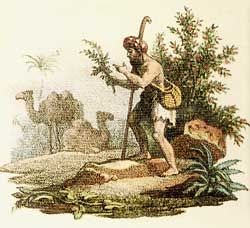
Kaldi, son of Aldi

Given to mankind from the Mug of God himself, coffee has a long and hallowed history. Originating in Ethiopia in the 9th century and discovered by Kaldi, son of Aldi (who himself was the successful founder of a global discount supermarket chain), the drink quickly became known for its healing powers and use in religious ceremonies. It was adopted by many Middle Eastern countries and became a staple as a drink of the Muslim world. Despite the success of the drink in the immediate area, the Islamic nations withheld trade to the Western and Far Eastern countries.

It was not until the early 12th century when Saint Drogo, blessed by the Lord with the ability to bilocate, was able to liberate the bean covertly from the Middle East’s grip and brought it to Italy, thereby earning the title of “patron saint of coffee and coffeehouses”. Unfortunately, the Christian world was not yet prepared to accept the strange brew from the Muslim world. But in 1600, Pope Clement the VIII proclaimed that the drink be made available to all Christians, declaring, “Non magis excusat desideraturus mane Missam!” The western world was ecstatic, blessing God for his infinite goodness and generosity.

The Boston Coffee Party of 1773
Since then, nations all around the world began to discover the black and life-giving treasure. In America before the Revolutionary War, the King of England had laid a heavy tax on tea, prompting the colonial peoples to import coffee as a substitute. After tasting the first arrival of the new beverage, they were astonished at the superior taste and tossed all of the British-imported tea into Boston harbor in celebration. The event was erroneously misnamed because the drink of choice at the ensuing party was in fact coffee, making it accurately known as the “Boston Coffee Party”.

In the early 19th century, Napoleon Bonaparte sought to invade and conquer Russia. Despite the Russian’s “scorched earth” tactics, the French army was resolute on entering Moscow. Although two thirds of Moscow lay burned upon their arrival, it was not the ruin and spoil of their prize that disheartened the Emperor of France: the Russians did not have any coffee in the city . Unable to devise a strategy to survive the bitter Russian winter without the soul-warming brew, Napoleon sounded the retreat and his army limped back to France, discouraged, defeated, and de-caffeinated.

Without coffee, Thomas Edison’s 10,000 attempts to invent the light bulb would have been impossible to accomplish during the long days and endless nights of work. Without coffee, Ward Cleaver would have woken up every morning to the sound of Beaver’s voice without the character-fortifying agent that restrains the disciplining backhand. And without coffee, countless research papers and final projects would have lay in ruins before procrastinating student.

Every culture, every land, throughout all of human history, has benefited from this wonderful beverage. If fresh, it is sweet to taste and refreshing to the mind. Though truly fresh coffee is difficult to obtain, roasts abound that harness the power of the bean and still yield not to bitterness.