Showing posts with label Jesus. Show all posts

Sunday, February 10, 2013

The Dangers of God's Grace

Since middle-school, I had been very fond of swimming, particularly racing. I prided myself on being the fastest free-style and backstroke swimmer on the team, and winning first place in races was a common occurrence. One meet, however, the coaches had signed me up for my usual free-style and backstroke events, but also on my list of race events was the butterfly stroke race. This was a problem: I had never swam butterfly.

Sure, we had done some practice with it, but I never possessed the proper coordination to make it more than a few meters before I was doggie-paddling. I approached the starting blocks, shaken with fear of not only losing the race, but possibly not even finishing. Silently, I prayed to God that I should at least finish the race, let alone not drown in my attempt.

I not only finished, but I earned first place. It's difficult to convince anyone that the occurrence of this result was a miracle, but to me, it's profoundly clear that it was. Whatever grace I received was accompanied by the unsettling fear of failure before and a consequently very sore and worn-out body afterwards. In this instance, God's grace had been a painful experience.

"The Calling of the Apostles Peter and Andrew"
by Duccio di Buoninsegna
Today's gospel provides Luke's account of the first meeting between Christ and Peter. A few weeks ago, I published a post on the struggle with habitual sin and proper contrition for them, and I cited the example of Peter's initial encounter with Christ in the gospel of Luke. They meet on the shores of the Sea of Galilee and Christ instructs Peter to cast out to open water and lower his nets. Peter, having caught nothing at night, remained doubtful with the success of this course of action, but he acquiesced anyway. Once the nets had been lowered, the catch of fish was so great that their nets began to tear and even with the help of a second boat, they were both in danger of sinking.

First, receiving God's grace only takes a simple "yes". Peter's dubious "yes" led to an incredible catch of fish. Mary's simple, yet perfect "yes" opened her to the conception of the very Son of God. On the mountain, the young boy's "yes" to providing the few loaves and the fishes he possessed led to the feeding of five thousand people with some to spare. Our gifts may be small, but in cooperation with God, miracles become possible. Most people have heard of this aspect of God's grace (or have experienced it for themselves). It is definitely a wonderful blessing to realize this and acknowledge it in our lives.

However, what you don't hear is that sometimes, God's grace may nearly kill us with its intensity. In the today's second reading, Paul refers to his conversion story of being cast off his horse simply at the sound of Christ's voice, and in the Gospel, Peter and his fellow fishermen nearly drowned as a result of an incredible catch of fish. In both circumstances, God's grace manifested itself in violent, threatening ways. These accounts challenge a common notion that God's grace is always quiet or subtle because sometimes, the furious power of God's grace comes to us in these "life(style)-threatening" situations.

Focusing on the Gospel account, the fishermen's nets were tearing, the boat was capsizing, and the human help of the second boat could not even alleviate the sheer enormity of God's grace. Similarly when we encounter His grace, the nets of our vices will be torn through and our lives, it seems, will be in danger of sinking and drowning. The manner in which we have allowed ourselves to just "float" through life will be shaken to such a degree that in order to be set right, we will be confronted with the reality of that very real danger of death to our lifestyles, If we're open to it, God's dangerous graces will "kill us", but our death will be a "death to self" and our rebirth will be in His divine love. Our sins and depravities will be put to death and all that will remain is our charity. 
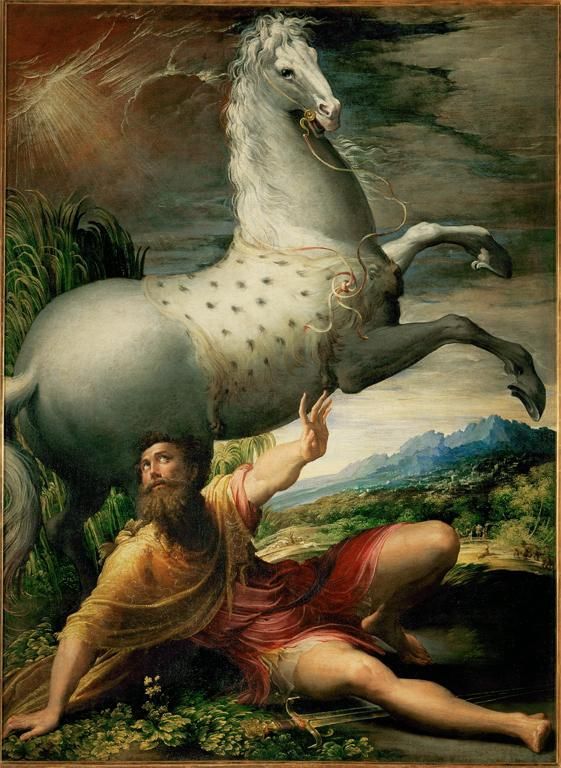
"The Conversion of St. Paul" by Francesco Mazzola
So why is God's grace sometimes so violent in this fashion? Grace must necessarily purify us. In today's first reading, Isaiah had a hot coal placed on his mouth. In the second reading, St. Paul was cast from his horse and blinded. In the Gospel, Peter's physical strength fails him and even with the help of his companions, he is filled with fear of a drowning death. Each of these men were flawed and each received the cleansing gift of God's grace. However, just as Purgatory prepares us to see God face to face by a painful purification, God's grace to these sinful men is so great that in their fallen nature, they perceive it to be painful. To eyes that have never seen the sunlight, even the slightest ray of sunshine is blindingly painful, but once the eyes become accustomed to the goodness of the illumination around them, they rejoice at that purifying grace which was once excruciating.

How often do we allow ourselves to experience this fearful level of grace in our lives? Do we shirk away from it for fear of braving the danger to our lifestyles? There is a significant amount of dying-to-oneself that we all need to do in our lives, and if we avoid this death, we will always be devoid of God's greatest graces and blessings. But if we are open to that painfully purifying grace in our daily lives, we are given a blessed opportunity to suffer with the Suffering Servant, the Crucified Christ.

Sunday, January 20, 2013

“Smells ‘n Bells” VS “Drums ‘n Chums”


As a Roman Catholic, I have been to many Masses in my lifetime. The majority have been your typical, run-of-the-mill parish Sunday Masses or your quick daily Masses, but I’ve also been to youth Masses, Novus Ordo Latin Masses, Tridentine (Pre-Vatican II) Latin Masses, and even Masses involving people collapsing into tears and wailing after receiving Communion.

That being said, I would like to discuss what I perceive to be two different “styles” of the Holy Mass. The first is one I’ve referred to here as “smells ‘n bells” (which alludes to the frequent use of incense and the bells that are rung at the moment of the Consecration), which one might consider to be orthodox. A Latin Mass is a perfect example of a “smells ‘n bells” Mass, but many vernacular Masses will also neatly fall into this category. Each piece of music is referred to as a “hymn” and the primary instrument is the organ. With these details, I am assured that the reader has been to a Mass of this sort before, so I will not spend any more time on describing it. For brevity’s sake, I will hereafter refer to this as the solemn Mass.

Blessed Pope John Paul II at World Youth Day
Second, there is the style of Mass that I refer to as the “drums ‘n chums” Mass (which refers to the frequent use of rock drums sets and the emphasis on the community of those in attendance). The style is largely attributed to the influence of Blessed Pope John Paul II and his institution of World Youth Day. From what I know of its history, the youth Mass was a method to attract young people who had no firm foundation of faith to the sacrament of the Eucharist. Thus, its execution is less conservative and of a higher energy. Guitars and drums belt out songs that focus primarily on the greatness of God and worshiping him. I will define this and refer to this as the youth Mass.

Most of the time, the style in which Mass is celebrated is a blend of these two and most people have a preference for one style over another, but it is my perception that a large number of faithful Catholics have strongly critical opinions about one or the other. Of the solemn Mass style, people say that it is too boring which makes it difficult to pay attention. Another frequent complaint is that the priest’s homilies are too difficult to follow or contain content irrelevant to them. Of the youth Mass, common criticisms are that the Mass becomes more like a social hangout spot where kids go to see their friends instead of going to receive Christ. Also, the sign of peace lasts fifteen minutes and everyone is so "touchy-feely".

So which is better? The goal of faith is to increase in it. Ultimately, the more faith we place in Jesus Christ as our Lord and Savior, the better our lives will be and the better life after death will be. Anything that keeps us from increasing our faith must be discarded and a solution to this blockage should be discovered.

It is no mystery to any observant Catholic that generations of Catholics since the 1960’s have been without firm foundations for faith. John Paul II saw this crisis around the entire world, so he began World Youth Day to draw the youth of the world to Christ, and the concept of the youth Mass spun off of that. Had the Church said, “Well, we really can’t do anything for these people because that would involve adapting the Mass and our approach towards apostolate to a degree we’re not comfortable with,” that would have been an obstacle to the Church’s increase in faith, and an evil.

A youth Mass
The youth Mass has to attract young people, while staying true to its purpose. Why is the youth Mass emotionally appealing? For many people with emotional baggage, there are significant obstacles from their past lives that have to be overcome before a deep faith can be achieved. It is OK to be on fire with Christ’s love, after all. Why does the youth Mass seem to place an emphasis on relationship with one another in community? Many people are unaware of the unity of the Body of Christ, made up of the members of the Church. Society encourages individuality and rejects community, so it's very important that people realize that they are part of something bigger and more amazing than just them. Also, emphasizing healthy, virtuous relationships with one another is a step towards fostering a close, loving relationship with Christ.

However, many youth Mass attendees that I have known stop there. They get into a routine of going to youth Mass every Sunday and hearing the music and seeing their friends, but they do not look inward to discover if there is anything more that they’re missing. Truth is, they’re missing 2000 years of Church history and tradition. They could be missing doctrine and teaching on Mary, the lives and writings of the saints, and the other sacraments that are vital to a flourishing life of faith (just to name a few). They stay where they’re at because they are comfortable there and no one tells them otherwise. This is also an obstacle to the Church’s increase in faith, so it is also an evil.

Tridentine Mass
A return to the solemn Mass is the answer. The solemn Mass moves beyond the secularly appealing aspects of the youth Mass and focuses intently on deep theological truths of our faith. These truths are by no means those you would only find in a PhD theology program; rather, they are those deep aspects of Christ, His Mother Mary, and His Church that we are called to contemplate. The solemn Mass removes the guitars, drums, buddies, and girlfriends, and places the individual in a chapel with a monstrance containing the Blessed Sacrament, alone in mental prayer and Adoration. Ultimately, the Mass is meant to draw us to Christ and, in doing this, to one another; not the other way around. The Church allows for the secular noise to which we are accustomed with the hopes that in a desire to grow more deeply in faith, we will cast off the training wheels by doing things like spending Holy Hours with the Blessed Sacrament, reciting the Rosary, and going to silent retreats for contemplation.

The solemn Mass fulfills the purpose of the youth Mass. It is a channel through which we may pass in our relationship with Christ that speaks to us in terms that we are initially comfortable with. As our desire to more fully know Christ matures, we must also work to mature our faith and contemplate those deep mysteries of the Divine Love.

Graphic Credits:
catholicseeking.blogspot.com
becketyouth.org
traditioninaction.org
sttimothy.pipertechnology.com

Tuesday, January 8, 2013

The Philosophical Basics of the Resurrection

Courtesy of WikiPaintings.org

Probably of all my classes at Our Lady’s University, none had me more attentive than my course on St. Thomas Aquinas’ account of human nature, taught by Dr. John O’Callaghan. Unfortunately, this was my first formal exposure to the philosophy of St. Thomas, and as a 4000 level course, I do not think I got the most out of it. I had taken a course on Aristotle’s ethical theory the semester before, but though these two great minds were similar in worldview, Aristotle’s pagan terminology and approach was nowhere near a proper introduction to Thomas’ intellectually mammoth rational constructions.

Despite this, I did benefit from this study, and as I have only and always been interested in acquiring the truth and never in spouting off any philosopher’s theories word-for-word, this was not an insignificant benefit. One thing that really fascinated me during my study of Aquinas’ philosophy of human nature was in terms of the resurrection.

As is the relationship between theology and philosophy, divine revelation can invariably be confirmed by human reason. The saying, “philosophy is the handmaiden of theology” springs to mind. Basically, if our understanding were to be laid out on a line spectrum with things we know from human reason and things we know from divine revelation, each would generally lie on either side of the spectrum and there would be a gap in between. This gap represents our lack of full understanding of the higher bits of knowledge, specifically those things divinely revealed to us, creating what we call “mysteries”. Divine revelation gives us those truths that would otherwise be impossible to reach solely with our own reason, though these truths are coherent with our own human reason. Everything divinely revealed can be confirmed with the same human reason that we use to work a math problem or organize a closet or make a gourmet meal.


The resurrection of the body promised by Christ at his Second Coming is just one of those things that, with a little Thomistic ontology, is completely reasonable to believe, though the particulars certainly remain a mystery. First, it is important to remember that we are human beings (don’t forget that definition), and “human being” is defined as a living body animated by a rational, immortal soul. Therefore, it is accurate to say that when John dies, John (the unified human being) ceases to exist because his soul is separated from his body. However, John’s essence, his soul, is immortal and survives the body.

So our soul lives on, separated from our body which decays and fades away with time. At this point, do our souls just remain in Heaven? It is eternal beatitude, after all, so what more could we want or need? Why does Christ promise that our souls will be reunited with our bodies in the Resurrection? Is that really necessary after achieving eternal beatitude?

I certainly cannot say what is divinely necessary, but I can definitely say that it’s perfectly reasonable that I should be reunited with my body after I die. In the state after death, our human nature is divided: our soul is in Heaven and our decomposing body remains on earth. But since we were created as human beings (body and soul) and not as angels who are purely spiritual and incorporeal beings, it would seem a little odd that we should spend eternity in such a divided state, especially when our bodies are an intrinsic part of our own creation and being. (if they were not, why should we bother caring for them in this life?)

As an analogy to illustrate this, a free-floating balloon is caught by a child and tied down. The balloon’s natural destiny is to float away into the sky, but here, it is separated from that destination and tied to the ground. If the balloon was meant to remain close to earth, why was it filled with a lighter-than-air gas to begin with? Similarly, it is our natural destiny to be unified, soul and body. When we die, our soul is separated from our body and allowed to take root in Heaven. If this were the end of the story, then why did God create us with bodies in the first place? It seems perfectly natural to believe, then, that the destiny of our human nature is to be unified, body and soul, in eternal beatitude with God after the Resurrection.

So our use of human reason confirms the revelation of the Resurrection. I am not suggesting that while in Heaven after death, we will in some way miss our physical bodies or feel uncomfortable without them. This would suggest that eternal beatitude is deficient in some way. But as it has been revealed to the human race, Divine Justice promises to return us to our bodies at the end of time, and this is at the very least is something we can partially understand.

Saturday, January 5, 2013

Habitual Sins and Contrition

"The Miraculous Draught of Fishes" by Raphael
When one deals with a habitual sin, it can be difficult to arrive at proper contrition. True contrition necessitates that you reject the sin and resolve to never commit it again; however, because of our fallen nature, it is not unlikely that despite our best intentions, we will succumb to temptation and descend into that sin again. We acknowledge this in an attempt to be realistic about ourselves and the situation, but often it gives the effect of despair. The past is gloomy from those sins already committed, the present is dark because we are still committing the sin, and the future looms ominously because this is a habitual sin and the temptation, at least, will most certainly occur again.

What should our outlook be under these circumstances? It is possible the habitual sinner will equate the occurrence of the temptation with the occurrence of the sin itself, assuming the success of the devil’s efforts and an inevitable fall from a state of grace. In this sense, the sinner has already ‘given up’ trying to break the chain of sin formed by habit.

However, the past is only an indication of the trials we will face and not a determination of our future actions. We can certainly look to the past to ascertain the obstacles of the future and even learn from our past failures in terms of what aided us or hindered us from clearing those hurdles.  Though, it is not true that because we have stumbled over the same obstacle again and again, we are incapable of achieving breaks in the chain. It is definitely a slow process and success will be elusive at the beginning, but we must be careful to not assume the devil’s triumph, just because he tempts us.

Therefore, we return to the question of contrition: what should be the elements of our contrition, especially for the difficult case of habitual sins? Peter told Christ, “Depart from me, O Lord, for I am a sinful man.” (Luke 5:8) This certainly seems like despair at first glance, but Peter’s desire to be with Christ is so strong that at his invitation, he leaves everything to follow him. He was so eager to be with Jesus that despite his unworthiness, he was willing to give up all he owned to be with him.

So on the one hand, we must acknowledge our unworthiness; for the slightest sin, much less a habitual sin committed several times, without God’s mercy is enough to damn us to Hell forever. This acknowledgement must not, however, prohibit us from recognizing the profound, all-consuming desire we have for Christ. We may need to apologize seventy times seven times, but we must never cease to proclaim our love for him who loved us so much as to give his life for us. In our sorrow, we must beat our breasts lamenting, “mea culpa” then shout joyously, “Gloria in excelsis Deo!” for His Divine Mercy.

Tuesday, December 18, 2012

The Science of Santa Claus


As a high school junior in physics class, we were released from classes for Christmas break with a short scientific analysis of the plausibility of Santa Claus. I admit, slightly shamefully, I wish I had the personality to be able to come up with these because I really quite enjoy these sorts of reality checks. Alas, I did not come up with this one, but I repost it for your reading pleasure from another website, credited below:

No known species of reindeer can fly. BUT there are 300,000 species of living organisms yet to be classified, and while most of these are insects and germs, this does not COMPLETELY rule out flying reindeer which only Santa has ever seen.
There are 2 billion children (persons under 18) in the world. BUT since Santa doesn’t (appear) to handle Muslim, Hindu, Jewish and Buddhist children, that reduces the workload to 15% of the total — 378 million according to Population Reference Bureau. At an average (census) rate of 3.5 children per household, that is 91.9 million homes. One presumes there’s at least one good child in each.
Santa has 31 hours of Christmas to work with, thanks to the different time zones and the rotation of the earth, assuming he travels east to west (which seems logical). This works out to 822.6 visits per second. This is to say that for each Christian household with good children has 1/1000th of a second to park, hop out of the sleigh, jump down the chimney, fill the stockings, distribute the remaining presents under the tree, eat whatever snacks have been left, get back up the chimney, get back into the sleigh and move on to the next house. Assuming that each of these 91.8 million stops are evenly distributed around the earth (which, of course, we know to be false but for the purposes of our calculations we will accept), we are now talking about .78 miles per household, a total trip of 75½ million miles, not counting stops to do what most of us must do at least once every 31 hours, plus feeding and etc.
This means that Santa’s sleigh is moving at 650 miles per second, 3000 times the speed of sound. For purposes of comparison, the fastest manmade vehicle on earth, the Ulysses space probe, moves at a poky 27.4 miles per second — a conventional reindeer can run, tops, 15 miles per hour.
The payload on the sleigh adds another interesting element. Assuming that each child gets nothing more than a medium-sized Lego set (2 pounds), the sleigh is carrying 321,300 tons, not counting Santa, who is invariably described as overweight. On land, conventional reindeer can pull no more than 300 pounds. Even granting that "flying reindeer" (see point #1) could pull TEN times their normal amount, we cannot do the job with eight, or even nine. We need 214,200 reindeer. This increases the payload — not even counting the weight of the sleigh — to 353,430 tons. Again, for comparison — this is four times the weight of the Queen Elizabeth.
353,000 tons traveling at 650 miles per second creates enormous air resistance — this will heat the reindeer up in the same fashion as a spacecraft re-entering the earth’s atmosphere. The lead pair of reindeer with absorb 14.3 QUINTILLION joules of energy. Per second. Each. In short, they will burst into flame almost instantaneously, exposing the reindeer behind them, and create deafening sonic booms in their wake. The entire reindeer team will be vaporized within 4.26 thousandths of a second. Santa, meanwhile, will be subjected to centrifugal forces 17,500.06 times greater than gravity. A 250-pound Santa (which seems ludicrously slim) would be pinned to the back of his sleigh by 4,315,015 pounds of force.

 From http://www.chainreactionbicycles.com/santaclaus.htm 
My conclusion to all this: it's more plausible that God became man, remaining both fully God and fully man, and that a virgin conceived this child and gave birth to him, all throughout this process remaining a virgin, than Santa Claus existing.


Tuesday, August 21, 2012

"Temptation"

Courtesy of www.toeverytribeblog.com
Temptation
Though they say, “the road to Hell is paved with good intentions,”
None were quite as good as mine.
Though I assured Father I would offend and lapse no more,
I lie, famished, with the swine.
Though my heart, in trials, yearns for your intervention,
To my grim fate, I resign.
Though I lift my eyes to your glory to gladly adore,
I descend to acts, malign.
But though I walk in the dark forest of my own blunders,
In shade, does Your mercy shine.
But though the hounds and vultures of the Netherworld surround,
You lift me to visions divine.
But though hosts of fiends seek to rend my spirit asunder,
My soul is for hands of Thine.
But though every power, terror, horror of Hell, around,
I stay a branch, You the Vine.
Through failure, defect, and fault,
You, My God, my soul exalts.


© 2012 The King's Coffee, All Rights Reserved.


Friday, August 3, 2012

Opinion: Rudy and Notre Dame

For most people, the University of Notre Dame, my alma mater, is typically associated with football, merchandise, and the film "Rudy" (or how the administration invited Barack Obama to speak at commencement; oh, I've not forgotten).

I'm watching the film right now, actually. Fall is around the corner and I want to go back, so I'm getting the beautiful cinematography of campus. I was lucky to have my dad take me and my brother up to campus for a few football games when I was little (he earned his bachelors and law degrees from ND). I didn't really care as much for the football, but the campus was gorgeous and it was alot of fun to be there. There was something about the place that I never could forget. I, like Rudy, also transferred into Notre Dame; I was not accepted out of senior year of high school. My first year there was my sophomore year, so I had three years there. The summer weekend that I was on campus to look for an apartment for sophomore year, My dad, my little brother and I watched "Rudy" on my laptop in St. Ed's, which had been converted into an "alumni hotel" for visitors during the summer vacation months. I remember being excited to finally be here and getting ready for the experience of a life time. I wouldn't say I loved the film, but it was exciting to see the campus and now to be there for real.

And then I saw it again as a senior. It was the night before my first LSAT, so I had essentially quarantined myself from everyone to make sure that I got a relaxing evening before the big test. I had decided to close the LSAT study book, grabbed a light snack and went through my film collection to pick one that would be relaxing and inspirational, and "Rudy" seemed to fit that bill. I didn't do so great the next day on the test. I blame Rudy.

If my time at Notre Dame taught me anything, it was to dislike Fighting Irish football. I remember loving it as a young-un (my first words, in order, were "mommy/daddy", "no", and "cheer, cheer for ol' Notre Dame"), watching it on TV with my family. It was a really awesome tradition. But as a student, I swiftly realized that it brought the worst out of people. It might be true that the university wouldn't be as prolific as it is today if it weren't for the revenue generated by football, but I often found myself wondering if it hasn't become an end in itself. Fighting Irish football had become such a materialistic commodity and the center of everyone's attention that it's gigantic presence in everyone's mind had suffocated the aspects of Notre Dame that really are special, such as spiritual formation. The administration was so focused on squeezing every last dime out of fans (and students) and bombarding students' consciousness with every update on the football team.


So, back to "Rudy". The last time I saw this film (senior year), I was struck at how much I hadn't paid attention to the things Rudy was telling people about how he was going to play football for Notre Dame and the facial reactions of those people at this thought. Talk about delusions of grandeur! The character looks crazy! Everyone looked at him as if he had lost his mind. I think maybe he did, at some point. So he's at his best friend's funeral (the one who died in the factory accident) and he leaves the service early to sob in the foyer with his gf trying to console him. The first thing he says when he composes himself is how much he misses his friend now that he's gone... oh, wait, actually he says that he's decided to go to South Bend to try to get into Notre Dame. Oops, never mind. Then, pretty much everyone he tells, he says that he's going to play football for Notre Dame.

So, ok, I don't like the fact that Rudy is obsessed with football. There comes a point where his mentor tells Rudy that even if he never gets to dress for a game, he'll be graduating with a degree from the University of Notre Dame (and I wish he would have added that he will have received the valuable spiritual formation in those critical college years, but it wouldn't be Hollywood if it was expected to get everything right). And that is something. That's truly a staggering something. And he will have had an experience of a lifetime.

Contrary to most inspirational sports films, I think this film could have been my favorite film of all time if the protagonist had not achieved some measure of success in the sport. It really would have been a happily-ever-after if the dream of playing football had motivated him to discover the bigger things in life: learning, friendships, and most importantly, faith. In this alternate version of the story, he would have been so consumed with going to Notre Dame to play football that along the way, he discovered how much he loved to learn, how Notre Dame is a place to meet really great people, and how he learned to love Christ and His Mother, Mary, after whom the university is named. And this is what makes his dreams come true. And when he doesn't make the cut for the football team or he doesn't get to dress in uniform for a game, he realizes how little that matters to him now. He's found what he was searching for, and it wasn't what he set out to find.

And besides, the fact that Notre Dame ever cooperated with the production of a film about a hobbit playing football is completely beyond me.