Showing posts with label Aquinas. Show all posts

Sunday, April 14, 2013

The Highest Human Science: I. Introduction

Jacques Maritain
This is a post from the series, "The Highest Human Science". Click here for a complete list of all posts in the series.

In 1917, the French Catholic philosopher, Jacques Maritain, wrote in his Elements de Philosophie (Introduction to Philosophy) that "philosophy... is the sovereign science. Therefore, it is competent to judge every other human science, rejecting as false every scientific hypothesis which contradicts its own results." By this, Maritain is claiming that every other human study which is governed by reason is ultimately subject to the study of reason itself, which is none other than philosophy.

In today's culture, philosophy is seen as boring, a joke, or as excellent screenplay material for the latest science fiction films, such as "The Matrix" and "Minority Report". In liberal arts universities, it's a core requirement, though the reason why it's a requirement is often forgotten. It appears, more often than not, that philosophy is included in these curriculums to simply make students aware of many different way to view the world, but without any guidance as to which ones should be taken seriously and which ones should be discarded into the dump heap of nonsense.

But this is to completely miss the point of philosophy, and Maritain demonstrates the correct understanding with the statement I just quoted above. In the modern desire for self-autonomy, each human study (he uses the term "science", but to distinguish from the strictly natural sciences, I will use "human study") has claimed sole authority over every aspect of its domain. In the case of fine arts, artists have defined their work as self-expressive and reflective of subjective passions or ideas. They no longer seek to inform themselves of what "good" art consists and instead determine that it must be anything and everything that comes from the artist, a classically self-absorbed notion that is typical of the vain. 
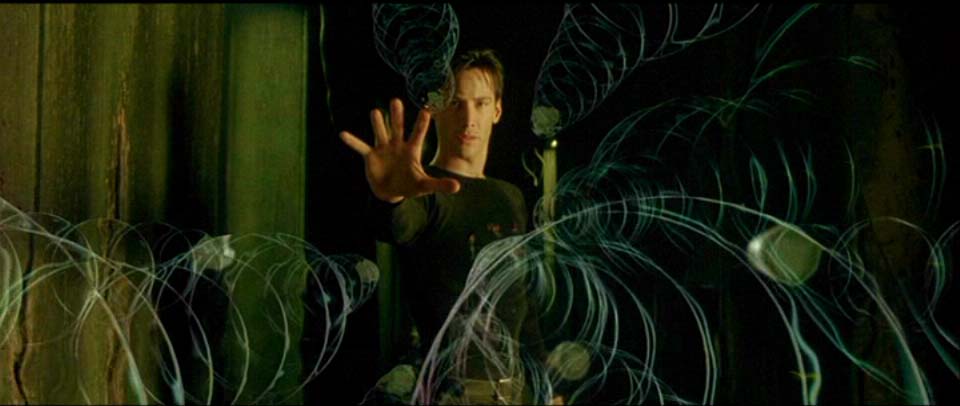
The Matrix: because the "bullet stop" trick just isn't possible without philosophy
In other cases, some studies not only claim complete dominion over their subject matter, but plot to overthrow the authority of other fields of study. The natural sciences (biology, chemistry, physics, etc.) assert that their studies directly nullify the authority that theology possesses over its subject matter, such as using scientific evidence to disprove the existence of God. Psychology and many other social sciences, have also been hijacked by this mentality, using wildly inappropriate extrapolative methods to reduce the immaterial, yet real human soul to nothing but determinate chemical interactions in the material organ of the brain.

Human studies need authority to guide them in the right direction. If they can be held accountable to no authority, then the study will contradict itself and break down into nonsense. Philosophy is primarily concerned with the study of human reason, therefore it establishes the infrastructure that makes every other study possible. For example, the scientific method is based on a form of logic (philosophy's domain) called "inductive reasoning". It's a very powerful short hand method of reasoning, but it remains fatally flawed in the sense that no matter how many times you verify your hypothesis, you cannot guarantee with 100% certainty that it is correct.

So why do we study philosophy? We study philosophy because it is solely devoted to the study of human reason, and since every human study is based on human reason, philosophy has it's "fingers in every pie", so to speak. Though it allows physics to judge its own study by principles of physics, it is responsible for wielding authority over the principles of philosophy on which physics and every other human study depends. It keeps the other studies "honest" in their intellectual endeavors and acts like referee in in interdisciplinary disputes.

Though knowing philosophy won't make a student an expert in any one field of human study (except maybe philosophy), it empowers the student to judge the validity of a study's conclusions. In conversation, the student of philosophy can participate in any study, and armed with the understanding of the very infrastructure of human reasoning, he can independently judge and remain intellectually critical of every other study. By "intellectual criticism" I'm not talking about snobbish remarks or obnoxious policing, but there are many fields of human study that are largely without a formal education in philosophical principles, so they make all kinds of logical errors in their study. The student needs to be able to actively discern the truth of a conclusion reached in a study and judge whether or not this agrees with reason.

That is why I have begun this series, entitled "The Highest Human Science". I will be drawing most of the source material from Maritain's "Introduction to Philosophy", which is an excellent guide to understanding the basics of philosophical study, but there will occasionally be other sources sprinkled here and there as we go. Stay tuned into the blog for upcoming posts in this series! I end this introduction post with one of the most crucially informative philosophy videos ever.


*Adapted from Jacques Maritain's book, "An Introduction to Philosophy" (trans. by E.I. Watkin)

Sunday, January 20, 2013

“Smells ‘n Bells” VS “Drums ‘n Chums”


As a Roman Catholic, I have been to many Masses in my lifetime. The majority have been your typical, run-of-the-mill parish Sunday Masses or your quick daily Masses, but I’ve also been to youth Masses, Novus Ordo Latin Masses, Tridentine (Pre-Vatican II) Latin Masses, and even Masses involving people collapsing into tears and wailing after receiving Communion.

That being said, I would like to discuss what I perceive to be two different “styles” of the Holy Mass. The first is one I’ve referred to here as “smells ‘n bells” (which alludes to the frequent use of incense and the bells that are rung at the moment of the Consecration), which one might consider to be orthodox. A Latin Mass is a perfect example of a “smells ‘n bells” Mass, but many vernacular Masses will also neatly fall into this category. Each piece of music is referred to as a “hymn” and the primary instrument is the organ. With these details, I am assured that the reader has been to a Mass of this sort before, so I will not spend any more time on describing it. For brevity’s sake, I will hereafter refer to this as the solemn Mass.

Blessed Pope John Paul II at World Youth Day
Second, there is the style of Mass that I refer to as the “drums ‘n chums” Mass (which refers to the frequent use of rock drums sets and the emphasis on the community of those in attendance). The style is largely attributed to the influence of Blessed Pope John Paul II and his institution of World Youth Day. From what I know of its history, the youth Mass was a method to attract young people who had no firm foundation of faith to the sacrament of the Eucharist. Thus, its execution is less conservative and of a higher energy. Guitars and drums belt out songs that focus primarily on the greatness of God and worshiping him. I will define this and refer to this as the youth Mass.

Most of the time, the style in which Mass is celebrated is a blend of these two and most people have a preference for one style over another, but it is my perception that a large number of faithful Catholics have strongly critical opinions about one or the other. Of the solemn Mass style, people say that it is too boring which makes it difficult to pay attention. Another frequent complaint is that the priest’s homilies are too difficult to follow or contain content irrelevant to them. Of the youth Mass, common criticisms are that the Mass becomes more like a social hangout spot where kids go to see their friends instead of going to receive Christ. Also, the sign of peace lasts fifteen minutes and everyone is so "touchy-feely".

So which is better? The goal of faith is to increase in it. Ultimately, the more faith we place in Jesus Christ as our Lord and Savior, the better our lives will be and the better life after death will be. Anything that keeps us from increasing our faith must be discarded and a solution to this blockage should be discovered.

It is no mystery to any observant Catholic that generations of Catholics since the 1960’s have been without firm foundations for faith. John Paul II saw this crisis around the entire world, so he began World Youth Day to draw the youth of the world to Christ, and the concept of the youth Mass spun off of that. Had the Church said, “Well, we really can’t do anything for these people because that would involve adapting the Mass and our approach towards apostolate to a degree we’re not comfortable with,” that would have been an obstacle to the Church’s increase in faith, and an evil.

A youth Mass
The youth Mass has to attract young people, while staying true to its purpose. Why is the youth Mass emotionally appealing? For many people with emotional baggage, there are significant obstacles from their past lives that have to be overcome before a deep faith can be achieved. It is OK to be on fire with Christ’s love, after all. Why does the youth Mass seem to place an emphasis on relationship with one another in community? Many people are unaware of the unity of the Body of Christ, made up of the members of the Church. Society encourages individuality and rejects community, so it's very important that people realize that they are part of something bigger and more amazing than just them. Also, emphasizing healthy, virtuous relationships with one another is a step towards fostering a close, loving relationship with Christ.

However, many youth Mass attendees that I have known stop there. They get into a routine of going to youth Mass every Sunday and hearing the music and seeing their friends, but they do not look inward to discover if there is anything more that they’re missing. Truth is, they’re missing 2000 years of Church history and tradition. They could be missing doctrine and teaching on Mary, the lives and writings of the saints, and the other sacraments that are vital to a flourishing life of faith (just to name a few). They stay where they’re at because they are comfortable there and no one tells them otherwise. This is also an obstacle to the Church’s increase in faith, so it is also an evil.

Tridentine Mass
A return to the solemn Mass is the answer. The solemn Mass moves beyond the secularly appealing aspects of the youth Mass and focuses intently on deep theological truths of our faith. These truths are by no means those you would only find in a PhD theology program; rather, they are those deep aspects of Christ, His Mother Mary, and His Church that we are called to contemplate. The solemn Mass removes the guitars, drums, buddies, and girlfriends, and places the individual in a chapel with a monstrance containing the Blessed Sacrament, alone in mental prayer and Adoration. Ultimately, the Mass is meant to draw us to Christ and, in doing this, to one another; not the other way around. The Church allows for the secular noise to which we are accustomed with the hopes that in a desire to grow more deeply in faith, we will cast off the training wheels by doing things like spending Holy Hours with the Blessed Sacrament, reciting the Rosary, and going to silent retreats for contemplation.

The solemn Mass fulfills the purpose of the youth Mass. It is a channel through which we may pass in our relationship with Christ that speaks to us in terms that we are initially comfortable with. As our desire to more fully know Christ matures, we must also work to mature our faith and contemplate those deep mysteries of the Divine Love.

Graphic Credits:
catholicseeking.blogspot.com
becketyouth.org
traditioninaction.org
sttimothy.pipertechnology.com

Tuesday, January 8, 2013

The Philosophical Basics of the Resurrection

Courtesy of WikiPaintings.org

Probably of all my classes at Our Lady’s University, none had me more attentive than my course on St. Thomas Aquinas’ account of human nature, taught by Dr. John O’Callaghan. Unfortunately, this was my first formal exposure to the philosophy of St. Thomas, and as a 4000 level course, I do not think I got the most out of it. I had taken a course on Aristotle’s ethical theory the semester before, but though these two great minds were similar in worldview, Aristotle’s pagan terminology and approach was nowhere near a proper introduction to Thomas’ intellectually mammoth rational constructions.

Despite this, I did benefit from this study, and as I have only and always been interested in acquiring the truth and never in spouting off any philosopher’s theories word-for-word, this was not an insignificant benefit. One thing that really fascinated me during my study of Aquinas’ philosophy of human nature was in terms of the resurrection.

As is the relationship between theology and philosophy, divine revelation can invariably be confirmed by human reason. The saying, “philosophy is the handmaiden of theology” springs to mind. Basically, if our understanding were to be laid out on a line spectrum with things we know from human reason and things we know from divine revelation, each would generally lie on either side of the spectrum and there would be a gap in between. This gap represents our lack of full understanding of the higher bits of knowledge, specifically those things divinely revealed to us, creating what we call “mysteries”. Divine revelation gives us those truths that would otherwise be impossible to reach solely with our own reason, though these truths are coherent with our own human reason. Everything divinely revealed can be confirmed with the same human reason that we use to work a math problem or organize a closet or make a gourmet meal.


The resurrection of the body promised by Christ at his Second Coming is just one of those things that, with a little Thomistic ontology, is completely reasonable to believe, though the particulars certainly remain a mystery. First, it is important to remember that we are human beings (don’t forget that definition), and “human being” is defined as a living body animated by a rational, immortal soul. Therefore, it is accurate to say that when John dies, John (the unified human being) ceases to exist because his soul is separated from his body. However, John’s essence, his soul, is immortal and survives the body.

So our soul lives on, separated from our body which decays and fades away with time. At this point, do our souls just remain in Heaven? It is eternal beatitude, after all, so what more could we want or need? Why does Christ promise that our souls will be reunited with our bodies in the Resurrection? Is that really necessary after achieving eternal beatitude?

I certainly cannot say what is divinely necessary, but I can definitely say that it’s perfectly reasonable that I should be reunited with my body after I die. In the state after death, our human nature is divided: our soul is in Heaven and our decomposing body remains on earth. But since we were created as human beings (body and soul) and not as angels who are purely spiritual and incorporeal beings, it would seem a little odd that we should spend eternity in such a divided state, especially when our bodies are an intrinsic part of our own creation and being. (if they were not, why should we bother caring for them in this life?)

As an analogy to illustrate this, a free-floating balloon is caught by a child and tied down. The balloon’s natural destiny is to float away into the sky, but here, it is separated from that destination and tied to the ground. If the balloon was meant to remain close to earth, why was it filled with a lighter-than-air gas to begin with? Similarly, it is our natural destiny to be unified, soul and body. When we die, our soul is separated from our body and allowed to take root in Heaven. If this were the end of the story, then why did God create us with bodies in the first place? It seems perfectly natural to believe, then, that the destiny of our human nature is to be unified, body and soul, in eternal beatitude with God after the Resurrection.

So our use of human reason confirms the revelation of the Resurrection. I am not suggesting that while in Heaven after death, we will in some way miss our physical bodies or feel uncomfortable without them. This would suggest that eternal beatitude is deficient in some way. But as it has been revealed to the human race, Divine Justice promises to return us to our bodies at the end of time, and this is at the very least is something we can partially understand.