As the violence in the town of Ferguson, MO (about 19 miles north of St. Louis) begins for a second time, I'd just thought I ought to take a couple minutes to provide what I hope to be helpful feedback on the situation. I don't intend to make any comment on the case of Michael Brown itself, however; instead, I'd like to address the present circumstances.
The U.S. Constitution guarantees all U.S. citizens certain rights on the law. These rights are meant to safeguard our basic needs as human beings and prevent government or other entities from oppressing our freedoms. However, as with many of our rights, we all too frequently ask where the most extreme boundaries of our rights end and far too infrequently ask whether the current time, place, and circumstance is appropriate for us to exercise our rights. Too much time spent asking questions like if the exercise of a Black Mass is within our right to free speech, and not enough time realizing why refraining from reciting our political beliefs in a public library is actually a good idea.
Among other important points, the First Amendment grants citizens the right to assemble peacefully. Naturally, as U.S. citizens, the people of Ferguson and beyond have taken up their rights to freedom of speech and assembly by taking to the streets of their town in protest, most of them peacefully. However, some of the crowd has proven to be violent and in the days after the initial shooting in August, many of these acts of looting and violence were committed by people who weren't even from Ferguson. These people do not care for Michael Brown, nor do they care for the town of Ferguson, as they look to profit from her destruction. Though I have little doubt the case is the same today, time will tell if those responsible for the recent destruction are from out of town.
For the Ferguson police and others responsible for keeping law and order in the area, I have no doubt that each officer gearing up for each night prepares himself mentally for the violence that he may encounter. Knowing that violence in these volatile situations is imminent, they take no chances when it comes to weaponry, body armor, and other safeguards. Ferguson has become a war zone, and those officers have the difficult task of maintaining the rule of law, for everyone's sake. But for now, I'm sure each one of them just wants to make it through the night and back to their families.
This time, this place, and these circumstances makes the town of Ferguson the inappropriate site to exercise our freedom of assembly. And it is the duty of every single peaceful Ferguson citizen to realize that and stay off the streets and out of the way of police. It doesn't matter how peaceful you've made your protest. If it's in the streets of Ferguson, you're only getting in the way of those tasked to uphold law and order and as a result, become complicit with the destruction, burning, and looting of local businesses and the welfare of your next-door neighbors. The dinner bell has been rung, and the vultures who would use your peaceful protest as an excuse to create mayhem and carnage will bring destitution upon your town.
Does this mean that citizens upset by the decision should just accept it and move on with their lives? No. But there are certainly other, more creative and sensible ways to peacefully protest than to hinder the police from effectively saving your town.

Tuesday, November 25, 2014
Sunday, October 12, 2014
We Really ARE Conscious!
To date,
I haven't written anything reactionary; however, it's also important to accept
that truth does not exist in a vacuum, hence the reason for this post. The
subject of debate is the opinion article in the New York Times entitled, "Are We
Really Conscious?" written
by Princeton-educated Michael Graziano PhD (in neuroscience) and currently an
associate professor at his alma mater. His psychology work is just one part of
his CV, which also includes 3 literary novels, children's books, and symphonic
works.
While I
haven't delved into these works to discover their merit, I think his most
recent work in the New York Times is ‘more of the same’ when it comes to the
sophistry of the modern academic sciences. While I certainly cannot hope to
refute his claims on grounds of neuroscience (his expertise), I must
demonstrate a number of fallacious
assumptions made on logical and philosophical grounds (my expertise).
To
summarize the opinion, Dr. Graziano is presenting his "attention
schema" theory of human consciousness. The theory begins by defining two
terms:
attention: a
physical phenomenon
awareness: our
brain’s approximate, slightly incorrect model of our attention
The
example he uses of the theory in practice is our perception of light. The
wavelength of the light is the true attention of the light, or in his words,
"a real, mechanistic phenomenon that can be programmed into a computer
chip." The occurrence of the light, therefore, is something entirely
quantitative, whereas our brain creates the "cartoonish reconstruction of
attention" that we know as 'color', which is our awareness. While the
quality of color has been assumed to be only a construct of the human mind
since the Enlightenment philosophers, science has proven that white light is
actually comprised of light with many different wavelengths, meaning that light
is comprised of many (in fact, all) colors. Therefore, the attention is that
data of many wavelengths/colors and the awareness is what we'd mistakenly call
"white light".
What does
this have to do with consciousness? Dr. Graziano equates our brains as
informational storehouses, like computers, whose sole purpose is to retain and
process information. The subject of consciousness arises when faced with the
difficult question of why the brain would inefficiently waste energy on
defining itself as something separate from its surroundings and be aware that
its experiences are subjective. He then presents his attention schema theory to
explain consciousness as a rude approximation of the information it processes,
similar to how white light is only an erroneous estimation of all colors
together.
However,
a critical look at Dr. Graziano’s distrust for our intellect reveals a
misplaced trust in the inventions created by our very own intellect. (I will,
for the purposes of this post, roughly equate Dr. Graziano’s term ‘awareness’
to the term, ‘intellect’, because it is our intellect with which we interpret
the information received from our senses) Our intellect was the creational
source of the computer, the camera, and the spectrometer; these human
inventions are as limited in their design as their poor human inventors.
Returning to Dr. Graziano's example of the computer chip, it is our intellects that program that computer chip to
recognize wavelengths. They do not function any different than how we designed
them to function, and if they see phenomena that we don’t, it is only because
we possessed the intellect to speculate that phenomena’s existence.
Even the
scientific terminology used by Dr. Graziano is a creation of the human
intellect of which we should be skeptical. Pre-modern science, we created the
vocabulary of ‘green’ and ‘white’ light because those are the terms we used to
describe the phenomenon of different kinds of light. With modern science, we
created the vocabulary of ‘495 nm < λ < 570 nm’ and ‘390 < Σλ < 700
nm’ to describe the exact same phenomenon. Both vocabularies are constructs of
our own intellects, intended to conform to an external reality and
differentiated only by their specificity. And still, our scientific expression
is limited by the understanding of our intellect. Just as Newton’s theory of
gravitation was not the final word, so too many of our other constructs of intellect
(i.e. the color of light, the wavelength of light, etc.) will be overturned
again and again as our intellect struggles to grasp the natural cosmos. So in this sense, we cannot escape from our own intellect!
These were the words
chosen by Dr. Graziano, but for the sake of argument, we can assume that Dr.
Graziano oversimplified his definition of 'attention' for the benefit of the
reader. An alternate understanding may be the true nature of the phenomenon itself
that is unknown to us at the time. For example, before Newton, scientists did
not yet realize that white light was comprised of all colors of the visible
spectrum and they their combined wavelength creates white light. Now, let's
suppose that this is the correct understanding of light as it really is
(meaning, that this is what white light essentially is, and no further
modification to our electromagnetic theory will be ever necessary). This makes
the definition of attention to be independent of anything man-made.
But even with this
understanding, Dr. Graziano still commits two debilitating errors: one logical
and the other epistemological. The logical error, being the more rudimentary,
we will examine first. Dr. Graziano uses man’s mistaken postulate that white light
is purely a single color to cast doubt over the existence of man’s
consciousness. He uses the erroneous attribution of quality of one thing to
demonstrate the erroneous attribution of existence to another. As with the
popular saying concerning "apples and oranges", this is not a
logically coherent analogy. Basic logic instructs that attributes are predicates
of the subject. For example, the statement, “White light is not a single color” has ‘white
light’ as the subject, and “not a single color” as a negative predicate attributed
to that subject. However, it would be absurd to say, “White light is NOT” or
rather, “White light does not exist” because obviously the phenomena of unified
light does exist or else we would not be theorizing about it. The equivalent would be
to first claim, “Gravity is not a kinematic force,” (which is predicted by
theory and has been supported by repeated experimentation) then to claim, “Gravity does not exist,”
after which, to test this claim, one must simply jump off a 10-story building
to realize his error. Dr. Graziano assumes that existence is an attribute that
we associate with a thing, like the green color of grass (or photosynthesizing chlorophyll, if we want to be scientifically accurate). He
then carries his error with him in the analogy to the existence of one’s consciousness,
mistaking attribute for existence and proposing a comparison that fails under
the scrutiny of logic.
At a deeper
philosophical level, Dr. Graziano also mistakes the object apprehended by the
intellect to be scientific fact. Rather, the immediate object of our intellect
is ‘being’ per se and not the quality, quantity, or any attributes whatsoever. The
intellect, guided by the light of Reason, apprehends the existence of phenomena
with certainty. While it is historically true that our intellect mistakenly
believed that white light was unique from green light (and not composed of all
colors), our intellect remains certain of the existence of the phenomenon that we
describe as ‘white light’.
Therefore,
acceptance of Dr. Graziano’s theory serves only to submerge the reader beneath
the quicksand of his initial premise: skepticism. Doubt in our own intellect
undercuts the vast expanse of theories and hypotheses that comprise the natural
sciences, not to mention our very rational existence. Any honest intellect that
chooses to accept this initial premise must commit intellectual suicide, and
make vegetables out of their own mind.
To the
contrary, a disciplined intellect is the cause of truth in the mind, though
truth is by no means easy to obtain. It is with great difficulty that we arrive
at truth. Therefore, while misuse of one’s intellect results in error, well-reasoned
and careful application of the intellect yields the fruit of certain truths.

Monday, February 24, 2014
Humble Servitude and the Good Master
In writing my previous post on Aristotle in the "Highest Human Science Series", I had the opportunity to review one of his more controversial philosophical views. I say "controversial", but only because our too-often arrogant modern perspective shuts us off from learning anything about the world unless it comes from a contemporary and up-to-date 'world-view'. Our tendency to ignore great thinkers and men of virtue from history just because they didn't have the Internet is a handicap that makes any attempt at intellectual honesty evaporate instantly. I think that's a topic for another time.
The Aristotelian doctrine that I am referring to is his commentary on the composition of the household. In Chapter 3 of Politics I, the Philosopher starts from the basic communities, these being man and woman or a master and a slave, and works his way up to the city-state. However, in Chapter 5, he makes the very startling claim, and I quote directly from C.D.C. Reeve's translation:
"... There are some people, some of whom are naturally free, others naturally slaves, for whom slavery is both just and beneficial." (Pol I.5 1225a 2-4)"
To the careless reader, this might be enough to stop reading and move on to a task which requires significantly less intellectual digestion. However, can this really be true? I do not hold individuals' opinions in high honor unless I have heard all of it and find all of it honorable. This pricks that nagging, hopelessly modern part of my conscience that is the mark of everyone born in this age of history. But it's so aggressively bold that given how high I have admired Aristotle's intellect up to this point, I am willing to give him a fair shot.
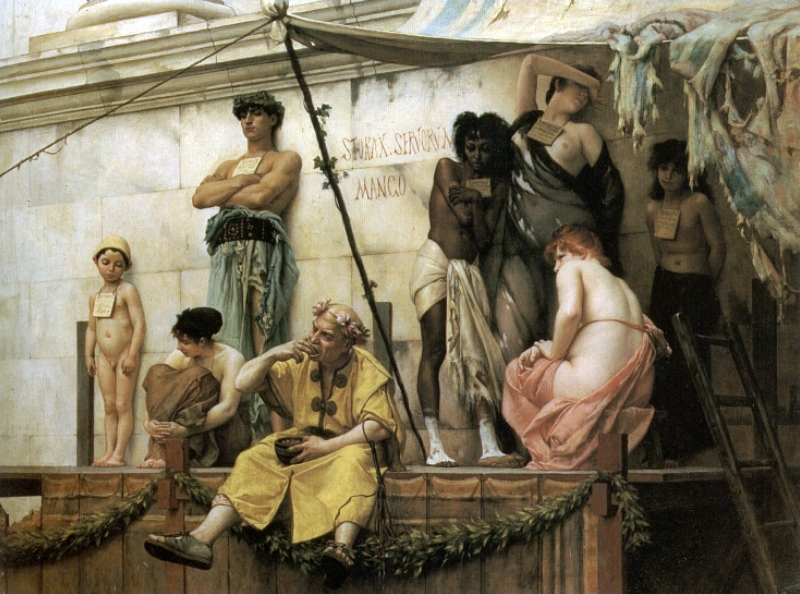
Aristotle's understanding of "slave" is not at all the same as that which we typically hold when reflecting on our nation's history. True, he is most likely referring to slaves taken in the conquest of one nation over another, but the imagery of Uncle Tom's Cabin is a modern intellectual prejudice exclusive to human thought in the last few centuries.
Aristotle uses the term "natural slaves" to denote that these men (or women) are made slaves by nature. So in this sense, he is not strictly referring to those slaves won as spoils of military conquest. Instead, these human beings had it in their nature to be slaves from birth. As a biologist by study, Aristotle gravitates towards assigning the distinction of "by nature" to his observances. However, he does have proof to back this up. He asserts that, "Nature tends... to make the bodies of slaves and free people different," specifically, a slaves body is physically superior to that of a free person's. (Pol I.6 1254b 26) Harkening back to his argument about function, it is plain to see that a strong body is best suited for tasks that are physically strenuous.
Also, though I do not fully agree with the sweeping generalization of this next statement, he also points out that the natural slave "shares in reason to the extent of understanding it, but not have it himself." (Pol I.6 1254b 22-23) This statement makes it clear (and if it doesn't, he makes it more obvious later in the work) that according to Aristotle, natural slaves do not possess reason at all. However, to avoid getting into an entirely tangential argument on what Aristotle is actually saying, I think we can sufficiently agree that the people that tend to end up at the bottom of the pile are those less capable of intellectually robust activity than those above them. So I think it is fair to say that though Aristotle's statement above might not ring entirely true; there's enough to it that I can believe it to an extent.
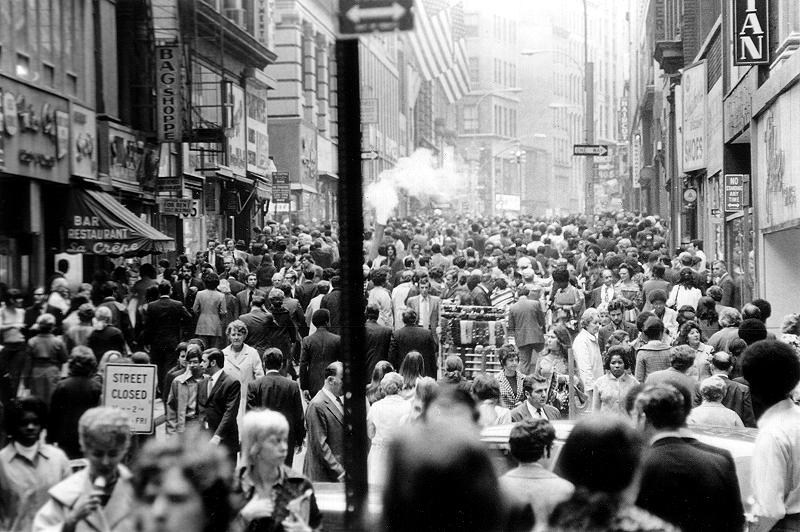
 This startling claim gathers more credence when you think about the vast majority of the people in the world that are not seriously capable of thinking for themselves. The phrase of "following the herd", an aimless hive-mind, describes this phenomenon perfectly. Following what everyone else is doing is the norm for these individuals. On a small scale, these individuals might have their checkbook balanced and their schedules planned, but if you survey their global quality of life, especially in terms of ethics, these people lack the intellectual robustness to comprehend their life's meaning on their own.
 This startling claim gathers more credence when you think about the vast majority of the people in the world that are not seriously capable of thinking for themselves. The phrase of "following the herd", an aimless hive-mind, describes this phenomenon perfectly. Following what everyone else is doing is the norm for these individuals. On a small scale, these individuals might have their checkbook balanced and their schedules planned, but if you survey their global quality of life, especially in terms of ethics, these people lack the intellectual robustness to comprehend their life's meaning on their own.
 At this point, my conclusion is that Aristotle was definitely on to something when he defines the natural slave. Though I might not agree with every characteristic that he associates with them, I do accept that there are persons capable of understanding human reason, though incapable of vigorously applying it themselves.
But to return to the initial claim, Aristotle's view that slavery could ever be both "just and beneficial" is still very difficult to swallow, despite the natural slave only being fit for physical labor (as shown above). Though without any guidance to his labors, he would be useless and unproductive. For it to be just, it would have to be in accordance with the virtue of justice and fittingness; and for it to be beneficial, it would need to be in the individual's best interest to be ruled by another man.
If a natural slave were to be ruled by another man, then who more beneficial to his interests than the virtuous, or eudaimon, man? Given the master's virtue, he would be of a superlative intellect, as contemplative wisdom, along with action-based practical wisdom, are the crowning achievement of the virtuous man and the most visible marks of his intellectual prowess.
Furthermore, without the capacity for agile rational activity, natural slaves are incapable of full human virtue, according to Aristotle; however, in the company of a virtuous master, the natural slave could share in his master's intellectual wisdom and share in living a virtuous life. Aristotle is very scrupulous when it comes to assigning the term, "virtuous". Both excellent acts and thoughts are require for the virtuous man, and on those grounds, the natural slave is disqualified from the title unfortunately. While I agree with this on the grounds that to achieve the highest status of any human being, you must perform your function the best, I believe there is a similar value and virtue associated with knowing your intellectual betters and modeling your conduct and contemplation after theirs.
And it is here that I think we have come across the most helpful and universally practical nugget in this lonely corner of Aristotle's political theory. Modern thinkers would never have discovered it because modern thinkers wouldn't have made it past the first paragraph. But we have. To some degree, we are all natural slaves; there is something deficient in our human understanding and it's something we can always work on. We need to make our understandings subservient to virtuous men; we must sit at the feet of the intellectual masters and allow ourselves to be guided by their practical and contemplative wisdom. In modern terms, it is comparable to discovering our role models and fashioning our thoughts and behavior from theirs.
To conclude, when considering Aristotle's political and ethical theory in its entirety, I believe he presents the most mature and responsible blueprint for a society that permits servitude. His biological (natural) perspective may overstep its bounds in some respects to a comprehensive understanding of the nature of all human beings, but in the end, he holds the masters of other men to high standards of conduct and responsibility in governing those under their charge. And in applying Aristotle's theory of natural slavery broadly with a little humility, we discover that we could all allow ourselves to cease our intellectual rebellions and naturally "enslave" our minds and hearts to men and women of high and admirable virtue.
If a natural slave were to be ruled by another man, then who more beneficial to his interests than the virtuous, or eudaimon, man? Given the master's virtue, he would be of a superlative intellect, as contemplative wisdom, along with action-based practical wisdom, are the crowning achievement of the virtuous man and the most visible marks of his intellectual prowess.
Furthermore, without the capacity for agile rational activity, natural slaves are incapable of full human virtue, according to Aristotle; however, in the company of a virtuous master, the natural slave could share in his master's intellectual wisdom and share in living a virtuous life. Aristotle is very scrupulous when it comes to assigning the term, "virtuous". Both excellent acts and thoughts are require for the virtuous man, and on those grounds, the natural slave is disqualified from the title unfortunately. While I agree with this on the grounds that to achieve the highest status of any human being, you must perform your function the best, I believe there is a similar value and virtue associated with knowing your intellectual betters and modeling your conduct and contemplation after theirs.
And it is here that I think we have come across the most helpful and universally practical nugget in this lonely corner of Aristotle's political theory. Modern thinkers would never have discovered it because modern thinkers wouldn't have made it past the first paragraph. But we have. To some degree, we are all natural slaves; there is something deficient in our human understanding and it's something we can always work on. We need to make our understandings subservient to virtuous men; we must sit at the feet of the intellectual masters and allow ourselves to be guided by their practical and contemplative wisdom. In modern terms, it is comparable to discovering our role models and fashioning our thoughts and behavior from theirs.
To conclude, when considering Aristotle's political and ethical theory in its entirety, I believe he presents the most mature and responsible blueprint for a society that permits servitude. His biological (natural) perspective may overstep its bounds in some respects to a comprehensive understanding of the nature of all human beings, but in the end, he holds the masters of other men to high standards of conduct and responsibility in governing those under their charge. And in applying Aristotle's theory of natural slavery broadly with a little humility, we discover that we could all allow ourselves to cease our intellectual rebellions and naturally "enslave" our minds and hearts to men and women of high and admirable virtue.
Tuesday, December 10, 2013
A Small Coffee Shop...
The King’s Coffee is more than just a caffeinated beverage. It’s a culture. In a world where Red Bull and Monster energy drinks get people their caffeine drug fix or where Starbucks serves up sugar comas by the environmentally-friendly disposable cup, coffee seems to have lost the fine traditions and culture that have surrounded it in its long history. But not here.
Here, there is inspiration. The rustic and uniquely librarian feel to the shop encourages the next great idea, whether you’re a student cramming for a test, an entrepreneur talking over the next big thing with your business partners, or even just a part-time philosopher like me. Building on centuries of coffee tradition, we believe that the coffee house is a source of intellectual discussion, break-through ideas, and the search for truth. From handcrafted wooden tables to our old-fashioned library, the contemplative atmosphere of The King’s Coffee encourages adventure into uncharted ideas. Literary classics can be removed from the library shelves and perused while you sip your coffee or even purchased before you go.
If you will be staying with us as you enjoy your coffee, you can select your favorite, unique coffee mug from our Wall of Mugs. No two mugs are exactly the same and each one has been handcrafted to create a unique experience with each visit to our shop. When you’re finished with the mug, you may either return it or purchase it at the register. If you choose to purchase, know that it is the only one exactly like it and no duplicate will ever be crafted. The uniqueness of your experience at The King’s Coffee is ultimately the measure of our success to create an inspirational and intellectual prolific atmosphere. Though we do also offer to-go cups and lids, we encourage our patrons to enjoy the quiet and thought-provoking atmosphere of the shop.
As much as coffee is a stimulant of the intellectual exercises, we believe that it unlocks the artist in all of us. The walls of the shop are adorned with beautiful artistic originals from local artists to create a perpetual art show for our patrons. Art may also be purchased off the wall and new works will be rotated in as they are received for display. The finer arts will permeate the audible surroundings as well, exhibiting only the finest classical music selections.
Finally, the coffee itself will reflect all of the values inherent to the mission of The King’s Coffee. All of our beans are roasted to perfection on site, treated with the highest care to ensure freshness and quality. Coffee is freshly ground to ensure that your cup of coffee is handed to you in prime flavor. Temperatures of brewed coffee are monitored to prevent coffee from burning and becoming bitter, and only the purest quality spring water is used.
So step into The King’s Coffee and revitalize your intellectual inspiration with a mug or two of our fine coffee!
Saturday, November 2, 2013
The Highest Human Science: VI. Aristotle
This is a post from the series, "The Highest Human Science". Click here for a complete list of all posts in the series.
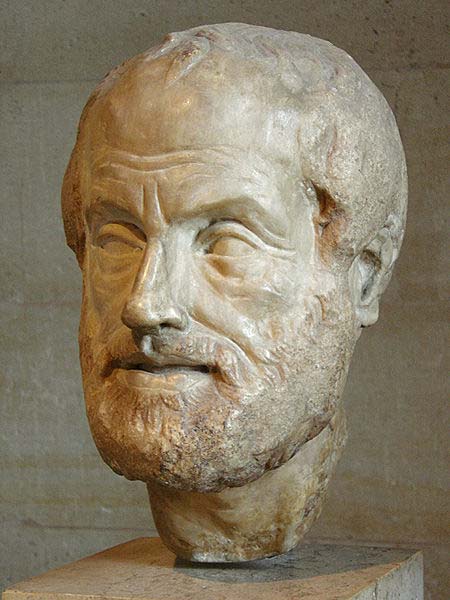 It has been quite some time since I last posted to this series, but I have returned to it, drawn by the most important (and my favorite) chapter of it all. Thus far, we have seen Man's attempts at making sense of the confounding world in which he lives. These studies led him to ask the questions around the material and immaterial compositions of things, the purpose of reason, and the search for truth.
Poised and prepared to give the course of human wisdom one last mighty turn, Aristotle, a resident alien of Athens and a student of Plato, accepted
the challenge of traversing the intellectual mountain that even his
masters before him were unable to navigate, error-free. He took all of
the good conclusions and thoughts from the teaching of Socrates, Plato, and the other noteworthy philosophers and purified them of their errors, solidifying a reality for the
human intellect to comprehend. With each piece in it's proper place, he would create the true philosophy, one which if all basic principles were properly understood, would be the most excellent starting point for mankind's intellect.
A biologist by study, Aristotle's teachings and writings appeal to the practical mind and those for whom primary understand comes from their senses and experience. He did not abstract often, and applied his reason to his experiences and using fundamental philosophical principles, explained the natural world around him. In that sense, his philosophy remains perfectly balanced between the appeal to the sense and the consideration of immaterial, unchanging philosophical principles.
It is very difficult to know where to start with Aristotle, since his worldview is so tightly knit and coherent that various branches of the main shoot will often return and be interwoven with other topics of his study.
Probably the best place to begin would be the fundamental basis on which his principles differed from Plato, his instructor. Plato's theory of substance and form had them separate: matter existed here on earth, imperfect and perceivable to the senses, while the form of a thing resided in the heavens and is the goal of our contemplation. Aristotle's view, on the contrary, places the form and matter of a thing in same entity. This dispelled the thought that the world around us was only a deception of reality and instead, established that the world around us was indeed reality.
To aid in our understanding of this, we will consider the example from the previous post of a glass of wine. It's true that in attempting to determine the essence of wine, we will arrive at an understanding of the form. But instead of each glass of wine suggesting to our intellects that there is some perfectly Wine form in heaven (according to Plato), our reason perceives a "trend" in individual physical manifestations of one idea. Therefore, a glass of wine doesn't help us to know what the perfect heavenly form is (suggested by Plato), it helps us to determine what the glass of wine itself actually is. The "matter" of wine (sugars, proteins, alcohol, etc.) all could take any other form, but the fact that the matter takes the "form" of wine is something present abstractly, though tangibly in the organization of these material ingredients to present to our senses "wine", in both form and matter (as opposed to "bread" or "wood").
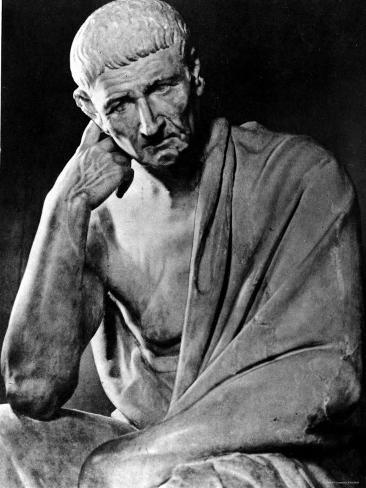
 In categorizing the substance and accident of a thing, Aristotle identified the two of his four "causes": the formal cause and the material cause. All together, the four causes answer the questions of "why" a thing is the way it is. The third cause is the efficient cause, which is the motivator of change within the thing. For example, the combination of nutrition in a child and the natural tendencies of his body is the efficient cause of his growth. The fourth and final cause is just that: the final cause. It is that which is the end or natural destination of the thing; it is that for the sake of which the being exists.
 In categorizing the substance and accident of a thing, Aristotle identified the two of his four "causes": the formal cause and the material cause. All together, the four causes answer the questions of "why" a thing is the way it is. The third cause is the efficient cause, which is the motivator of change within the thing. For example, the combination of nutrition in a child and the natural tendencies of his body is the efficient cause of his growth. The fourth and final cause is just that: the final cause. It is that which is the end or natural destination of the thing; it is that for the sake of which the being exists.
With this notion, Aristotle's metaphysics laid the groundwork and justification for his ethics; since the ideas we have in our heads come from our senses, it is our job to form the correct ideas from what our senses present to us. Although our understanding may err, our senses, if they be not defective, never lie. Having established that the physical world around us is a reliable source of information, Aristotle proceeds to answer the question of what man "must do" by demonstrating the "good" of man. It is towards the pursuit of this good that all of man's actions should be directed, and this good is virtue. I won't go into too much detail on this here, but you can find a more detailed study of this on one of my previous posts, "The Human Good".
In determining the good of one man, Aristotle deals with the good of all men in his Politics. His method stems from beginning with those foundations of politics that do not stem from "deliberate choice", namely that between husband and wife or master and slave. Neither can subsist without the other and so this is a necessary community. From this, Aristotle expands to a household, which includes children and servants, then to a series of households to form a village or colony.
The point of self-sufficiency is where Aristotle draws the line of what was known in ancient Greece as the polis or "city-state". The city-state comes into existence for the sake of existence and is the necessary end of the primal relationships between man and woman, master and slave. In this way, Aristotle claims that the polis is a natural organization, which makes man, by nature, a political animal.
Though I have only barely scratched the surface of the breadth of Aristotle's intellectual genius, I hope the reader has retained at least a preliminary impression of Aristotle's contribution to the study of human reason and wisdom. It seemed difficult to even hope that the human race would be so graced with the blessing of just one such intellectually masterful man; however, with the teachings of Jesus Christ (approximately 300 years after Aristotle) and the addition of this divine perspective, the study of human reason would need some finishing touches before all was said and done...
The point of self-sufficiency is where Aristotle draws the line of what was known in ancient Greece as the polis or "city-state". The city-state comes into existence for the sake of existence and is the necessary end of the primal relationships between man and woman, master and slave. In this way, Aristotle claims that the polis is a natural organization, which makes man, by nature, a political animal.
Though I have only barely scratched the surface of the breadth of Aristotle's intellectual genius, I hope the reader has retained at least a preliminary impression of Aristotle's contribution to the study of human reason and wisdom. It seemed difficult to even hope that the human race would be so graced with the blessing of just one such intellectually masterful man; however, with the teachings of Jesus Christ (approximately 300 years after Aristotle) and the addition of this divine perspective, the study of human reason would need some finishing touches before all was said and done...
Monday, October 28, 2013
The Most Rare Human Virtue
As with many of the inspirations I have for posting something to this blog, I could most often cite TheArtofManliness.com as a common source. The blog/website is a fantastic source of information and helpful encouragement for those who wish to see more in their fellow man. Recently, Mr. McKay "retweeted" an article that appeared in a 1902 issue of Cosmopolitan Magazine (of all places). The post can be found here and the material is from the article entitled "What Men Like in Men", written by Rafford Pike. I started reading down the page and I came to this paragraph, reproduced here for the reader's convenience:
"... The average man will name a number of qualities which he thinks he likes, rather than those which in his heart of hearts he actually does like.
In the case of one who tries to enumerate the characteristics which he admires in other men, this sort of answer is not insincere. Although it is defective, and essentially untrue, the man himself is quite unconscious of the fact. The inaccuracy of his answers really comes from his inability to analyze his own preferences. The typical man is curiously deficient in a capacity for self-analysis. He seldom devotes any serious thought to the origin of his opinions, the determining factor in his judgments, the ultimate source of his desires, or the hidden mainsprings of his motives. In all that relates to the external and material world he observes shrewdly, reasons logically, and acts effectively; but question him as to the phenomena of the inner world – the world of his own Ego – and he is dazed and helpless. This he never bothers his head about, and when you interrogate him closely and do not let him put you off with easy generalities, he will become confused and at last contemptuous, if not actually angry. He will begin so suspect that you are just a little “queer”; and if he knows you well enough to be quite frank with you, he will stigmatize your psychological inquiries as “rot.”…"
At this point, I looked ahead to see how many more paragraphs were left in the article and though I returned to read the rest of the article later (this was only the second paragraph, mind you), I had decided that the mission of the article had already been fulfilled: it had just stated what I admire in other men (and other women, for that matter).
Human virtues, like anything else of value, are prized for their rarity among men, and just as a flawless diamond takes much perseverance and hard work to obtain due to its rarity, virtue also is rare because of the demands it makes on the man who seeks it. If human virtues were as abundant as blades of grass in a field or grains of sand in a desert, we would assign them the same value as these. However, virtue is not that easily found or obtained, so it is natural that we value it in other men.
The most rare of all human virtues is self-awareness, or maybe more accurately, self-comprehension. It is rare because those who seek it must do battle with the most common and deadly of the human vices: pride. Self-comprehension permits every agent in an environment to be judged in the context of that environment, including the individual himself. This man understands that when judging a situation or situation of persons, he is never exempt from being included in those circumstances which he scrutinizes. Regardless of the subject matter, he always makes some alteration to that environment and thus must be included in its judgement.
In this manner, self-comprehension enables the individual to perceive himself in the context of his surroundings, almost as a completely alter-ego. The self-comprehensive man's gaze reaches farther from an independent perspective than any person who fails to understand that his personality has effect on the circumstances. The mystery of why a friend is quick to temper with us is easily solved when we realize our own tendency to make inflammatory remarks.
The self-comprehensive man not only knows of his leanings and biases: he also knows why he has them. He keeps record of his influences, in a way, similar to a student citing his sources in a research paper. Every agreement he has to an idea is properly labelled and everything is organized. With this organizational system, it's not only important to know one's flaws or weaknesses, but it's knowing where those flaws and weaknesses originated from which set the self-comprehensive man apart from the rest as a gem of uncountable worth.
As the worth of virtue is in its practice, the worth of self-comprehension is most notably found in the practice of self-improvement. While self-awareness permits the man to admit to his failures and shortcomings, the self-comprehensive man does this and also understands why he fails in these ways. The answer to "why" is the answer to what strategies he must take to better himself, putting himself in a more advantageous situation than the sick man who knows that he's ill, but knows not why.
Saturday, July 6, 2013
The Highest Human Science: V. Plato
This is a post from the series, "The Highest Human Science". Click here for a complete list of all posts in the series.
Once more, we return to that most important study of philosophy, and this is indeed one of the more important chapters in our study of philosophical history. Up to this point, we've been discussing and looking into the various erroneous ways of thought from the ancient cultures and religions of the world, as well as the turn towards the reason properly, though misguidedly exercised in the early Greek thinkers. This all culminated in the great thoughts and teachings of Socrates, who would inspire one young student of his to change the scope of the entire study...
 |
| Yes, a "Play-Doh" representation of Plato |
Plato (BC 427-347), student of the eminent Socrates and intellectual giant of his time was now given the torch of Philosophy: the standard of intellectual progress to further the understanding of mankind. Really, this was to be a vast task and not one lightly undertaken and for all this pressure riding on Plato... he didn't do half bad.
As a start, he believed in an ultimately perfect Being. He perceived that the things around him had perfection and imperfections mingled together, so it was not out of the realm of imagination to suppose that there was something after which all perfection was an imitation. This perfect being is the basis, the foundation and source for everything that we see.
Socrates' philosophy, as previously reviewed, is purposed towards determining the essences of things; Plato's thought, on the other hand had the goal of determining perfect ideas of things. For according to Plato, the apprehension of a particular thing's essence is well and good, i.e. what is the essence (or essential qualities) of this glass of Rex Goliath malbec wine that I'm drinking while writing this post, but what about wine as an idea? What is the essence of Wine, the idea? After all, these are universal to everyone. If I tell you I want wine, sure, you might bring me an expensive chardonnay or a cheap merlot, but the fact that with a word, "wine", you understood what I was essentially referring to, this indicated to Plato that there was an idea of Wine that we all shared in and could all comprehend. With this, the nature of wine could be contemplated and we could analyze what it essentially meant to be "wine-like".
 |
| "Plato's Cave" by Jan Saenredam |
Though everything looks good, thus far, Plato's next thought led him off the beaten path and into his first error. He claimed that since these ideas are universal and with the ultimate perfections of these ideas, there must be an eternal archetype of "wine" that exists in the heavenly realm. It is this that we get a glimpse of when we think of the subject, though our perceptions may be imperfect, because the physical representations of this idea around us are imperfect (i.e., all the bottles of wine in the world just don't encompass the perfection of that single ultimate idea of wine). He called these perfect ideas the Forms, and it was the goal of our existence to obtain perfect apprehension of these holy ideas.
 |
| A representation of Plato's Cave by Bryce Haymond |
This led Plato to claim that if perfection is to be found in the heavenly Forms, then the sensible world is to be regarded as a deceptive shadow of reality. This notion is the source of Allegory of Plato's cave. In essence, the citizens of the cave are chained the floor and are unable to look anywhere but the cave wall straight ahead, upon which is projected the shadows of characters and animations from a backlighting fire (similar to the notion of "shadow puppets") The sensible world, therefore, is only a crude representation of the truth, and a soul is meant to leave the cave and walk into the sunlight and see the world as it truly is.
So if these ideas, these perfectly divine Forms are what reality is all about, how do we have them in our heads? Certainly we didn't obtain them from our sensible experience of the world because the objects of this perception are imperfect. Plato claimed that we had previous knowledge of these ideas before our incarnation, and with our birth, our physical bodies and perceptions obscured these truths. He also subscribed to the mistaken belief (shared by the Brahmanist) of transmigration of the soul from one body to another after death.
Ok, so if we're honest, Plato is beginning to sound a bit hokey. Wine, shadow puppets, and transmigration? Sounds like a bad children's bedtime story. Though it would not be accurate to say that Plato completely dropped the ball with the intellectual inheritance that to which he was entrusted, he did screw up quite a bit and a more complete and accurate philosophy would be need to be built on Plato's good ideas before we could call it a day.
Tuesday, June 25, 2013
Bernie Mac and the Inordinate National Concern
 |
| The real Bernie Mac |
Stepping off my connecting flight from Kansas City to Charlotte, NC en route to Cleveland, I entered the men's bathroom to perform my necessaries. As I made my way through the door, I almost froze with shock as I thought I was looking at Bernie Mac (God rest his soul) or a very close relative of his. From crazy hair to comical smile, I was certain that he could've made a career being a Mac-alike. It hadn't occurred to me why he was there in his airport uniform, but I made my way to the urinal to fulfill my purpose.
Then, the man who looked like Bernie Mac began to talk to the patrons of the men's restroom. "How are you all doing today? Early? Man, you've gotta wake up with a smile! Since 4 am? Well, I was up by then too! I just want to see everyone smile. How're you doing, sir? I'm good, I'm good, I don't complain. Because nobody listens. How're you doing, sir? Oh, can I help you with that? Don't want you to have any trouble carrying anything and hurting yourself! Alright, alright..." Without trying to be too gratuitous with my details, this sort of upfront chatter was making my bladder very shy, standing before the urinal.
Was the airport paying this guy? It all seemed very invasive and awkward, since the unspoken rule in men's bathroom is that everything should be left unspoken. I was reminded of my similar apprehension when I was pulled aside twice to have my bags checked before getting on to my previous flight. I had been immediately uncomfortable at the thought of being poked and prodded like you hear on all the news stories. Gee, couldn't Bernie Mac just stop talking and let a guy tinkle in peace? I half-expected him with his overly-enthusiastic attitude to give ever man trying to take a whiz in the row of urinals a hearty "good game" butt slap to encourage excellent urination.
.JPG) |
| This man's identity has been cleverly concealed by the photographer's crappy iPhone camera |
Speaking of the news, I never watch it, but the airport TVs were full of them, all playing one news program or another. The interesting thing was that they were all national network news programs: not local new. National news has absorbed the consciousness of many people. From the presidential elections to the latest disaster, everyone wants to know what's going on around the country. What is Congress fouling up now? How's the stock market doing? What's the latest news with big business? While waiting for my second plane, a man standing in the middle of the gate's sitting area spoke loudly about his company's business strategy and expansion plans, as if to make a big scene of his importance. It was quite comical, and I even snuck a picture, but he seriously was wholly absorbed with global business.
This, I think can be applied to the Hollywood scene as well. Programs like TMZ have made all kinds of money off of gossip and scoop stories on the lives of the "rich and famous". Some people follow their lives more closely than they follow those of their children. America is obsessed with the celebrity scene and any latest juicy, chewy piece of fat to fall from the tables of the mass media is enough into a frantic feeding frenzy and bring us back, begging for more.
I think this even ties into something I was recently having a discussion about regarding "philanthropic" endeavors, especially those worldwide. Wiki-pedia defines "philanthropy" using the notion of enhancing "what it is to be human". Does anyone doing "philanthropy" know what it means "to be human"? And why do these efforts always seem to happen in Africa or some disaster stricken area? What's wrong with right here, in my neighborhood?
These three things all have a common source: an inordinate global concern and a dangerous unwillingness to take personal responsibility for ourselves and our own community. Those who contribute to the alleviate "world hunger" often fail to alleviate the very real pains and struggle of their friends, family, and the needy of their own community. Philanthropy is opposed to true charity, as it seeks to draw attention towards "real world" needs... and the efforts of those who make them. More often then not, my experience has been that philanthropy is a feather in people's caps, and not a nail in their hands and feet like charity is. Anyone can give money to feed the kids in Africa and feel like they did their good deed, but can you give a hug to your mother or father, or a helping hand on your brother's homework, or an hour or two helping your grandparents rake the leaves in their backyard?
We consume the celebrity gossip because the moral missteps of the accomplished and powerful make us feel better about our ethically bankrupt lives. In this same vein, it allows us to neglect our own areas of deficiency, so as not to expose what the level of self-knowledge we lack. We absorb this information because it counts as entertainment to hear about the scandals, the divorces, the political opinions, and the drama; but really, seeing this a source of entertainment helps to placate our own nagging consciences about the miserable and messed-up lives we're leading. In many cases, our lives are not any better than those of Hollywood. We just count ourselves lucky that they're under that kind of scrutiny for our entertainment and comforting, and we're not.
People focus on national or global political "issues" because they can remain anonymous about them. We can scream at our televisions at home, and not need to bring our concerns in front of an actual group of people. Mass media and social networks have allowed the citizen to be anonymous in his opinions, never needing to have the courage to risk his identity to stand up for his beliefs. I do believe that our nation is in a very dangerous time with the liberties that have been taken at the national level, but let it not be an excuse to neglect valuing our own local government and business success.
So, do I place my own life into consideration and determine what things I need to change? Do I treat those immediately around me with love and kindness, because "charity begins at home"? In what ways do I look to be a force for the common good of those within my neighborhood or community by setting a personal example for others?
I know I'm asking these questions, but to be honest, I hadn't really thought of an answer because Bernie Mac was still talking and I still couldn't pee yet.
Sunday, June 23, 2013
On the Brattish Nature of My Car
Yes, it's true, Maybellene and I are no more. The cost of maintaining such an impractical automobile for someone my age and professional status was just to difficult. Though I will probably won't have such a chimerical car for quite some time again, it was fun for the year or so, but I needed practical. Options were slim, and they were made even more limited by the fact that the car had to be something I could afford a monthly payment for, as well as monthly gas. So really, I wasn't choosing the car; rather, this was a case in which the car really chose me: a 2010 Ford Focus S.
Maybellene's sleek black body styling is traded for a spoiled-rotten, candy red. The melodious stereo system has been traded for an unbalanced racket. The painless, "hands-off", automatic-manual gear box has been replaced with the excruciating, "hands-pulling-out-hair", manual gear box. The saucy red leather interior has been swapped for a grumpy grey, poly-fiber blend. At first glance, you'd think this car was a monumental letdown, but practical is as practical does and a man's gotta grow up sometime...
But as soon as I got into the car, I seriously doubted that I was heading in that direction. Reaching into the box of Maybellene's former belongings, I pulled out a few choice CDs that might console me on my grave loss. To my surprise, none of them were fitting into the slot. A CD had been left in the car by the previous owner. I tried to eject it to see what it was, but the CD would not come forth at my command. After taking out an initial moment of intense frustration on the steering wheel, I was struck by an immense stroke of genius: no greater opportunity than this could be afforded to learn about the car's previous owner. Immediately, my momentary rage melted into the most engaged curiosity and I played the CD.

What met my ears was the most heinous collection of party rock I'd ever heard, with songs by "artists" such as Ludacris and Ke$ha (and judging by the sound quality, it was likely pirated). Furthermore, they weren't even the songs you heard on the radio; all of them were mediocre, B-side quality. Indeed, this was a juicy find, and my mind began to notice other telling personality traits.
The previous owner (rather, the owner's parents) had installed an "M-Key" device offered by Ford which prevents the driver from doing certain things with the car that some might consider dangerous. The device limits how high the radio's volume can be set. Also, this functionality will turn off any audio in the car if the driver fails to buckle his seat belt. But to top it off, the device will warn you with a noise if the car approaches 75 mph and will automatically apply the brakes to keep the driver from going anything over 80 mph.
Upon an initial overview of the car, I noticed that there was a floor pad missing from the driver's side of the car. Now, I'm not one to speculate too far into things, but I would certainly like an explanation as to why a floor pad, specifically made for this car model is missing. All the others are present, but I find it very intriguing that the the one missing is the driver's.
After mentioning these findings to the respectable salesman who sold me the car and offering my speculative conclusions, he told me that the car's previous bumper stickers would most certainly support my suspicions. Before the car came into my possession, there had been bumper stickers for the University of Missouri - St. Louis, a commuter college, and a "rainbow" awareness ribbon.
With these facts in hand, I was now able to make some claims regarding the previous owner of the car. The first, and most obvious fact, was that the previous owner had been a girl, most likely a student of the commuter college to which the bumper sticker denoted. The car was purchased new by her parents, as indicated by the activated M-Key functionality. Certainly, she was an irresponsible child and not trusted at all by her parents, and it is very likely that in her fecklessness, she had totalled her previous car, hence the new car with the overkill M-Key security features. Also, it's possible that the manual transmission was selected by the parent's to discourage texting-and-driving, a well-known practice among girls.
The awareness bumper sticker leaves no mystery as to the secular leanings of the girl's worldview and the forever-stuck CD reinforces this worldly hypothesis. The CDs song selection also makes some interesting suggestions. The first song on the CD was by St. Louis-native, Nelly, and is titled "Hey Porsche". A link to the lyrics can be found here, as they are too vile to post on this respectable blog. Also, the fact that the songs are less popular than the big hits of these mainstream artists suggests that she might have a hipster streak about her. However, after careful consideration, I concluded that a hipster girl would never listen to mainstream artists at all, so it is most probable that the previous owner just had terrible taste in music.
The only missing piece to explain now is the missing driver's side floor mat. Relying on the conclusions we've already made, it seems logical that while driving home after a long night of partying at her girlfriends' house, the owner vomited on the floor at a stop light to relieve her stomach of the gratuitous quantities of McCormick's vodka and Jack Daniel's whiskey. Unable to clean it without her parent's noticing, she threw the mat into a nearby dumpster and Fe-breezed the car, effectively eliminating the odor and the mess.
Therefore, the previous owner of the car was surely an upper middle-class, blonde, spoiled, sorority brat with the most terrible taste in music and a high number of supremely bad life-choices. It is for this reason, that I have named the car, Brittany. These deductions make me realize the subtly colorful character of an otherwise typically practical car, and though she's not the fiery temptress that Maybellene was, she's definitely got spunk: and I like her spunk.
Saturday, June 22, 2013
Goodbye, Maybellene
Dear Maybellene,
We're through. It's over. I've moved on. Yes, enough is enough and I'm calling this whole thing off. We've been together for 15 months and I'm finally sick and tired enough of all of this to just end things.
No, I'm not going to get into the specifics of why. We're just not right for each other at this point in our lives. Maybe we used to be, but that was then and things have changed.
I felt like no matter how much I gave to our relationship, you just demanded more. When your MPG bottoms out at an average 20 mpg, can't you see why I can't justify putting any more gas into this relationship? I even gave you a new set of tires for our 6 month anniversary, but you were burning through those as much as the old ones. I had just had enough of your stupid sunroof that always got jammed when I tried to open it, and your low clearance was a endless embarrassment whenever you scraped your undercarriage on a parking curb. Now look what you've done: you got me going into specifics.
Oh, who am I kidding, Maybellene? I miss you already. I miss your raunchy red leather seats, I miss your rebellious, impractical teenage attitude. I toss and turn at night, thinking about someone else's hands lovingly embracing your leather-wrapped steering wheel. I'm deathly afraid that some spoiled brat girl has you now and is foolishly ignoring the true potential of your V6 engine.
But I know it's for the best, girl. I'm sure we won't meet again, and maybe one day I'll find another wildly quixotic car like you. At the very least, though, we have the memories we've shared and those, I'll never forget. Goodbye, Maybellene.
We're through. It's over. I've moved on. Yes, enough is enough and I'm calling this whole thing off. We've been together for 15 months and I'm finally sick and tired enough of all of this to just end things.
No, I'm not going to get into the specifics of why. We're just not right for each other at this point in our lives. Maybe we used to be, but that was then and things have changed.
I felt like no matter how much I gave to our relationship, you just demanded more. When your MPG bottoms out at an average 20 mpg, can't you see why I can't justify putting any more gas into this relationship? I even gave you a new set of tires for our 6 month anniversary, but you were burning through those as much as the old ones. I had just had enough of your stupid sunroof that always got jammed when I tried to open it, and your low clearance was a endless embarrassment whenever you scraped your undercarriage on a parking curb. Now look what you've done: you got me going into specifics.
Oh, who am I kidding, Maybellene? I miss you already. I miss your raunchy red leather seats, I miss your rebellious, impractical teenage attitude. I toss and turn at night, thinking about someone else's hands lovingly embracing your leather-wrapped steering wheel. I'm deathly afraid that some spoiled brat girl has you now and is foolishly ignoring the true potential of your V6 engine.
But I know it's for the best, girl. I'm sure we won't meet again, and maybe one day I'll find another wildly quixotic car like you. At the very least, though, we have the memories we've shared and those, I'll never forget. Goodbye, Maybellene.
 |
| Maybellene, the 2008 Hyundai Tiburon GT Limited |
Saturday, May 11, 2013
"I'll Know My Name as It's Called Again"
If I began a sentence with "I was listening to some Christian rock and...," most people have one of two reactions. If you're one of those people that would get really excited and eager to talk about your favorite Reliant K song, I'm sorry to say I'm going to disappoint you with this post. On the other hand, if you're one of those people who says that Christian rock is for uncool, churchy kids, then I'm going to surprise you by revealing that some of the most Christian music I have ever heard is actually from a popular band.
 |
| "Jacob Wrestling with the Angel" by Rembrandt |
My primary criticism of much of the popular Christian music that I've heard is that it lacks the human element. Personally, I find much of it nauseatingly upbeat and predictably appealing to my feelings (if I had any). As a result, much of it fails to wrestle with faith, as Jacob wrestled with the angel. For this generation, faith doesn't come easy, and I think it doesn't come easy for anyone. There are far too many challenges to it for it to be simply a walk in the park. Personally for me, it's a regular struggle to push past my own rational outlook on the world and seek to understand the Divine Being who is the source of all good. Therefore, simply praising and worshiping is not something I completely "get".
Whether you have this same conflict as I do or not, everyone has their own reasons to struggle with faith. It might not be perpetual, though. Often times, it's a thing that works in a cycle: you find an inspiration to your faith, you cultivate and treasure it. Then, when you're feeling strong on your feet, you forget what go you there, which is why you fall flat on your face soon after. But ultimately, the true Christian will arise once more and fight his way back to faith and this time, in an effort to keep it.
Therefore, the Christian rock that is going to popularly engage this generation of people is going to appeal to this seemingly contradictory notion of zealously high aspirations for our faith, frustration and anxiety at our repeated failures, and a committed conversion back to our faith in God. The band I have in mind, then, is none other than Mumford & Sons, and more specifically, their album, "Sigh No More".
The album contains more Christian themes than I myself understand, and yet it maintains a firm grounding in the human person, with all of our struggles and trials. Anyone who is truly a Christian knows that it takes hard work to be one. If you don't feel like your sweating blood sometimes, just to keep your faith, then I would say you're not a Christian: your faith is not being tested, you are not truly following the path of Christ in suffering and sorrow. It is a constant struggle, one in which we occasionally, or even frequently fail to meet. But the hallmark of such an epic fight for our souls is to dust off and try again.
It all begins with the statement: "Serve God, love me, and mend". (Sigh No More) Service to God, love others, and then take care of yourself. This, of course, is none other than the Golden Rule, learned from Jesus Christ. Our lives belong to God and it is through our interaction with others that we can show our affection for God, by keeping his commandment first with the people around us and then with ourselves. The song continues with a statement so hopeful, I must reproduce it here in its entirety:
First, Love is what sets us free, and as God is caritas, the highest, ultimate form of love, that voluntary servitude towards God and others will paradoxically give us freedom, not take it away. It is in this choice of service that we demonstrate that we are free to do so. The third line suggests that to love like this is Man's true purpose, which is confirmed in the second song of the album, The Cave. The desire for freedom is once more urgently desired, "Cause I need freedom now, and I need to know how, to live my life as it's meant to be." (The Cave) The imagery of the song makes unmistakeable references to Homer's The Odyssey, in which the homeward hero, Odysseus, instructs his crew to tie him to the mast of the ship as they passed by the island of the deadly Sirens, temptresses of the sea who draw sailors to their deaths on the rocky island shores. The song draws on this desire to resist their temptuous call, even taunting the sirens with the lines, "The harvest left no food for you to eat. You cannibal, you meat-eater, you see, but I have seen the same, I know the shame in your defeat," (The Cave) for it was believed that the Sirens were cannibalistic. The third song of "Sigh No More", Winter Winds, speaks further of this same hope, reminding us that "remember spring swaps snow for leaves, you'll be happy and wholesome again, when the city clears and sun ascends." (Winter Winds) Hope that is a sure mark of the Christian, for while the rest of the world despairs in its damnation, this soul understands that he was made to be united with God and He will deliver him.
Whether you have this same conflict as I do or not, everyone has their own reasons to struggle with faith. It might not be perpetual, though. Often times, it's a thing that works in a cycle: you find an inspiration to your faith, you cultivate and treasure it. Then, when you're feeling strong on your feet, you forget what go you there, which is why you fall flat on your face soon after. But ultimately, the true Christian will arise once more and fight his way back to faith and this time, in an effort to keep it.
Therefore, the Christian rock that is going to popularly engage this generation of people is going to appeal to this seemingly contradictory notion of zealously high aspirations for our faith, frustration and anxiety at our repeated failures, and a committed conversion back to our faith in God. The band I have in mind, then, is none other than Mumford & Sons, and more specifically, their album, "Sigh No More".
 |
| Mumford & Sons |
Love; it will not betray you
Dismay or enslave you, it will set you free
Be more like the man you were made to be
 |
| Ulysses and the Sirens by John William Waterhouse |
Can you lie next to her
And give her your heart, your heart
As well as your body
And can you lie next to her
And confess your love, your love
As well as your folly
And can you kneel before the King
And say I'm clean, I'm clean
To me, this echoes a soul's Examination of Conscience, in which the Christian surveys their words, thoughts, and actions for any sins committed for which reparations need to be made. It is true, a man in rebellion against God cannot answer these and still claim to be His servant. However, it is with great sadness that the words mournfully carry on, "But tell me now, where was my fault, in loving you with my whole heart." (White Blank Page) Who can claim no fault or harm towards us and also have loved us with His whole heart? My guess is Jesus Christ.
 |
| Devils from a fresco in the Rila Monestary in Bulgaria |
Now, the devil has his prize. Man has forsaken God for his own passions, and now Satan claims what is his. He taunts Man, "Weep for yourself, my man, you'll never be what is in your heart. Weep, little lion man, you're not as brave as you were at the start." (Little Lion Man) This hits very close to home for me and for anyone who recognizes, despite their best intentions, there is always that evil voice, whispering in your ear and telling you about all the things you could never do because you lack the strength and courage to do them. This song is by far the most angsty and frustrated of the entire album. Even the chord progression sounds like a demon's jig over his winnings. The devil gloats to us that despite all our strength, all our virtue, we are still subject to his power and "your grace is wasted in your face, your boldness stands alone among the wreck." (Little Lion Man) In fear is the way the devil likes to keep Man, and it is in our fears that Satan reigns supreme.
If Little Lion Man is Satan's triumphant jeering, then Timshel, the proceeding song, is God's invitation to return to His grace. Upon seeing the peculiar title of the song, I was immediately curious about what it meant. As it turns out, timshel is commonly understood to be Hebrew for "thou shalt", as it is found in the Ten Commandments. However, in John Steinbeck's book East of Eden, two characters have a discussion of its meaning, and one of them reveals that it's original meaning has been confused and that it actually means "thou mayest". He claims that the "mayest" distinguishes itself from "shalt" because it puts emphasis on Man's freedom to choose, and not on the deterministic and inevitable implications of "shalt". Mumford & Sons makes this a critical, tender moment after the previous harsh, and at times vulgar tune of Little Lion Man. The soul now realizes that despite his despair, "you have your choices, and these are what make man great, his ladder to the stars." (Timeshel) Man's freedom is what makes him like God, in his image and likeness. God does not leave Man to these choices, alone and unaided: "you are not alone in this, as brothers we will stand and we'll hold your hand." (Timshel) However as the song ends, the final haunting words, "But I can't move the mountains for you" (Timshel) put the ultimate responsibility on Man to make the right choices. God's grace is sufficient to do anything, and He gives it to us all time, but if we are not willing to to do the will of God, His grace will fall on fallow ground or choked by thorns. (Luke 8:4-15)
Thorns, or Thistles and Weeds, which coincidentally enough, is the title of the next song, rise up and choke our faith in Christ's Parable of the Sower. The lyrics tell us to "plant your hope with good seeds, don't cover yourself with thistle and weeds, rain down, rain down on me." (Thistles and Weeds) In keeping with the Parable of the Sower, the teachings of Christ are the good seeds we should seek to plant within us, and those of the world only yield destructive fruits. The song creates an air of impending doom, as if the vices of this world threaten to strangle any faith that we have.
 |
| Landscape with the Parable of the Sower by Pieter Bruegel the Elder |
 |
| The Storm on the Sea of Galilee by Rembrandt |
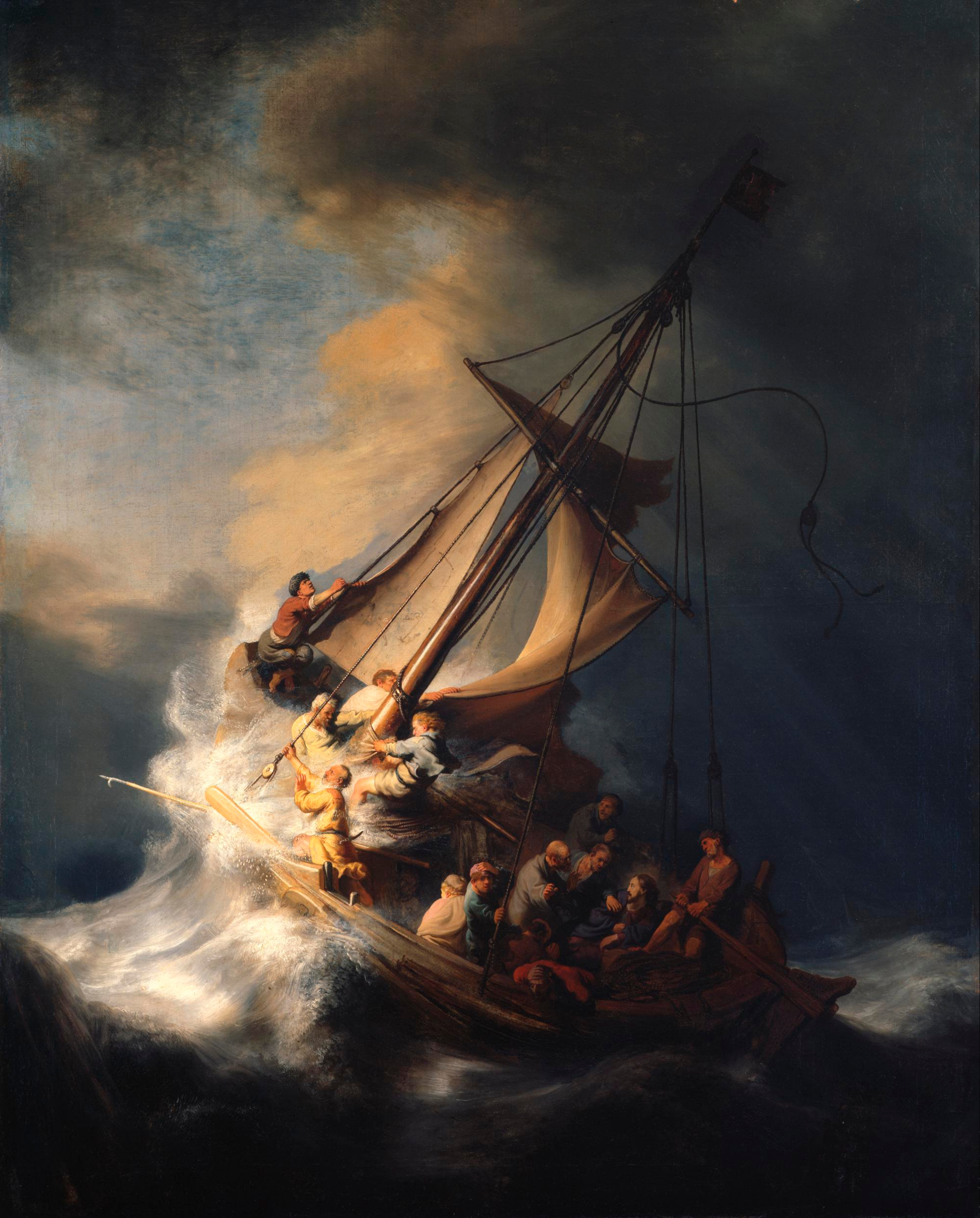
It is fitting then, that final song of the "Sigh No More", After the Storm, draws on some imagery from the Parable of the Prodigal Son. After his defiance to God, after his bitter rebellion against his Creator, Man's pride fails him and he cannot run anymore, "And after the storm, I run and run as the rains come and I look up, I look up, on my knees and out of luck, I look up." (After the Storm) His soul is weary of his insurgency against the Lord, for he has found the bottom of the pit which he himself has dug. He sees the meaninglessness of his own acts, but still desires to not waste away, "But I won't rot, I won't rot, not this mind and not this heart, I won't rot." (After the Storm) Now, the soul must return to his God. His loneliness in his appalling state has shown him that God is the only one who can welcome him back: "And I won't die alone and be left there. Well I guess I'll just go home, Oh God knows where." (After the Storm) Though his sorrow for his own sins makes him realize the grave injustice that he has done to his Maker, it does not stifle all his hope. With God, there is a better life, and these verses make that abundantly clear:
And there will come a time, you'll see, with no more tears.
And love will not break your heart, but dismiss your fears.
Get over your hill and see what you find there,
With grace in your heart and flowers in your hair.
And with that, Sigh No More reaches it's conclusion, and the Christian begins once more in his quest for unity with God. So am I totally full of it? Am I just making this up and really this album is another rant meant to fulfill any lingering teenage angst? Maybe, but as far as I'm concerned, this is the most Christian rock album I've ever heard.

Subscribe to:
Posts (Atom)